A collection of links to music, images and videos relating art and science. Today: Images of Messier 8 by Argentines; Two objects together, but separate; Cosmic riches; Libration. Music: Mariano Fresh. Video: Nights of music and science.

Images of the decade
The Lagoon Nebula in sky blue and white
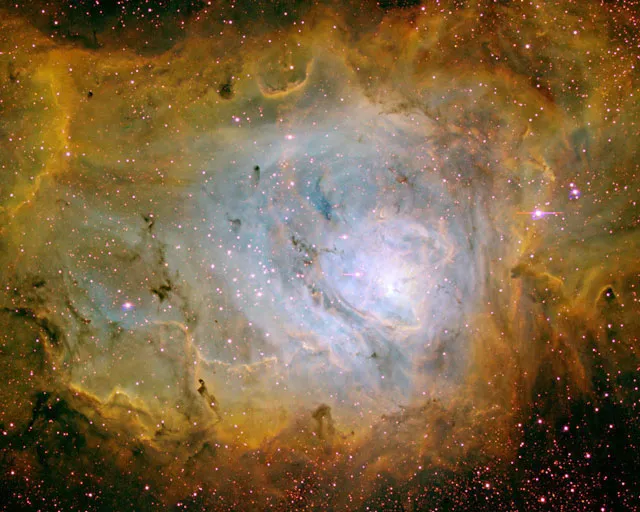
The bright Lagoon Nebula is one of the most photogenic regions of the sky and the home of a wide range of astronomical objects.
Particularly interesting is a bright open star cluster and several energetic star-forming regions.
If seen with the naked eye, the light from the cluster is dominated by an overall red glow resulting from hydrogen gas, while the dark filaments are caused by the absorption of light through dense dust.
The Lagoon Nebula, also known as M8 and NGC 6523, lies about 5000 light-years away.
The top image, from the Curtis-Schmidt Telescope, in fact, shows us the emission nebula in three colors that encode the emissions from hydrogen, oxygen, and sulfur.
Although it is a three-color image, the nebula was seen with sky blue and white glasses. It's that the astronomers responsible for the recording are the Argentines Rodolfo Barbá, Nidia Morrell, and others, from the Universidad Nacional de La Plata.
The scientists studied the region and found stars pre-main sequence, as well as studied the Cluster "Hourglass" in infrared.
Credits: R. Barba, N. Morrell et al. (UNLP), CTIO, NOAO, NSF.
It was the Astronomy Picture of the Day (APOD) for October 6, 2002. And in Observatorio.
A rare pair: Together, but separate
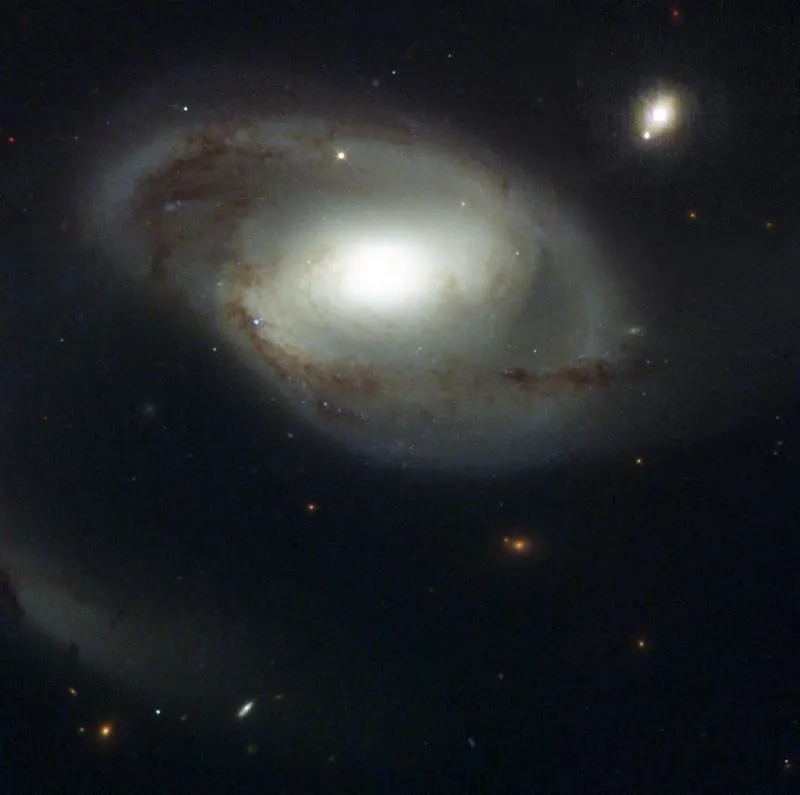
That appearances are deceiving is probably one of the first lessons in astronomy. The rare celestial duo composed of the spiral galaxy NGC 4319 at the center of the image and the quasar Markarian 205, to the right, may seem like neighbors. In reality, the two objects are very far apart in space-time. The spiral lies at 80 million light-years, while the quasar is 14 times farther away, as it resides at one billion light-years from Earth.
The image was published on HubbleSite on October 3, 2002.
Credits: NASA and The Hubble Heritage Team (STScI/AURA)//R. Knacke (Penn State Erie)
Images of the week
Cosmic riches
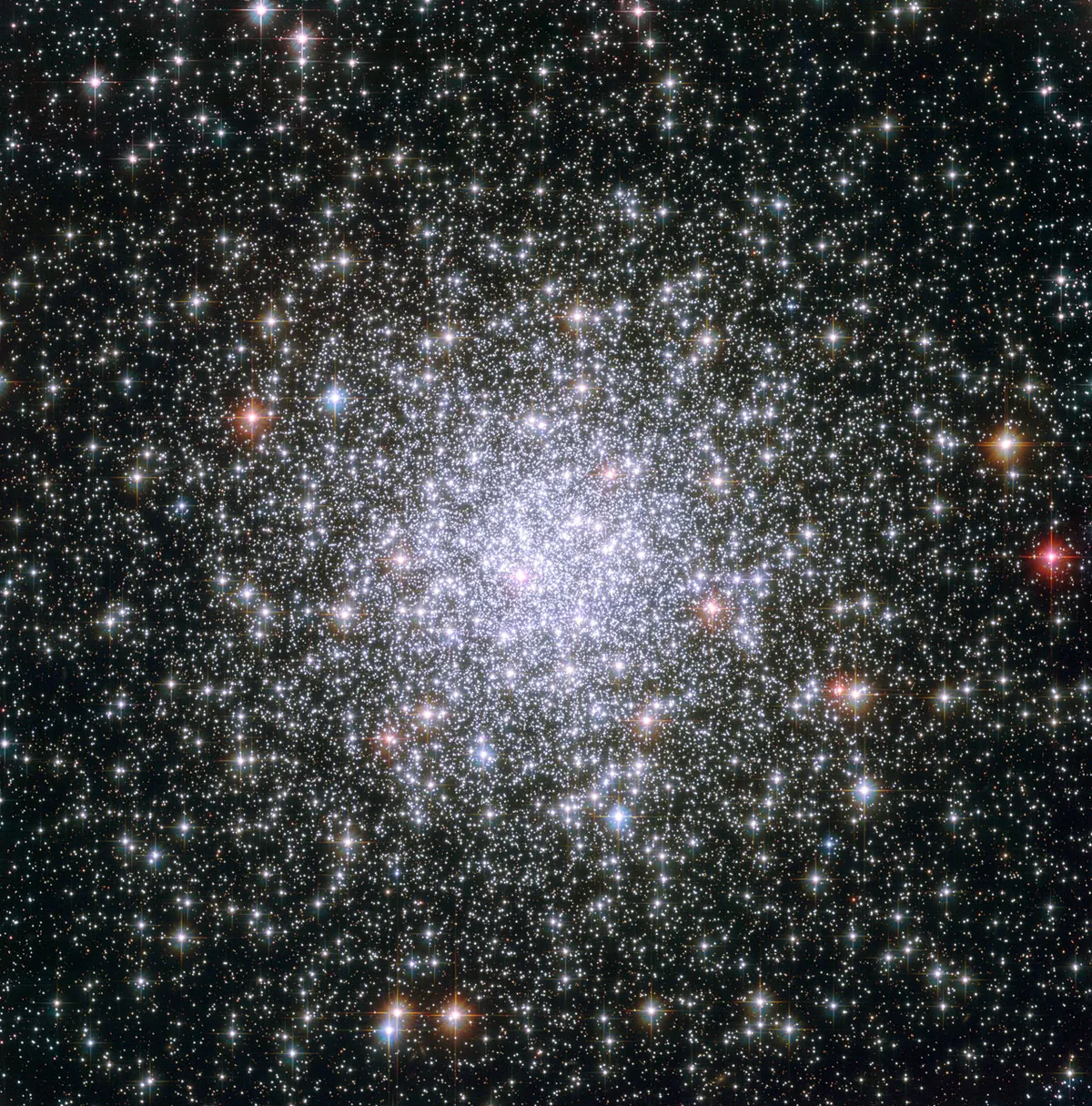
This dazzling image shows the globular cluster Messier 69, seen by Hubble. Globular clusters are dense collections of old stars. In the photo, the foreground stars appear large and golden compared to the background of silvery stars that form M69.
Another aspect that tends to make one think of the cluster with the jeweled metaphor is that M69 is one of the most enriched clusters on record. In astronomy, that enrichment in metals means that the objects have elements heavier than hydrogen and helium. That abundance in metals is generated by nuclear fusion.
M69, NGC 6637, is located in Sagittarius, near Messier 8, but much farther away, at 29,700 light-years distance.
It was the Space Telescope Image of the Week.
Credit: NASA/ESA Hubble
Libration
Although the Moon takes the same time to rotate and to orbit around the Earth, from here we can see a little more than 50% of its surface, that is, we see a little more than "one face", thanks to the wobble of the satellite known as libration movements.
From Málaga, Spain, José Cabello (Chepar) recorded images of the Moon at different times and then marked several lunar features in each image. The first image is from June 28 (waxing phase) and the second from July 11 (waning phase).
With suggestions from other users of the Astronomo.org forum, he made an animated gif so that the oscillation would be more evident.
In the forum we can find more information and larger images.
In my view, it is a splendid work that well deserved to be considered the Amateur Astronomy Picture of the Day (AAPOD) for October 6, 2012.
Space Music
Mariano Fresh & Vanaheim: Meteorite EP
Mariano Fresh is a prominent DJ who released this album containing three tracks at the end of August. The second, although it appears here as "Causar" is "Cuasar" as we can see on Beatport.
Animated Science
Cycle "Nights of music and science" with astrophysicist Alejandro Gangui
The pianist Horacio Lavandera performed on October 3 at the Teatro Maipo together with astrophysicist Alejandro Gangui, in the second of the concerts organized by the TEC TV channel. The first meeting was with mathematician Pablo Amster.
In the third concert (on 10/16) physicist Daniel De Florián will speak, who will explain what elementary particles are, how they interact with each other and how scientists can use them –“notes of matter”– to help understand the composition of the universe. In a second part, he will delve into “determinism behind chance”, in what promises to be another exciting evening of music and science. Tickets can be picked up from 11 to 19 h, at the theater box office located at Esmeralda 443. Seats are limited. Those who cannot attend the theater will be able to watch the live broadcast via musicayciencia.tectv.gob.ar
The concert program can be read on Issu.
To access previous editions of this section, consult the Multimedia Selection Series. The series attempts to show that the immensity of the universe can be perceived in different ways. I choose some of the images from a decade ago -so they don't fall into oblivion- and from the current week that ends, as well as sounds/music and videos that are artistic forms of expression and with content related to astronomy and related sciences. I am also collecting these materials in the Pinterest account