What is the South Atlantic Magnetic Anomaly and what causes it? Does it pose any danger? What is the importance of its scientific study?
Our planet's core is like a giant magnet (tilted about 11º) that generates the so-called Magnetosphere. On the Earth's surface there are various layers: the atmosphere. According to their height and composition of gases and temperature, regions are distinguished within the atmosphere: the Troposphere, Stratosphere, Mesosphere, Thermosphere (Ionosphere), Exosphere. The Magnetosphere is a volume of space surrounding the Earth in which the magnetic field dominates and which interacts with charged particles coming from the Sun. Other planets in the solar system also have a similar layer: Mercury, Jupiter, Saturn, Uranus and Neptune. American scientist James Van Allen (1914-2006) participated in the Explorer mission. With data from Explorer I, launched in 1958, he discovered the belts that bear his name: The Van Allen belts are zones in the magnetosphere that contain trapped charged particles. There are two belts: the inner one is located about 1.5 Earth radii (9,400 km) above the equator and contains protons and electrons of solar and ionospheric origin. The outer one is at 4.5 radii (28,000 km) and contains mainly electrons from the solar wind. These values are, of course, approximate and do not form a "magnetic sphere," but are asymmetric, meaning that in some areas they are closer to the planet's surface.
The South Atlantic Magnetic Anomaly (AMAS in Spanish, SAMA in English) is a region of the inner belt that is located a few hundred kilometers (approx. 200 km) from the planet's surface.
The belts are asymmetric with respect to the Earth's magnetic axis, which is tilted 11º relative to the rotational axis. The intersection between both axes is located not at the center of the planet but 500 km to the North. Thus, the inner belt is closer to the surface over the Atlantic Ocean. The shape of the SAA changes over time, but not only in the long or medium term, it also does so during the day. At an approximate altitude of 500 km, the Anomaly expands from -50º to 0º geographic latitude and from -90º to +40º longitude.
Importance
In this region there is higher radiation, which is significant for the passage of satellites and spacecraft.
In 1996, Hubble reached 100,000 exposures. In the press release, Hubble Institute director Robert Williams noted that it was "a truly remarkable achievement, especially when you take into account Hubble's low orbit and that it cannot observe 50 percent of each orbit due to Earth occultation (when the Earth blocks Hubble's view) and the South Atlantic Anomaly".(*1)
In 2004, there was an event in the Gravity Probe B mission.
Moreover, in 2010 NASA reported that the old GPCs (General Purpose Computers) although heavy and huge, were more reliable than notebooks, particularly when passing through the Anomaly. This was because the GPCs had a debugger that protected against radiation.(*2).
Because of this and because the origin and consequences of the Anomaly are not perfectly known, the motivation to scientifically study the region has grown in recent years. The Danish satellite Ørsted, launched in 1999, was dedicated to magnetic research. Data obtained in the year 2000, compared with observations made with the American satellite Magsat 20 years earlier, indicated a weakening of the field's strength, even suggesting its possible disappearance or the occurrence of a geomagnetic reversal.
There's no need to be alarmed, of course, as these are processes that would take very many years.
Uruguayan geologist and geophysicist Leda Sánchez told BBC: "It is impossible for it to happen so soon. It is estimated that the process could take between 1,000 and 1,500 years. Furthermore, there is no evidence to show that the reversal causes mass extinctions," she assured.
On the other hand, studying that region, performing magnetic measurements, is a way to investigate the interior of our planet and its functioning.
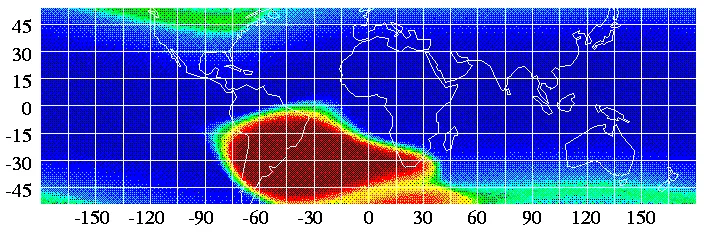
A map of the SAMA by ROSAT
In the initial image of this entry we see a map showing, in red, the Anomaly, which is a depression in the Earth's magnetic field that allows cosmic rays and charged particles to reach low altitude. The interference with communication satellites and spacecraft is a concern, but it also encourages research into its geological origin.
The particle flux also affects X-ray detectors. The PSPC instrument on ROSAT had to be turned off when passing through that area because otherwise it would have been damaged. The data shown here were obtained with the specially prepared Detector -to the point that it was called SAAD for South Atlantic Anomaly Detector- aboard ROSAT. It consisted of 10 cm3 of germanium and served as a background particle monitor.
Another map, with UoSAT-2
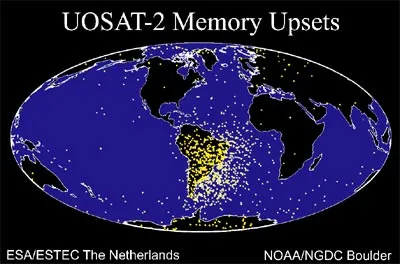
Spacecraft failures are common over the South Atlantic during periods of high solar activity. There is a local weakness in the Earth's magnetic field there that leads to a higher level of charged particles affecting the electronic systems aboard spacecraft. This South Atlantic Anomaly is illustrated here with a graph showing the memory failures of the veteran spacecraft UoSAT-2. The image shows how those failures were distributed, mainly over South America.
It is possible to see an animation of the SAMA on BBC (in English) in the article Magnetic mysteries of Earth's Core, by Gaby Hornsby (where it says Magnetic flip).
Scientific valuation
For the reasons stated, the study of that region is scientifically significant. And the ideal for this purpose are studies in the region, with the appropriate instrumentation.
From the Aigua Astronomical and Geophysical Observatory, Uruguay, it is pointed out that the country "is located in the center of the South Atlantic Magnetic Anomaly, an anomaly where the magnetic field has values less than half the planet's average, which implies that we are more vulnerable to harmful cosmic radiation. In our region, it is estimated that the value of the total magnetic field has fallen by about 20% in the last hundred years (Figure 2). Despite this particular situation, Uruguay does not have a Geomagnetic Station".
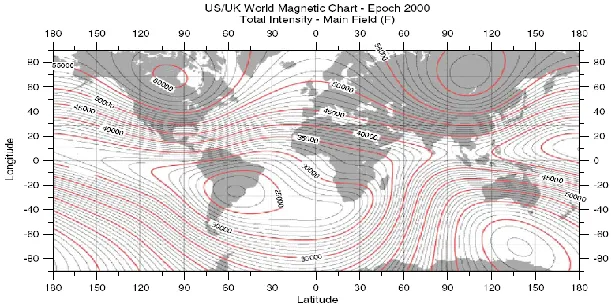
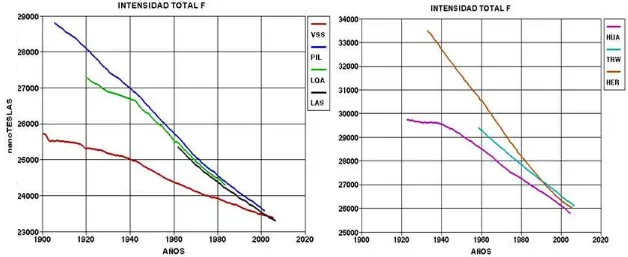
Scientific study in Argentina
A riometer was recently installed in Bahía Blanca. In this regard, the importance of the SAMA was indicated: "That anomaly implies that there is more radiation here than in other places. This is why it is important to analyze how the atmosphere behaves in this problematic zone," explained Dr. in Geology, Jorge Spagnuolo, from the Argentine Institute of Oceanography, to InfoUniversidades.
The SAC-C satellite is one of the Argentine instruments in orbit that takes data on the magnetic field for scientific study.
There are other facilities to study magnetic phenomena and, what is vital, there are also a couple of initiatives (a specific project and a framework project) linked to establishing synergies and interdisciplinary work. But I will tell you about that soon. For now, it is enough to be clear that you hate the South Atlantic Magnetic Anomaly, the SAMA. And that scientists want more.
Note written for the XXXIV Carnival of Physics, in this edition hosted by Hablando de ciencia. To join and read the entries visit Gravedad Cero.
Sources and related links
- VAN ZELE, María Andrea. Influence of the South Atlantic Geomagnetic Anomaly (SAMA) on geomagnetic variations due to sudden magnetospheric compressions by the solar wind. Geoacta [online]. 2010, vol.35, n.1 [cited 2012-09-21], pp. 25-39 . Available at: Scielo
http://www.scielo.org.ar/scielo.php?script=sci_arttext&pid=S1852-77442010000100003&lng=es&nrm=iso. ISSN 1852-7744. - ESA: Focus on our magnetic planet
- (*1): Hubble Achieves Milestone: 100,000th Exposure
- (*2): Shuttle Computers Navigate Record of Reliability
About the images
- ROSAT map: Credit: S. L. Snowden.
- UoSAT-2 map. Credit: Credits: M. A. Shea, Geophysics Directorate, Philips Laboratory.
- Fig.1: Abdu et al. 2005 DOI: 10.1016/j.jastp.2005.01.014
- Fig.2: Gianibelli y Quaglino 2010