ALMA locates a surprising spiral structure around a dying star.
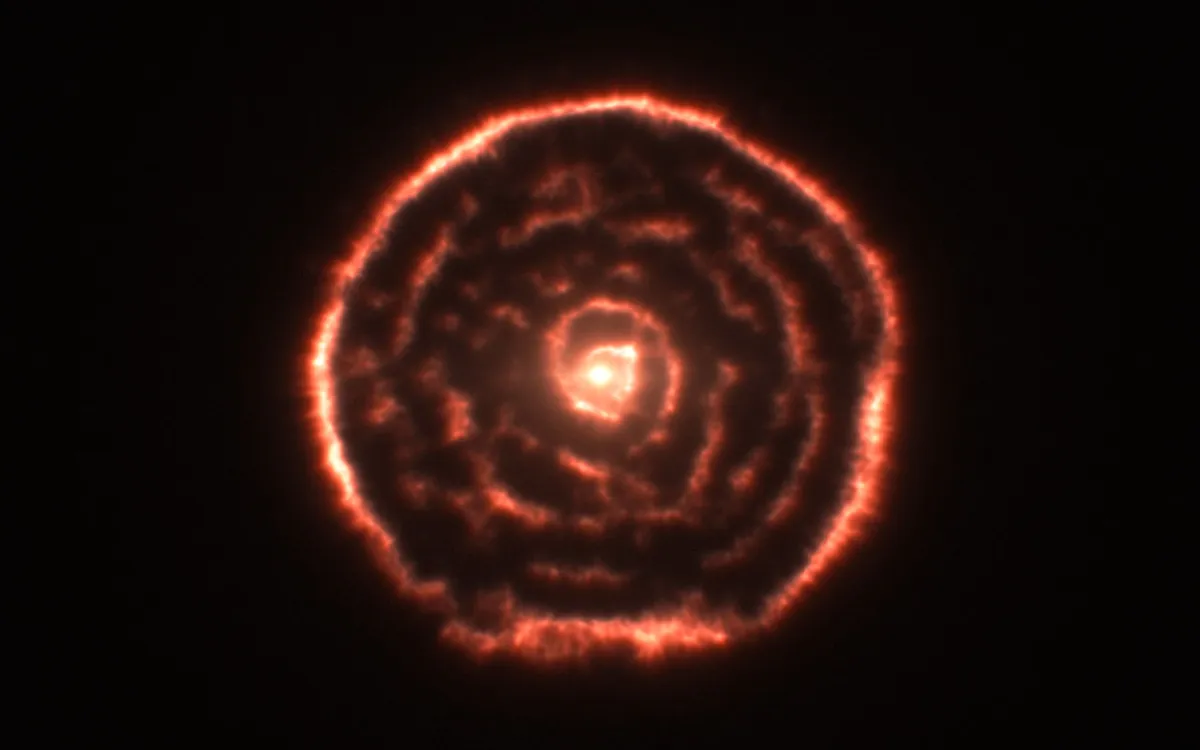
Using the ALMA telescope array (Atacama Large Millimeter/submillimeter Array), astronomers have discovered a completely unexpected spiral structure in the material surrounding the old star R Sculptoris. This is the first time this type of structure has been found, together with the spherical envelope, around a red giant star.
Probably, the strange shape was created by a hidden companion star orbiting the red giant. This work is one of the first scientific results from ALMA to be published and appears in the journal Nature this week.
R Sculptoris (HIP 6759, V* R Scl) is located in the Constellation of Sculptor about 1,500 light-years from Earth (#1). It is a semi-regular variable (SRB) whose magnitude fluctuates between 9 and 12.9 over a period of 370 days, according to AAVSO. It is currently visible from Buenos Aires, after sunset, towards the East and throughout the night.
Using the ALMA array (Atacama Large Millimeter/submillimeter Array), the world's most powerful millimeter/submillimeter telescope, a team of astronomers has discovered a surprising spiral structure in the gas surrounding the red giant star R Sculptoris. This means that, probably, there is an unseen companion star orbiting it. Astronomers were surprised to discover that the red giant has ejected much more material than expected.
"We had seen envelopes around stars of this type before, but this is the first time we see a spiral of material coming out of a star together with an envelope," says the lead author of the paper presenting the results, Matthias Maercker (ESO and Argelander Institute for Astronomy, University of Bonn, Germany).
The Hubble Space Telescope (NASA/ESA) has observed a similar spiral, but not its envelope. These are observations of the star LL Pegasi. But, unlike the new ALMA observations, these data did not allow studying the complete three-dimensional structure. Hubble observations detected dust and ALMA detected molecular emission. The reported observations correspond to carbon emission at 345 GHz.
Another, somewhat similar case, is the star TT Cygni, also known as AFGL 3068.
Because they expel large amounts of material, red giant stars like R Sculptoris provide most of the dust and gas that form the raw material for the formation of future generations of stars, planetary systems, and, later, for life.
"When we observed the star with ALMA, not even half of the antennas had been installed. It is really exciting to imagine what the complete ALMA array will be able to do once it is fully installed in 2013," adds Wouter Vlemmings (Chalmers University of Technology, Sweden), co-author of the study.
In a late phase of their lives, stars with masses greater than eight times that of the Sun become red giants and lose a large amount of their mass through a dense stellar wind. During this phase, stars also experience periodic episodes of thermal pulses. These are short phases of explosions of helium burning in the envelope surrounding the stellar core. The thermal pulse leads to the expulsion of material from the star's surface at a much higher rate than usual, which generates the formation of a large envelope of gas and dust around the star. After this pulse, the star's mass loss rate returns to its normal values.
Thermal pulses occur approximately every 10,000 or 50,000 years, and last only a few hundred years. The new observations of R Sculptoris show that it suffered a thermal pulse about 1,800 years ago that lasted around 200 years. About 3x10⁻³ of stellar mass was ejected at a speed of 14.3 km s-1. That is three times more mass returned to the interstellar medium during and immediately after a pulse than previously thought.
The companion star shaped R Sculptoris's winds into a spiral structure.
The star in question is an example of an Asymptotic Giant Branch (AGB) star (#2). These are stars with initial masses between 0.8 and 8 solar masses in the final phases of their lives. They are cold, red giants with large mass losses in the form of strong stellar winds, and are typically long-period variables. Their structure consists of a faint central core of carbon and oxygen surrounded by a shell of burning helium and hydrogen, and a huge convective envelope. In time, the Sun will become an AGB star.
In order to describe the structures observed around R Sculptoris, the team of astronomers has designed computer simulations to follow the evolution of a binary system. These models (they used a modified version of GADGET-2) fit very well with the ALMA observations.
The modeled system consists of a primary AGB star, with a small companion star, going through a thermal pulse phase. The separation between the stars used in the simulation is 60 astronomical units with a total system mass of two solar masses. The orbital period is 350 years.
"In the near future, observations of stars like R Sculptoris with ALMA will help us understand how the elements we are made of ended up in places like Earth. It also gives us clues about what the distant future of our own star will be like," concludes Matthias Maercker.
Hidden binaries have also been suggested as an explanation for the strange shapes observed in related objects, such as planetary nebulae. After the AGB phase, low-mass or intermediate-mass stars (0.8–8 solar masses) would end their lives forming a planetary nebula, that is, the bright remains of the stellar envelope of gas ejected during the AGB phase, ionized by the ultraviolet radiation emitted by the central star. Many planetary nebulae have extremely complex and varied morphologies. It has been suggested that the mechanisms that produce such a variety of shapes could be central binary stars, stellar disks, and magnetic fields.
Sources and related links
- Matthias Maercker, et al. Unexpectedly large mass loss during the thermal pulse cycle of the red giant R Sculptoris. Nature 2012. DOI : 10.1038/nature11511
- ESO: ALMA locates a surprising spiral structure. See more images and videos at ESO.
- #1: J. Bergeat, L. Chevallier (2006). The mass loss of C-rich giants.Astron.Astrophys. 429 (2005) 235-246. arXiv:astro-ph/0601366v1: In that paper, Table 2 indicates a distance of 475 parsecs for R Scl.
- #2: Wikipedia: Asymptotic giant branch
About the images
- Image credit: ALMA (ESO/NAOJ/NRAO)