An annotated listing of the entries published for this edition of the Carnival of Physics.

First of all, two matters.
First, to point out that the Carnival of Physics is an initiative of Gravedad Cero that had its first edition in November 2009, towards the end of the International Year of Astronomy.
The goal is to popularize physics, in an accessible and enjoyable way, through science blogs.
Since then, this blog has participated in all editions, and we hosted the carnival in editions number six in 2010 and twenty-four in 2011.
This year, edition 34, corresponding to the month of August, was not held that month, but the following one, so the August edition remained pending. And in this case, then, this is edition 35.
This presents us with the need to be aware of this issue among those of us who participate so that a "vacant edition" does not happen again. Sometimes, since we don't dedicate to our blogs and reading other colleagues the time we would like, this slips our mind.
Secondly, I want to thank everyone who usually participates in the Carnival of Physics and especially those who sent their contributions for this edition.
Having said what's necessary, let's move on to our summary:
1-From Física e química en Ribadeo, Antonio Gregorio invites us to look at the sky in the northern autumn through beautiful images in Clase de astronomía ó natural.
2-In El zombi de Schrödinger they amaze us with the following statement: Do you have a GPS phone in your pocket? Then you have proof that Einstein was right when he stated his theory of special and general relativity. La prueba que necesitaba Einstein está en tu bolsillo is a good article that shows how physics is part of our technological daily life.
3-José del Toro (Torjo Sagua) from Enciclopedia Galáctica tells us about the chemical element with atomic number Z=117 in Revisando los paradigmas de la estructura nuclear 4 de 4.
4-In El Mundo de las Ideas, Araceli tells us what El Arco Iris is. An entry to read to the end.
5-The same Araceli Giménez Lorente wrote another contribution on the blog High Ability Dimension about a Taller de Circuitos Eléctricos. A didactic, recreational activity that runs smoothly.
6-Daniel Martín Reina surprises us in La Aventura de la Ciencia with a post linking music, album cover art and astronomy. The cover art for the album Unkown Pleasures, by Joy Divison corresponds to the signals received by the first observed pulsar. Ultimately, the entry Placeres desconocidos: Joy Division y el primer púlsar observado, serves to open our eyes...and our ears.
7-Vicente Torres, in El Tao de la Física invites us to watch a video and, of course, think about what we are seeing. Juguetes geeks: El radiometro de Crookes, una máquina térmica. The radiometer is a fabulous device to talk about physics and certainly a fabulous geek decoration element.
8-From Astrofísica y Física, Verónica Casanovas, tells us about new clues about Jupiter's Trojan asteroids, from NASA data in Los asteroides troyanos de Júpiter nos muestran sus colores Trojan asteroids are asteroids that share an orbit with a planet around the stable Lagrange points L4 and L5. By the way, have you all seen the pilot of L5, right?.
9-Later, José del Toro sent us his second contribution. In Enciclopedia Galáctica he wrote about Composición y estructura de los polímeros. The Greek word πολυμερής means "composed of many parts". A polymer is a substance formed by several molecules, like polystyrene. José tells us about the classification of Wallace Hume Carothers that distinguishes condensation and addition polymers.
10-César, from Experiencia Docet, provides us with a story -based on sad real facts- titled La geometría del hombre gordo, about the Manhattan Project, John von Neumann and Fat Man, the code name for the bomb that devastated Nagasaki.
New contribution, added after the publication of the summary:
11-Manuel Sánchez, author of Curiosidades de la Microbiología, invites us to think about microbes and astronauts. I add, as a reminder, that in the novel The War of the Worlds, the Martians are not defeated by the empire of weapons (even the atomic bomb, in one of the film adaptations), but by bacteria. The entry titled De astronautas y microbios brings us the research of Professor Mermel on the 106 space shuttle missions.
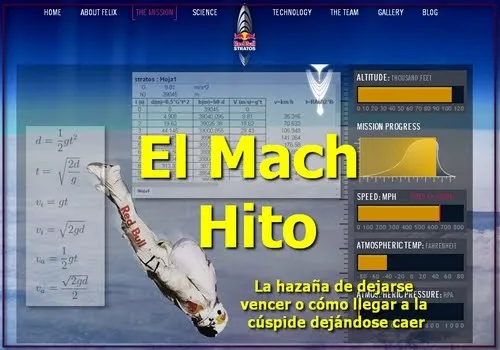
12-From this blog, I talked about the famous jump of Felix Baumgartner in El Mach Hito.
I invite you to participate in the next edition, which will be hosted by Gravedad Cero.