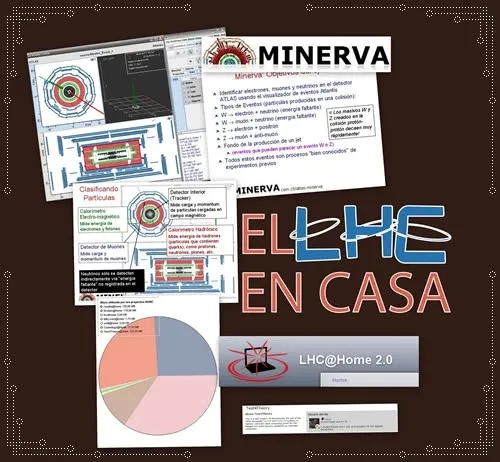
In late 2010, Test4Theory was launched, a cloud computing project that allows participants to run high-energy particle physics simulations on their computers.

Today, computer users have an unparalleled resource. Santiago Bilinkis (former CEO of Officenet) says that if cars had had exponential growth in their top speed since 1960 as computers have, we would have vehicles that exceed the speed of light (although it is physically impossible). I commented on it here before.
However, with the most modern and powerful processors, ultra-fast RAM, and large disk storage capacity, users generally do nothing more than browse the web. It's like having a Ferrari and driving on dirt roads.
That is why it is important to raise awareness about distributed computing, which allows us to put our computational resources at the service of science.
The Test4Theory project allows users to run high-energy physics simulations that physicists use to evaluate real LHC events. But first, a bit of history.
Science and computing
Many scientific projects require large computing infrastructures to run simulations and process data. It is possible to use facilities created for such purposes, at the State level in research institutions and privately.
These computer networks (Grid model) have their limitations: public institutions may not be sufficient or not properly prepared, while private ones are economically coercive.
A model change came with the "cloud," through providers like Amazon, Google, IBM, and Microsoft.
A key technology that enabled the development of the cloud is virtualization, which allows a logical separation of a physical computing infrastructure, installed in a center, from the users who use the resources provided by that hardware. In particular, platform characteristics, such as the operating system, connectivity, memory, processor configuration, can be abstracted into virtual machines that can then be customized by or for end users during the period they are used.
The BOINC model is based on a server that sends jobs on behalf of a project to all volunteer clients participating in it so that they are processed by those users' machines.
Each BOINC project required considerable effort to implement, among other things because users may have different hardware and operating systems.
LHC@Home
The paradigmatic distributed computing project of the BOINC platform is SETI@Home. But in 2005, LHC@Home was launched as part of CERN's 50th anniversary. The code (called Sixtrack) was based on Fortran and was ported to Windows and Linux in the traditional way, incorporating calls to the BOINC library and producing executables for each platform. About 60,000 users with about 100,000 computers have been active in that project since then. It should be noted that a user can run several projects on a PC and also do so on several computers at the same time, for example in a company or academic institution, always with due permission. That's why there are more computers working than users.
The interest generated by that application drove the idea that CERN could benefit from BOINC to assist in Large Hadron Collider research.
LHC physics at home
One problem is...Windows. It turns out that in a discipline like High-Energy Physics (HEP), almost all computational codes are developed under Linux (Scientific Linux in the case of the LHC) and porting them to Windows or even to other Linux distros is laborious. Each experiment has a long code with a lot of third-party dependencies and each collaboration at the LHC has different environments, so codes are rewritten very frequently.
But by using virtualization, the entire environment including the operating system, code, libraries, etc., can be incorporated into a virtual image that is then run under what is called a Hypervisor installed on the client machines, ensuring compatibility. That solves the "porting" problem, but another appears: the size of the image. The entire environment of an LHC experiment is on the order of 10 Gigabytes!
Another problem was the handling of "jobs" or tasks by BOINC. In this case, each task is an event or group of particle collision events that is mapped to a BOINC "work-unit," which in turn is divided into parts and sent to volunteer clients. When two or more results of a work-unit are received and validated, the work unit is considered complete, volunteers receive credit, and only then is the task database updated.
Each physics experiment must write scripts to feed tasks from its production system to the BOINC server and wait for that process to be complete for each task. Therefore, task management becomes important and BOINC does not provide adequate monitoring tools.
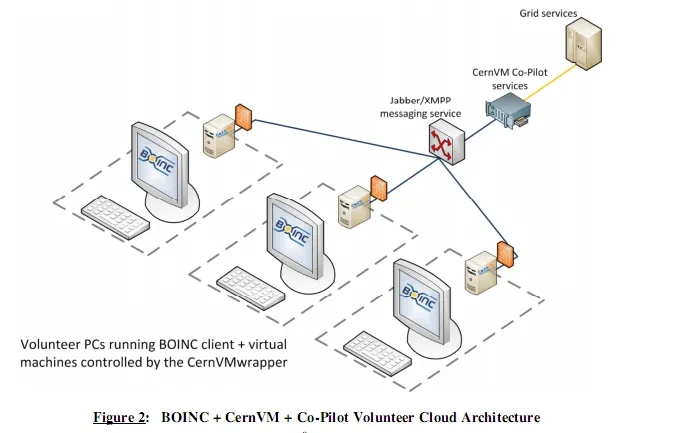
But the LHC experiments developed their own task submission and monitoring systems, much more suitable, so an interface called Co-Pilot was created that offers a gateway to the different task monitoring implementations (Pilot-job).
CernVM
In 2008, a CERN research and development project, called CernVM, was launched to offer a general solution to the virtual image management problem for computing in LHC physics. There are several papers written on the subject, but basically CernVM optimizes the image size by loading each virtual machine with the basics (200 MB) initially and then increasing it as required. The resulting images, of 1 GB, are cached by the virtual machines, minimizing access to the CernVM repository until there are changes in the code.
The Co-Pilot system is an intermediary between users and Cern's Grid services.
To connect BOINC and CernVM, the BOINC "wrapper" was used in 2006 until CernVM appeared and then the VMWrapper.
The BOINC-CernVM system
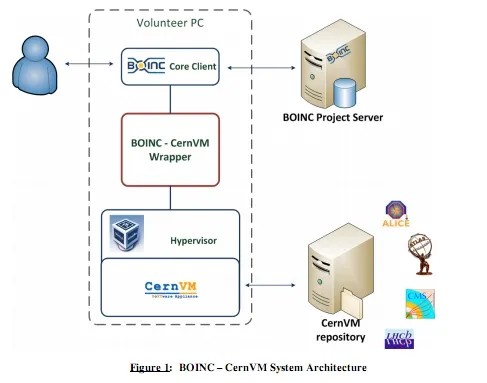
The BOINC volunteer first pre-installs the open-source hypervisor VirtualBox on their system (it is planned that this will not be the case in the future).
Then the volunteer adds the project to BOINC in the traditional way.
The user receives a work-unit that contains two files: the CernVM-Wrapper (the executable) and the standard CernVM virtual image which in turn contains the Co-Pilot agent.
The CernVM-Wrapper is executed: it configures, loads, and runs the CernVM image in a VirtualBox virtual machine.
Inside the virtual machine, CernVM runs in a standard way, including a connection to the file in the repository.
What Test4Theory Does
What is done in this project are simulations of high-energy particle collisions. By comparing the simulations with real data, scientists can notice signs of disagreements between current theories and the physical universe. That is not bad, but quite the opposite.
But those simulations require computers. The processing requirements of the LHC have been estimated at 100,000 CPUs and growing. That implies an enormous cost.
In the context pointed out at the beginning, with the computational power of current home computers, volunteer computing is a real option, both for scientists and for users. There are billions of people on the planet. There are also organizations where many people work and which have many computers for them, unused at many times.
"I think we can reach 10,000 or more people participating in Test4Theory. That would make an important difference to the resources available for theorists," indicated Peter Skands, theoretical physicist behind the project, in an ISGTW note.
The project uses Monte Carlo simulations to determine the rate at which specific events should occur in the experiments. These simulations, named after the city famous for casinos, generate random numbers. The simulations generate random events based on the probabilities of an interaction in the Quantum Chromodynamics model and allow comparing those results with the real data from particle collision events in the LHC experiments.
The simulations are performed through applications like Herwig++, Pythia 6, Pythia 8, Sherpa and Vincia (The paper by A. Buckley details those applications. Note that in that work, in English, the term Parton is used).
"We cannot be able to simulate as many events as the LHC," indicates Skands. "The fastest Monte Carlo simulation would produce one collision per millisecond, on average. But the LHC produces 40 million per second".
According to what Skands commented in e-sciencetalk, between 10 thousand and 100 thousand volunteers would be needed to obtain a "true" virtual LHC (if you allow me the oxymoron).
According to the Project Status, at the time of writing these lines there are about 6765 users with credits. Will you be the next one?
How to Participate
Those who are already users of BOINC and run other projects, must first download VirtualBox and install it. It should be noted that BOINC must not be installed as a service (in Windows) or daemon (in Linux).
If BOINC is already installed in that way, reinstall it. In any case, close BOINC before installing VirtualBox. After installing VB, run BOINC and add the Test4Theory project.
Those who are not BOINC users will, therefore, have to download that platform.
In any case:
Before installing anything, consult the Test4Theory FAQ.
It is possible to run the project on several cores, but for that VirtualBox needs chip extensions usually enabled in modern computers and laptops, but which are sometimes disabled from the BIOS. It is possible to do it, but with the due care that modifying the BIOS implies. Consult the forum for specific instructions.
It is possible, as in any BOINC project, to configure the usage mode. We can indicate that the projects run only when we are not using the computer, set a maximum of disk and memory, that it connects only at certain times, that is, adjust the use to our specific needs.
Projects in BOINC grant credits that only "serve" as an incentive, they have no other value. It is not a competition for who gets the most credits, therefore, it makes no sense to cheat in any way.
By default, when running Test4Theory a console will appear in Windows. It is possible that it does not appear if from the project configuration we use the Headless option set to YES.
There is a Firefox add-on to obtain user statistics for Test4Theory.
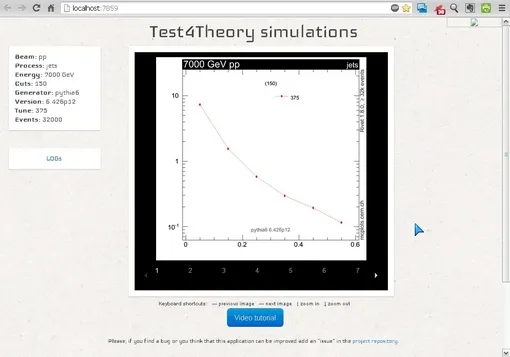
Some BOINC projects have a screensaver that shows the data being processed in the form of graphics. In the case of Test4Theory, on the other hand, when that project is running, it is possible to see graphics from http://localhost:7859/. A sample can be seen at CitizenCyberScience.
Note written for the XXXVI Carnival of Physics, in this edition hosted by Gravedad Cero. To join and read the entries visit Gravedad Cero.
Sources and Related Links
- LHC@Home:Test4Theory
- Andy Buckley et al, General-purpose event generators for LHC physics, arXiv:1101.2599 [hep-ph]
- Carlos Aguado Sanchez et al 2011, Volunteer Clouds and Citizen Cyberscience for LHC Physics, J. Phys.: Conf. Ser. 331 062022
DOI:10.1088/1742-6596/331/6/062022
About the Images
- Images 1 and 2 are from Test4Theory.
- Figures 1-2: from Carlos Aguado Sánchez et al 2011.