The feat of leaping into the void from 39 km high in free fall allows us to approach the topic from physics. The milestone by which a human without mechanical means surpassed Mach 1 also allows us to steal a supersonic smile.
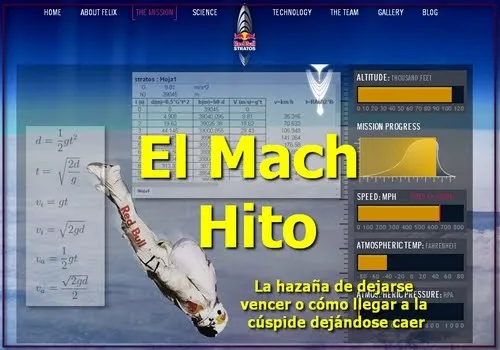
It is no news that Felix Baumgartner seems to have broken several records. On October 16, Red Bull released some concrete data, but the rest—on whose analysis the FAI's effective recognition of the achievement depends—will take a few weeks.
However, before that, let's review a bit of free fall. This is the name given to motion in one dimension caused exclusively by the action of gravity. It is said to be one-dimensional in relation to space, since if we must graph the fall, we only need to consider the height, the y-axis, that is, the ordinate.
We already know the history of this knowledge, provided by Galileo and his experiments. From them emerged formulas to calculate motion in free fall (without considering air resistance).
Before getting to the equations, it is worth clarifying why the fall of bodies does not depend on their mass, as the Italian demonstrated.
Confusion often arises for two reasons. On the one hand, as I indicated above, due to air resistance. It is clear that if we throw two objects of very different mass, the one with greater mass will fall faster. That seems to be the opposite of what Galileo demonstrated, although it is not. It's just that there is a contingency there: air resistance. But if we remove that variable and only consider gravity, then there is no contradiction.
However, in school we were taught the following equation for gravitational force:
F=-G. m.M/r2 (when writing this, we also added "little arrows" because we are talking about Force, which is a vector).
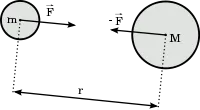
In this formula, G is the gravitational constant, r is the radius vector, and m and M are the masses of two objects. From this it follows that mass is indeed related to gravity.
But we also know, from Newton's Second Law, that g=F/M.
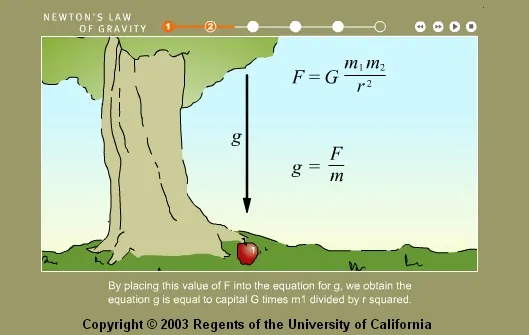
If we replace the value of F in this equation, we get:
g= G.m.M/r2/M
From there we can cancel two M's, as seen in Fig. 2., and we get:
g=G.M/r2, where M is the mass of the Earth and we no longer need to consider the mass of any other object.
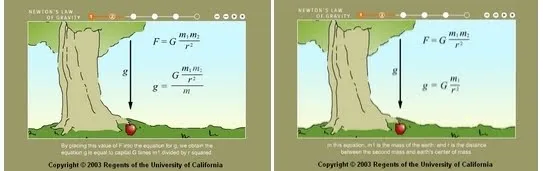
Note: Figs. 1 and 2 are screenshots from videos hosted on Hippocampus.org, which has many educational videos on physics and other topics, in English.
I made a small list of videos on these topics.
Now, let's go to the free fall equations on our planet. Here, the constant G= 9.81 m/s². It is an average value, since it is not the same across the entire Earth's surface (because the Earth is not a sphere) and because it decreases with height (it is inversely proportional to the square of the distance). However, since these changes, for our case, are very small, we neglect them.
Now we will say that d is the distance in meters, t is the time in seconds, v is the velocity at a given instant, in m/s, g is the previous value, then:
d=0.5.g.t2 t=SQRT((2d)/g)
v= g*t
With these simple equations, then, we could pretend we have a crystal ball and predict how long it would take a 43-year-old Austrian to fall from 39,045 meters high and reach the speed of sound, what the maximum speed would be, and how many meters he would have traveled at those moments.
Physics gives the illusion of being deterministic. Some would object to me that it is an illusion, to point out that it is an undeniable reality. However, Nature is so complex and difficult to predict that it is certainly an approximation. Let's remember we had to leave aside air resistance. And we will see what other variables we are underestimating...
Let's set our computer crystal ball in motion:
The spreadsheet can be downloaded from Google Drive.
The spreadsheet indicates the value of G, the initial height, then the time in the first column is not a calculation but a value that increments by unit, d which is the distance calculated according to the equation above that indicates each second how much the parachutist fell, h which subtracts the previous value from the initial height to know at what height above the surface he is at that moment, the instantaneous velocity each second. Outside the grid, the velocity in km/h also appears for reference, and finally the calculation of t, according to the equation above, only to show that the formula works...
If the spreadsheet were correct and my understanding is not clouded, then it would be enough to know what the speed of sound is and look for that speed in the spreadsheet to know, immediately afterwards, how many seconds should have passed and at what height Baumgartner should be at that moment. A piece of cake, right?
The problem that arises then, and which hasn't been talked about much, is that the speed of sound is not an absolute value, but a relative one.
What? Have we lived deceived? Was it all a farce, a joke with wings?
No, one second.
Let's think about the speed of light (c). It is possible to say its value is approximately 300,000 km/s. But, in what medium? Not in water, for example, or in air.
The same happens with sound waves. So let's set a frame of reference and end the discussion: the Earth's atmosphere. Done, then the sonic speed is... another second, referee.
Let's take it step by step, as they say... well... ahem... let's see: the speed of sound varies according to temperature and in this sense "the atmosphere" is not a single frame of reference, especially at the height chosen by Baumgartner.
I wanted to take several reference sources, but in an old physics book it only states that at 20 ℃, in air, the speed of sound is 343 m/s.
Wikipedia confirms that data, but the Anglo-Saxon version adds that: at 15 ℃ it is 340 m/s, and at -25 ℃ it is 315 m/s.
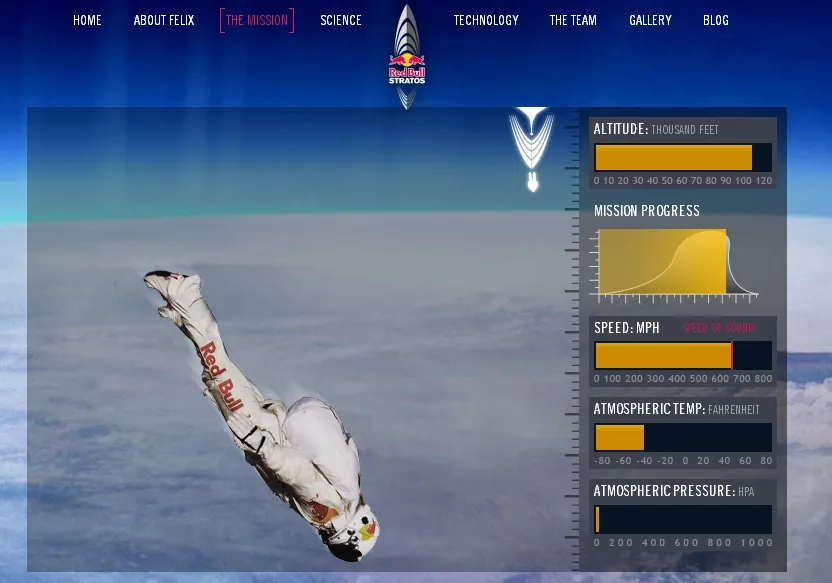
Red Bull Stratos data
Let's look at the Red Bull press release:
Initial altitude: 39,045 m
Maximum speed: 1,342.8 km/h / 833.9 mph (Mach 1.24) [It doesn't indicate t]
Time to reach the speed of sound: 33s
Vertical free fall distance: 36,529 meters / 119,846 feet. Below I clarify what this data means, in case someone missed it.
Total free fall time: 4m, 22s
Parachute opening at 5,300ft (1,615.44m) above ground
Total time from jump to landing: 9m, 9s
The most relevant data point seems to be the time to reach Mach 1, which, according to the sponsor, was 33s. In the spreadsheet above, the record of that time is shaded. However, using the formulas cited earlier, the speed reached at 33s should be 323.73 m/s. Is that the speed of sound? It depends on the temperature. According to English Wikipedia, at -15 ℃ in air, it is 322 m/s.
In Image 2, which is a screenshot of the interactive Red Bull site, it is noted that, according to preliminary calculations, the intrepid athlete would reach the speed of sound at 650 miles per hour, that is, 290 m/s, with a temperature of -40 ℃.
The other important data point is the maximum speed. According to Red Bull it was 1342 km/h. According to our spreadsheet, that would have occurred at 38s.
This means that after 38s, the team had already broken three records:
Maximum altitude of a manned balloon; first human to break the sound barrier without mechanical aid; free fall from the greatest height.
But two more were still missing, among the planned ones: maximum vertical free fall distance and greatest amount of free fall time. The latter was not achieved, but the former was.
The central question, then, is not whether Baumgartner broke the sound barrier, which seems unquestionable, but to what extent the preliminary calculations correspond to the real data. Given that we have set aside air resistance and that in these calculations we are not considering temperature (and density), it is worth asking how far reality is from theory.
What does maximum vertical free fall distance mean?
If he jumped from a height of 39km, why is the maximum vertical free fall distance 36.5km?
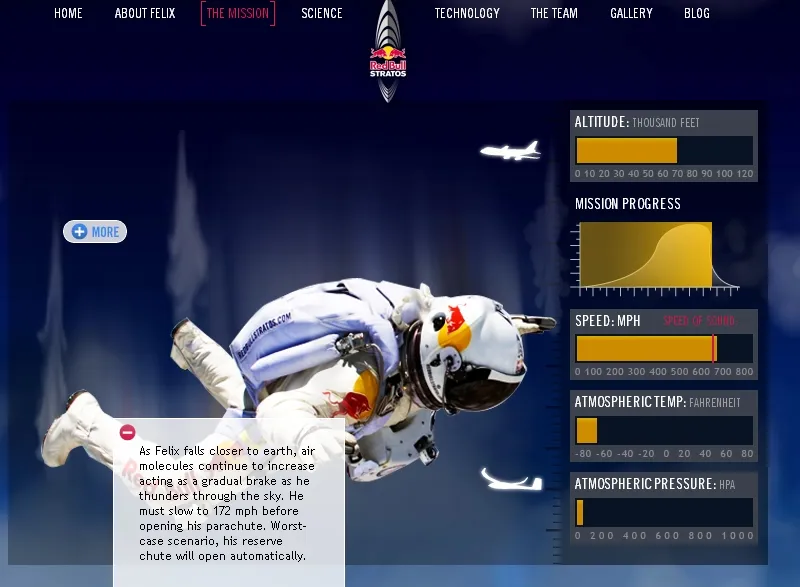
It's because Baumgartner didn't fall to the ground and shatter, but opened his parachute. Otherwise, there would be nothing to celebrate! He opened the parachute at 1,600 meters above the ground. But to open the parachute, the extreme athlete had to slow down his speed and for that he had to adopt another position, not perpendicular to the ground, but parallel, flexing his limbs to have a larger area, greater air resistance, and decelerate before releasing the parachute. Image 3 illustrates this aspect.
The scientific value and the humorous view
Red Bull took care not only to make monumental advertising of the event (and its products), but also to point out the scientific interest of the jump. The medical director, Dr. Jonathan Clark, indicated that exploring the effects of acceleration at supersonic speed on humans will allow "setting new standards for aviation. Red Bull is testing new equipment and developing procedures to withstand those conditions for longer." These developments are not only related to the scientific thirst for knowledge, but also to the potential space tourism of the future.
On the site, the Red Bull people also explained that there is no "sound barrier" and made an explanatory video (in English).
Seen this way, it's quite a feat, a milestone. A Mach Hito. By the way, the term Mach comes from Ernst Mach, who was also Austrian.
But, in the neighborhood, where men beat each other up because we are very macho, what has value is overcoming adversity. David, facing a Goliath, was very macho, to be illustrative. In contrast, the one who imposes himself on the weaker, more than macho, is a "machito." Our friend Podeti, with his usual wit, tells us something similar about the achievement of "not defeating gravity." An insult to the Wright brothers!
Since I don't want to steal readers from him, I link to Podeti's post, ironically titled:
Congratulations, you achieved something that seemed completely possible!
It is paradoxical that Baumgartner reached the pinnacle of his career by letting himself fall.
That said, he fell at a speed greater than that reached by a commercial airplane (in flight, not in a fall!).
In this matter of ascending or descending, of being or not being the fastest, which can have a metaphorical correlation with a person's transcendence, I think we fall into clichés, perpetuating them. The giraffe is not better than the flea, nor the hyena better than the turtle. The parachutist who risks his life for fun is not better than the construction worker who risks his existence to bring bread to the family table.
On that point, I take something from Podeti without irony: sometimes we let ourselves be carried away by epic narratives just because they make a lot of noise. Could it be that the true feats are the ones that go unnoticed?
I'm left thinking about that, even though the speed of thought is quite less than the speed of sound...
Note written for the XXXV Carnival of Physics, in this edition hosted on this blog. To join and read the entries visit Gravedad Cero.
Sources and related links
- English Wikipedia: Speed of sound
- Red Bull Stratos Mission: Preliminary statistics
About the images
- Images 1 to 3: Screenshots from Red Bull Stratos Mission Timeline.
- Formula image from Wikipedia: Universal gravitational constant
- Fig. 1 and 2 taken from Hippocampus. Copyright © 2003 Regents of the University of California