A collection of links to music, images and videos relating art and science. Today: Images of Journey to the Center of the Galaxy; NGC 720; An Argentine among 84 million stars; NGC 4178: A mini-supermassive black hole. Music: Lichtmond and Alan Parsons. Video: The Center of the Milky Way.

Images of the decade
Journey to the Center of the Galaxy
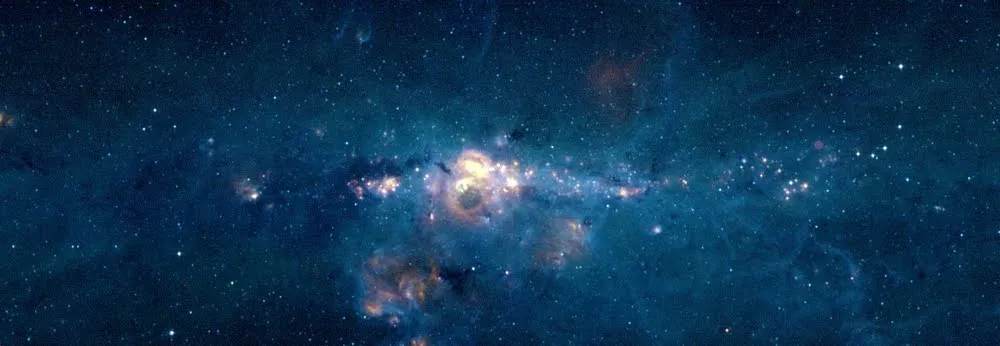
What wonders lie at the center of our galaxy? In the science fiction classic Journey to the Center of the Earth, by Jules Verne, Professor Liedenbrock (or Prof. Hardwigg in the most popular English translation) and his fellow explorers find several strange things. Astronomers already know some of the exotic objects that exist in the galactic center, including vast clouds of dust, clusters of bright stars, swirling rings of gas and even a supermassive black hole. Much of the galactic center is shielded from our view in visible light by gas and dust, but it can be explored using other forms of electromagnetic radiation. This evocative wide-field image of the galactic center region in infrared was constructed with data from the Midcourse Space Experiment (MSX) satellite. The image traces three semi-infrared bands, otherwise invisible to the human eye, coded in blue, green and red that reveal the thermal emission from dust clouds heated by starlight in the vicinity of the galactic center. The galactic plane runs along the central zone of the image, while the center of the galaxy itself is the bright spot at the center of the photo. The field of view of this image is approximately 1.5 by 2.5 degrees.
Credit: MSX,IPAC,NASA
It was the Astronomy Picture of the Day (APOD) on October 25, 2002. And at Observatorio.
NGC 720
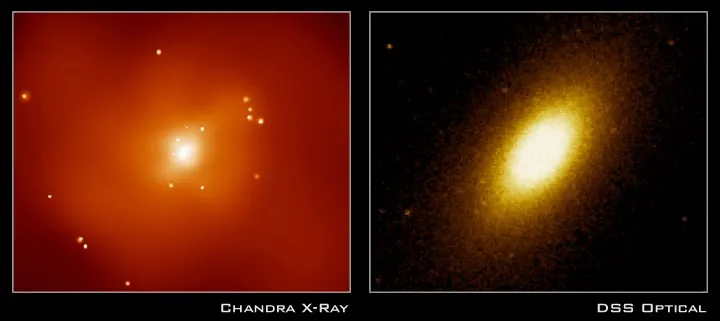
An image obtained with the Chandra X-ray Observatory shows galaxy NGC 720 -located 80 million light-years away- enveloped in an ellipsoidal or flattened cloud of hot gas that has a different orientation from the optical image of the galaxy. This flattening is too large to be explained by theories in which gas and stars are assumed to be the main mass content in the galaxy.
According to the theory of gravity, the cloud would need an additional source of gravity, a halo of dark matter. The mass of that dark matter should be about five to ten times the mass of the stars in the galaxy.
An alternative theory of gravity, called MOND (Modified Newtonian Dynamics) does not require dark matter, but cannot explain this observation made with Chandra. Which implies that dark matter is not just an illusion.
The data obtained agree with the cold dark matter model in which dark matter consists of slow-moving particles that interact with each other and with "normal" matter only through gravity.
Credit: X-ray: NASA/CXC/UCI/D.Buote et al., Optical: DSS U.K.Schmidt Image/STScI
These observations correspond to the research of D. Buote et al., 2002 Astrophys. J. 577, 183. The image was published by Chandra on October 22, 2002.
Images of the week
An Argentine among 84 million stars
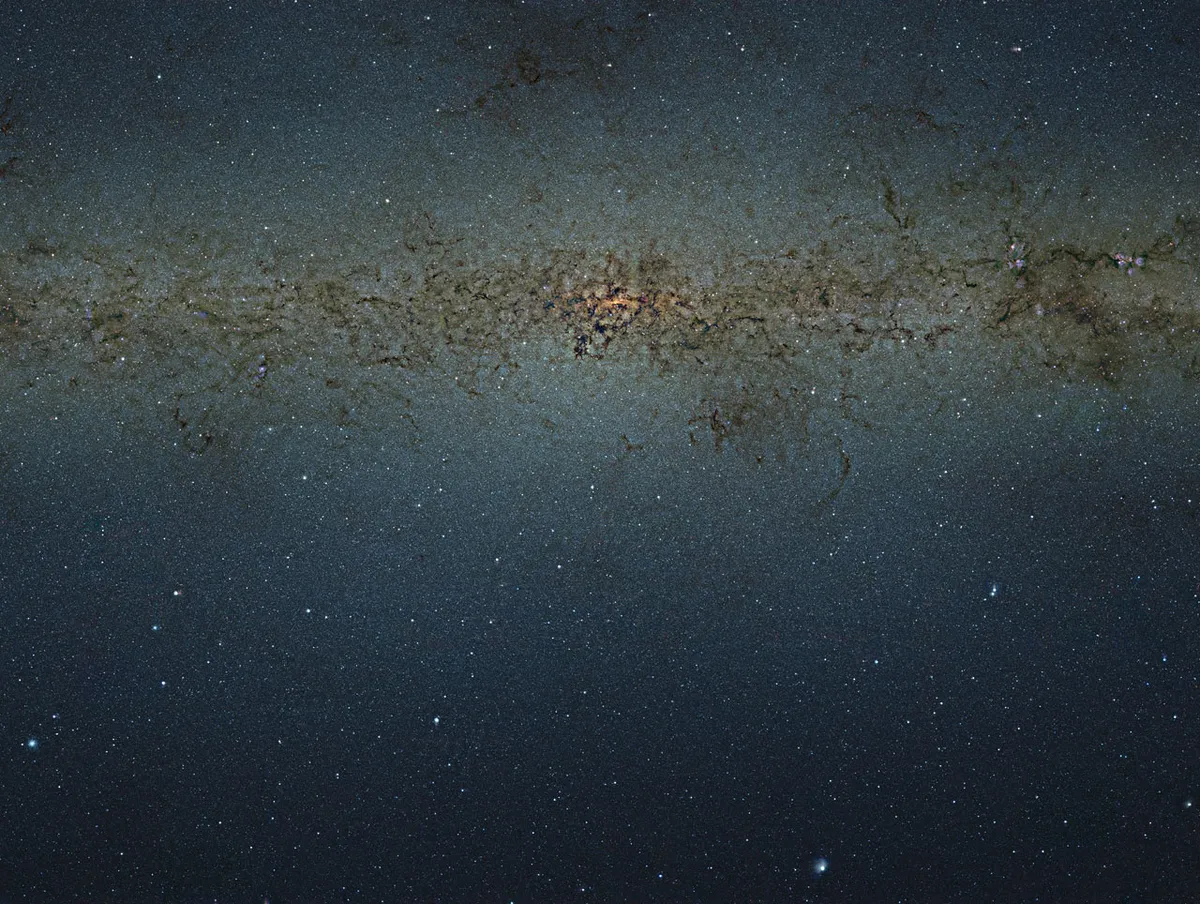
This week ESO published a scientific announcement stating that: "Using a huge nine-gigapixel image from the VISTA survey telescope, installed at ESO's Paranal Observatory, an international team of astronomers has created a catalog of more than 84 million stars located in the central areas of the Milky Way. This gigantic dataset contains more than ten times more stars than previous studies and is a major advance in the knowledge of our host galaxy. The image gives the viewer a view on which they can zoom in, approaching the central part of our galaxy. It is so large that, if we wanted to print it with the typical resolution of a book, it would measure 9 meters long by 7 wide".
And it adds: "Observing the core of the Milky Way is very difficult, as it is obscured by dust," says Dante Minniti (Pontificia Universidad Catolica de Chile, Chile), co-author of the study. "To penetrate into the heart of the galaxy, we need to observe in the infrared range of light, which is less affected by dust".
Some media outlets republished this content, without noting that Dr. Dante Minniti is an Argentine astronomer. Even some major media in our country interviewed the lead author of the article, but not the native of Santa Fe who was the second author of the paper.
To aid in the analysis of this huge catalog, the brightness of each star is plotted on a diagram against its color for about 84 million stars in order to create a color-magnitude diagram.
"Each star occupies a particular point on this diagram at any moment of its life. The place where it falls depends on how bright and hot it is. Since the new data gives us a snapshot of all the stars at once, we can take a census of all the stars in this part of the Milky Way," explains Dante Minniti, one of the Argentine astrophysicists working in the world.
More information at ESO.
Credit: ESO/VVV Consortium//Ignacio Toledo, Martin Kornmesser.
NGC 4178: A mini-supermassive black hole
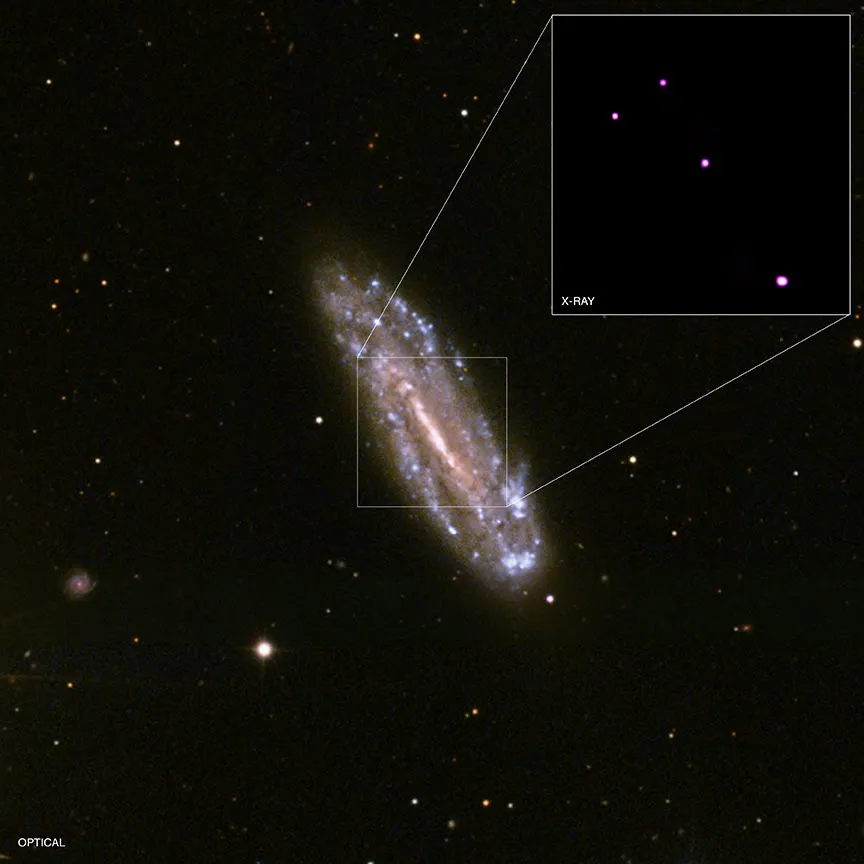
One of the least massive supermassive black holes was identified at the center of a galaxy thanks to the use of Chandra and other observatories.
The black hole resides at the center of galaxy NGC 4178, shown in the Sloan Digital Sky Survey image. The inset shows the X-ray source at the position of the black hole. The galaxy in question is a spiral and is located 55 million light-years from Earth.
A known relationship between the mass of a black hole and the amount of X-rays and radio waves it generates was used to calculate the mass of the black hole. This method predicts that a black hole has a mass less than 200,000 times that of our Sun. This value, although it seems high, is much lower than the typical ones for supermassive black holes of millions to billions of times the mass of the Sun.
The research was published by Secrest, N et al, 2012 ApJ 753:38.
Credit: X-ray: NASA/CXC/George Mason Univ/N.Secrest et al; Optical: SDSS
The publication on Chandra was made on October 24, 2012.
Space Music
Lichtmond Meets Alan Parsons at Paranal
In 2012, the musician brothers Lichtmond released their third multimedia album called Moonlight. They recently finished a continuation of that work in the form of a new project: Lichtmond 2: Universe of light.
The band, which resides in a town near Garching, Germany (where the European headquarters of ESO is located), had the collaboration of Alan Parsons thanks to the mediation of the director of the Paranal Observatory, Andreas Kaufer.
Kaufer invited Parsons to a night visit during the great artist's stop in Chile. Giorgio Koppehele, one of the two Lichtmond brothers, accompanied Parsons on the visit and convinced him to lend his voice for the first single of the new album, the song titled "Precious Life".
Koppehele's visit to Paranal and ALMA inspired him to create a film about the site (ESO & ALMA Suites), using material from ESO's archives. The audiovisual production is only available in the special edition of the album, along with an interview with Alan Parsons.
Lichtmond 2: Universe of light was released on September 28, 2012. Above you can listen to an excerpt from the album tracks.
More information on the Lichtmond website and on ESO.
A video of "Precious Life" with Alan Parsons is on Lichtmond's YouTube channel.
Animated Science
Journey to the Center of the Milky Way
We commented above on the crowded galactic center. Here is an animation about the center of our galaxy. Towards the end, you will see an annotation pointing to the star S2, which we talked about last week.
The video belongs to ESO and is in the press release 0846e.
Another video, also from ESO, allows a close-up of the galaxy's center. It can be seen on YouTube.
To access previous editions of this section, consult the Multimedia Selection Series. The series attempts to show that the immensity of the universe can be perceived in different ways. I choose some images from a decade ago -so they don't fall into oblivion- and from the current week that ends, as well as sounds/music and videos that are artistic forms of expression with content related to astronomy and related sciences. I am also compiling these materials on the Pinterest account