A collection of links to music, images and videos relating art and science. Today: Images of Quaoar; CG4; Lunar Mosaic; Hen 3-1475. Sound: ColossalView. Video: The Rabbit on the Moon.

Images of the decade
Quaoar
In June 2002 Chadwick A. Trujillo and Michael E. Brown discovered an asteroid with a magnitude of 18.5 in Ophiuchus.
In October of that year, with Hubble astronomers measured that cold rock whose provisional designation was 2002 LM60.
Although it is smaller than Pluto, at the time of measurement, it was larger in volume than all other asteroids combined.
Later, others that were larger and more massive would be discovered. The same astronomers found the object now known as Makemake in 2005. Quaoar is almost 1,300 km in diameter. Pluto, in comparison, is about 2,400 km.
The animated image above shows three photographs taken 90 minutes apart from the Oschin Telescope, where the discovery was made. Of the entire field possible to obtain with the instrument, this is only one part in 150.
More information, in English, on the page of one of the discoverers.
The name "Quaoar" originates from the name of the force of creation worshipped by the Tongva tribe, the original people of the region known today as Los Angeles. On that page, Mika Acuña is quoted as saying "Quaoar, the great force of creation sings and dances the high deities into existence. Quaoar has no form or gender. Dances and sings first to Weywot, who becomes Father Sky; then to Chehooit, Mother Earth. The trio sings Tamit and Grandfather Sun is born..."
Evidently, in this mythological tale, singing and dancing is a birth ritual. Weywot is the name given to Quaoar's moon.
It was the Astronomy Picture of the Day (APOD) for October 9, 2002. And on Observatorio.
CG4 a "broken" cometary globule
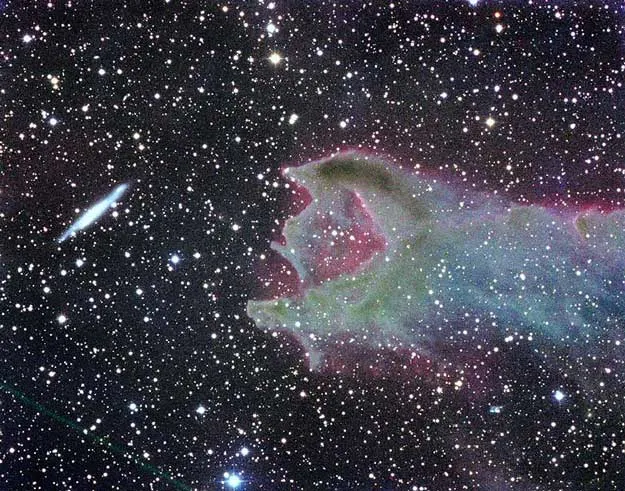
The strange object on the right of the image is a gas cloud known as a cometary globule. Due to their shape, these gas clouds resemble comets, as they give the sensation of having a large "head" and a long "body." These clouds are stellar nurseries where new stars are born. On the left, the edge-on galaxy that is seen is actually very far from the globule, although it doesn't seem so.
It was the Astronomy Picture of the Day (APOD) for October 13, 2002. And on Observatorio.
Images of the week
The Moon on a summer night
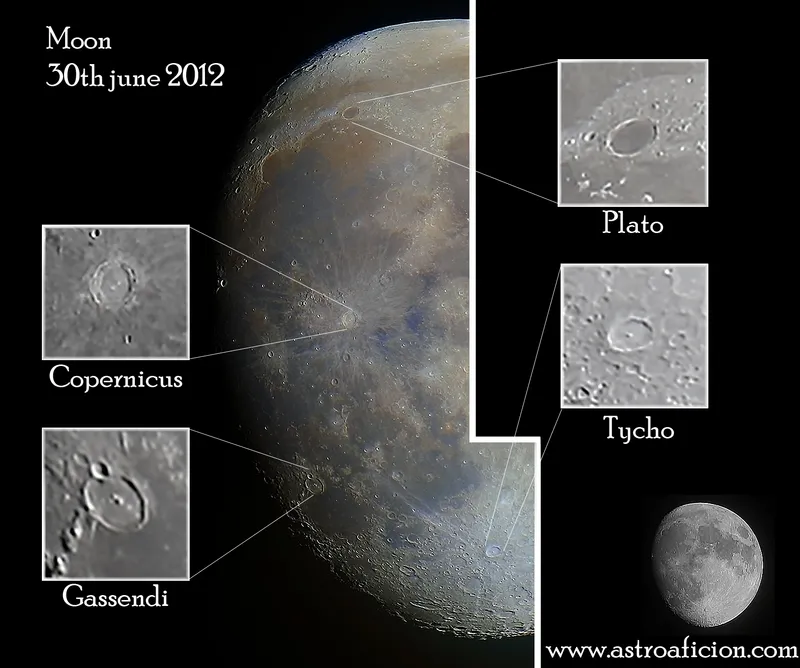
With a Newton 150/750 on a CG5-GT mount, a Canon EOS 1000D and photo retouching, although with poor seeing, Roberto Ferrero (AstroAficion) achieved this mosaic of five images. The record is from June 30 of this year. And, of course, it was taken from the Northern Hemisphere, in Altea, Spain.
Although the shot is not of a complete "face" of the Moon, does anyone see a rabbit there? I ask, in case someone knows. Perhaps at the end of this selection we'll find it...
It was the Amateur Astronomy Picture of the Day (AAPOD) October 9, 2012.
Hen 3-1475
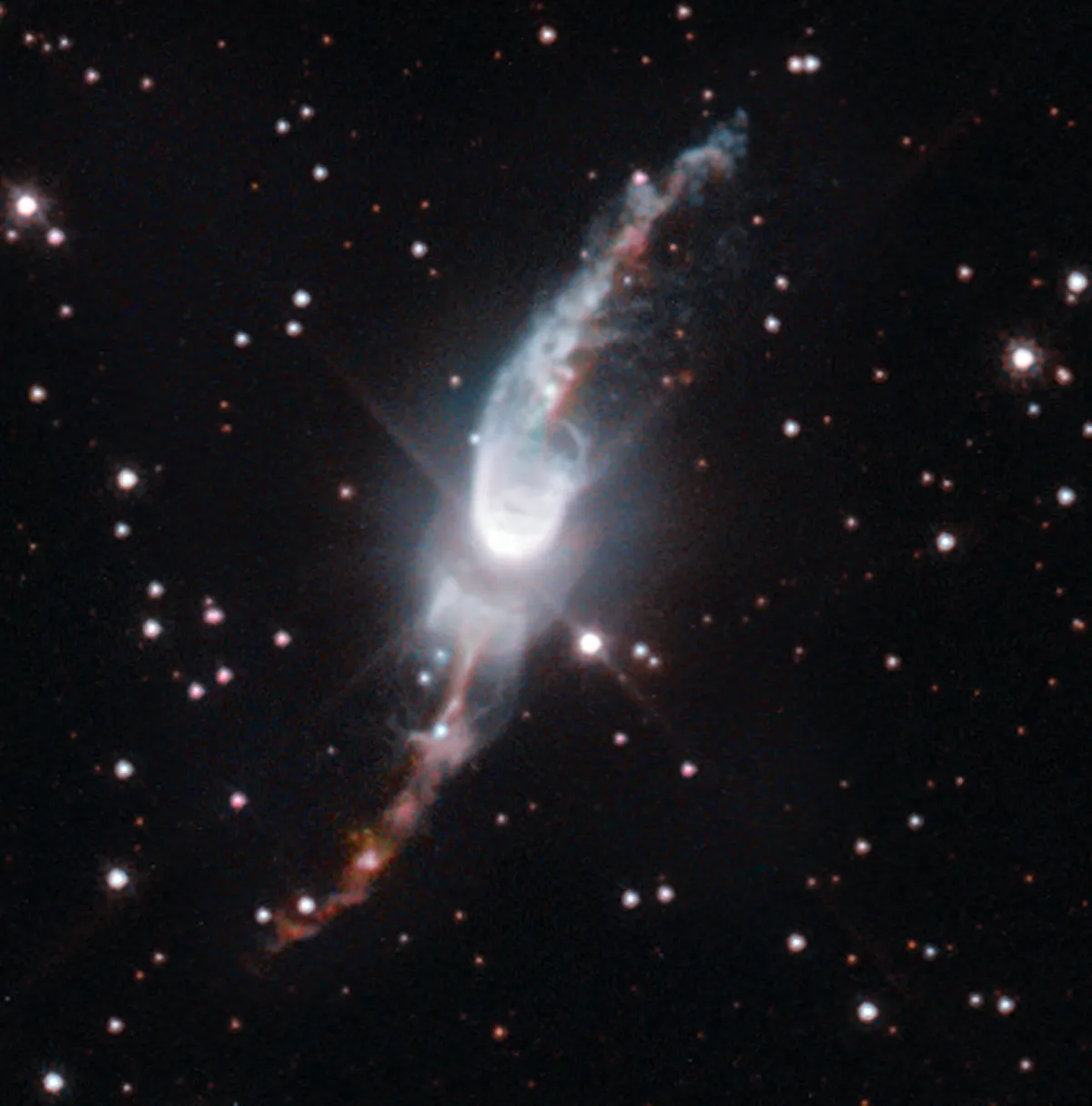
Among the most photogenic objects in the universe are planetary nebulae. This one, named Hen 3-1475, is in the process of formation so it can be called a proto-planetary nebula. It is located in Sagittarius about 18,000 light-years from us. The central star is more than 12,000 times as luminous as our Sun.
The object was also recorded by Chandra and previously by Hubble with the Wide Field and Planetary Camera 2. The image, which in this case was achieved with the WFPC 3, was the Space Telescope Image of the Week.
Space Music
ColossalView: The Planetary Traveler
Ryan M. Brown, from the United States, expresses his passion for astronomy through his artistic name ColossalView, which in Spanish would be Vista Colosal.
Animated Science
The Rabbit on the Moon
Just as the Tongva had their worldview, other peoples in the world also created stories to explain the origin of the universe. In Mexico, for example, those mythologies explain why there is a rabbit on the Moon.
Another perspective on the same topic is held by Ana Jiménez, who wrote a story and made an animation for Animasivo 2009.
Day of Cultural Diversity
Both in the story behind the name of the asteroid and possible dwarf planet, Quaoar, and in this last narration of the rabbit on the Moon, what exists is a cultural richness that we must value and respect. In Argentina, this October 12 was celebrated as the Day of Cultural Diversity. That date, on which the arrival of Columbus to America was traditionally commemorated, now promotes a day of historical reflection and intercultural dialogue about the rights of indigenous peoples.
To access previous editions of this section, consult the Multimedia Selection Series. The series attempts to show that the immensity of the universe can be perceived in different ways. I choose some images from a decade ago -so they don't fall into oblivion- and from the current week that ends, as well as sounds/music and videos that are artistic forms of expression with content related to astronomy and related sciences. I am also collecting these materials on the Pinterest account