A collection of links to music, images and videos relating art and science. Today: Images of Star S02; Centaurus A; IC 5148; Messier 8. Music: Earthfriend - Alpha Centauri. Video: Danger Planet, by Justin Burks.

Images of the decade
Star S02
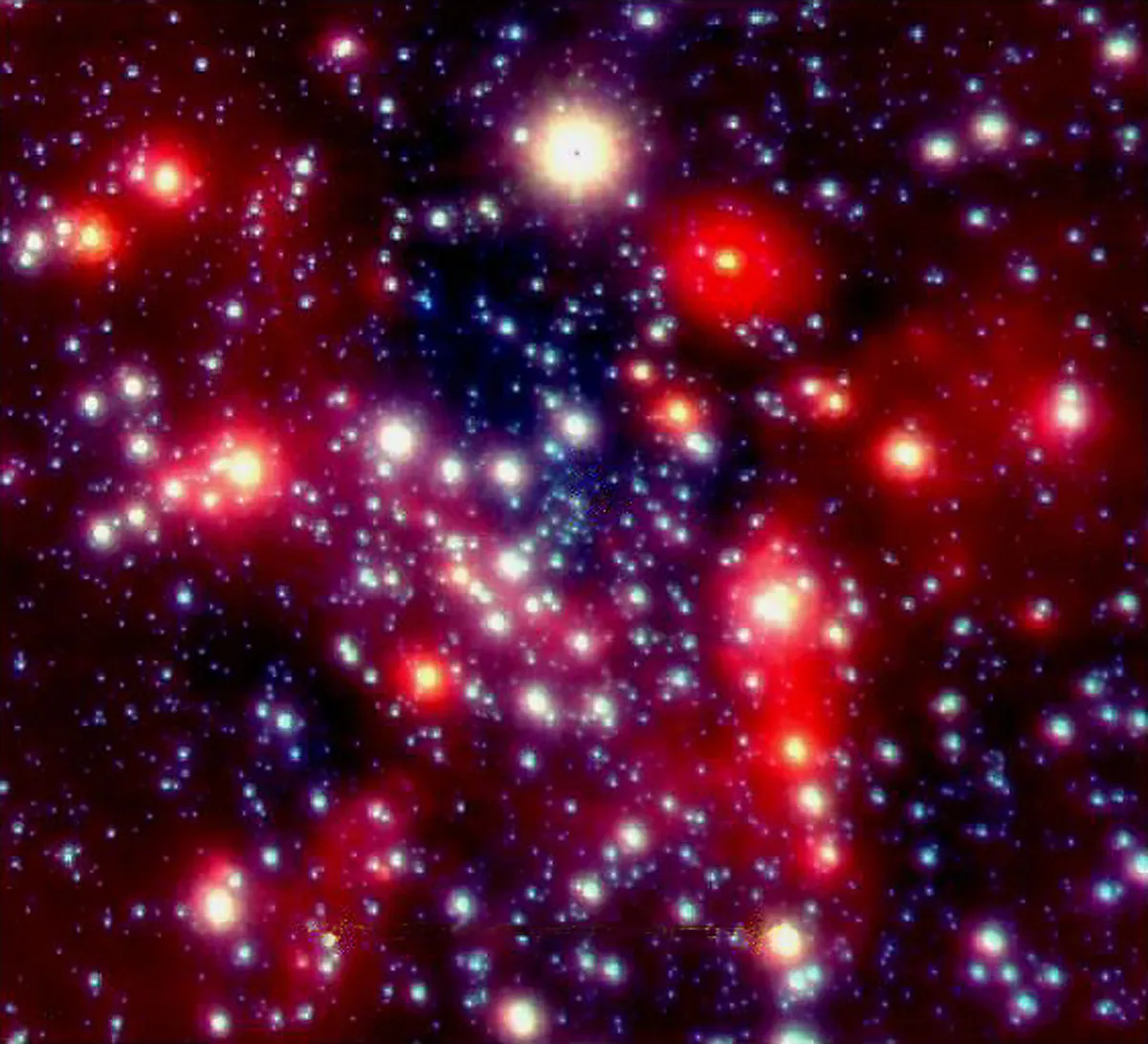
An international team of astronomers from the Max Planck Institute observed a star orbiting the supermassive black hole at the center of our galaxy. After ten years of measurements made with the NACO instrument on the Yepun telescope of the VLT at ESO's Paranal Observatory they were able to detect that star S02 approached to within 17 light-hours of the massive object at no less than 5,000 km/s.
The star was observed for two thirds of its orbit and was the closest observable star to the radio source known as SgrA* at the center of the Milky Way.
The center of our galaxy is located in Sagittarius, about 26,000 light-years away from Earth.
From previous observations of many other stars it was known that within a radius of 10 light-days of that radio source a large amount of matter was concentrated, approximately 3 million times the mass of our Sun. However, it could well be a supermassive black hole but other objects could also explain such an accumulation of matter, such as several not-so-massive black holes or clusters of neutron stars, among other hypotheses.
According to a detailed report published in Nature, those other possibilities were ruled out by these measurements.
The image was obtained in mid-2002 with the NACO instrument at ESO. It combines data in three infrared bands (between 1.6 and 3.5 µm). What is perceived are stars and their color indicates temperature, blue for the hottest and red for the coolest.
In 2008, a new image of the same area was made.
Credit: ESO.
The ESO press release was issued on October 16, 2002. There is a Spanish translation of the release, made by Axxon.
In the ESO release and on YouTube there is a video with the movements of star S2 and others around the black hole.
Centaurus A
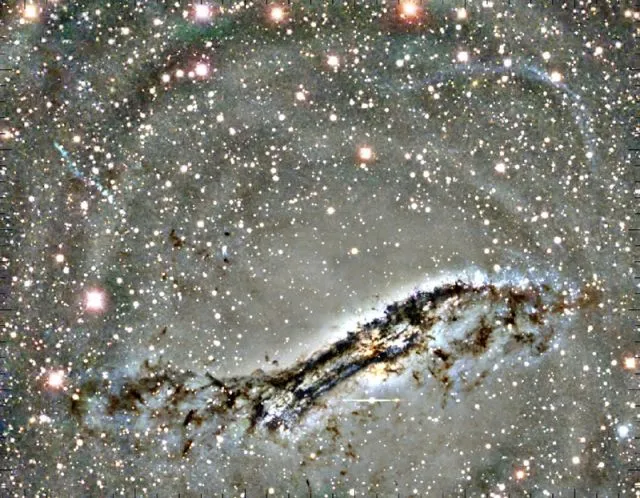
Almost lost among so many stars, gas and dust, a faint but clear bluish arc is noticeable in this image (top left of the image or, if not noticeable, see this image with arrows). It is a stream of young stars whose formation was probably triggered by the interaction between a dwarf galaxy and the giant elliptical galaxy called Centaurus A. That arc, which is 2000 light-years long, has been interpreted by astronomers as a piece of evidence of "galactic cannibalism" in progress. Centaurus A (NGC 5128) is located in the constellation Centaurus about 14 million light-years away.
The peculiar galaxy is located very close (in the apparent sky) to the famous cluster ω Cen and if we then look for the currently super-duper-hyper-famous Rigil Kent (α Cen) we will have traced a small astronomical arc between certainly outstanding objects.
By the way, the Earth-mass planet found in the Alpha Centauri system we will not be able to see with a telescope, but the lenticular galaxy is within reach of a medium telescope.
Credits: E. Peng and H. Ford (JHU),K. Freeman (ANU),R. White (STScI),CTIO,NOAO,NSF.
It was NASA's Astronomy Picture of the Day (APOD) for October 17, 2002. Also on Observatorio.
Images of the week
From cosmic spare tire to ethereal flower
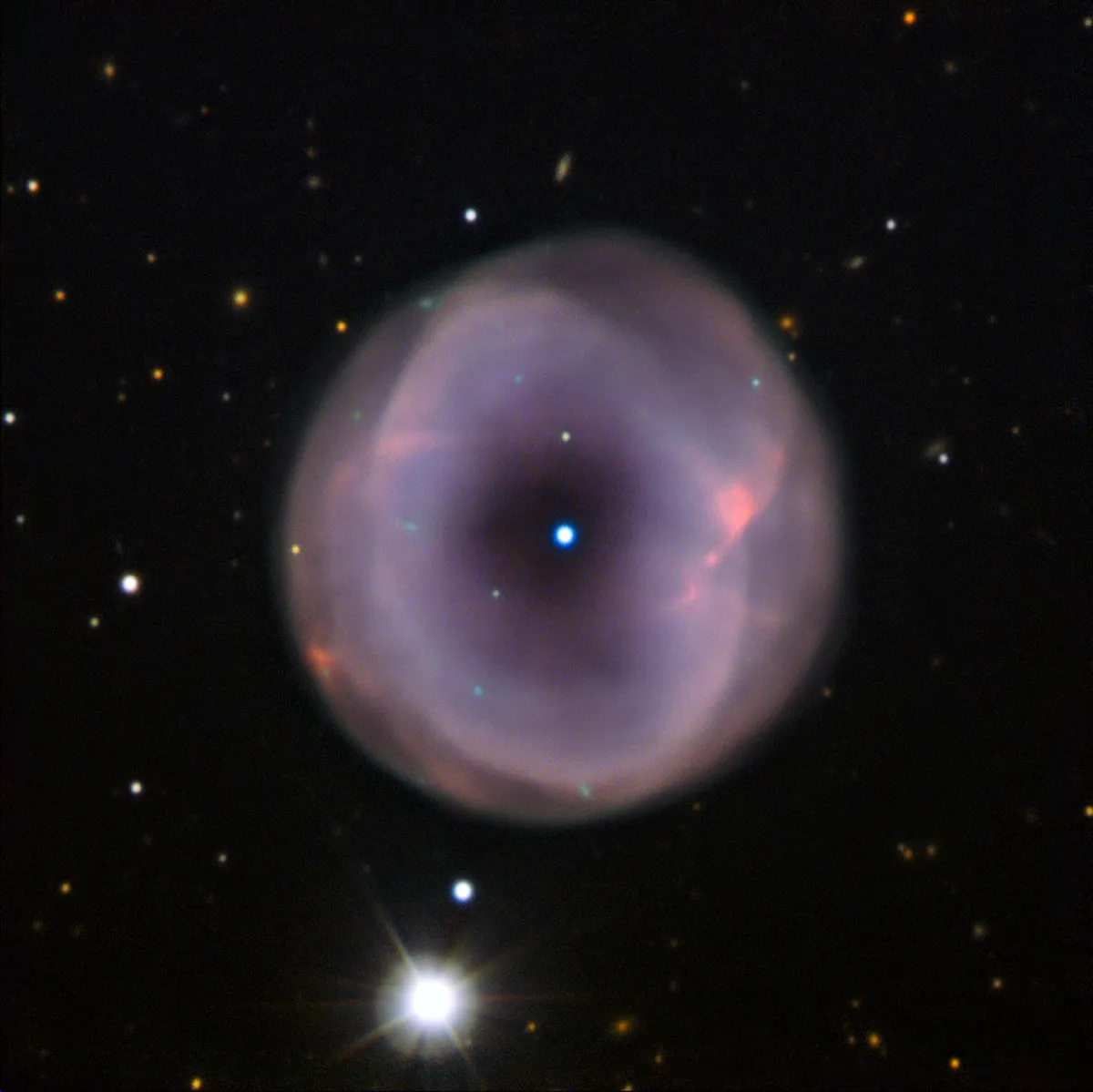
IC 5148 is a beautiful planetary nebula located about 3,000 light-years away, in the Constellation Grus (The Crane). The nebula has a diameter of a couple of light-years, and is still growing at about 50 kilometers per second — one of the fastest known planetary nebula expansions.
If observed with a small amateur telescope, this particular planetary nebula looks like a ring of material, with the star — which will cool to become a white dwarf — shining in the middle of the central hole. This appearance led astronomers to nickname it IC 5148, the Spare Tire Nebula.
The EFOSC2 camera (ESO Faint Object Spectrograph and Camera), installed on the NTT (New Technology Telescope) at La Silla, offers a somewhat more elegant view of this object. Rather than looking like a spare tire, the nebula looks like an ethereal flower with overlapping petals.
Credit: ESO.
It was the European Southern Observatory's Picture of the Week.
A Lagoon in the sky of Buenos Aires
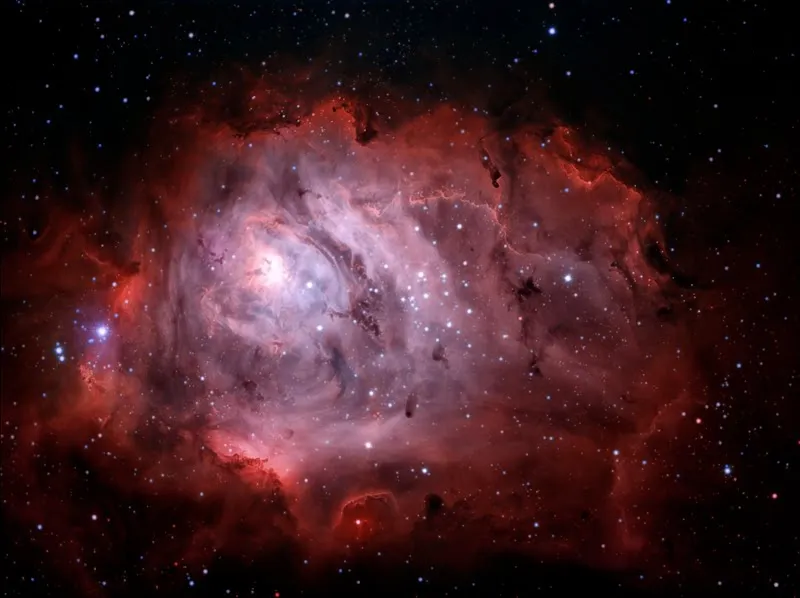
Messier 8, the Lagoon Nebula, along with M20, are two objects to observe with a medium telescope from a sufficiently dark place. Although it has an apparent magnitude of 4.5, in a 130mm (5") Newtonian only a cloud is barely perceived in the eyepiece. But with an 11" Schmidt-Cassegrain we not only have double the aperture, but also much greater focal length (2800 mm). If we put a Hyperstar III in place of the secondary mirror, we can put a CCD in the front so the field of view will be wider and images will be obtained faster.
With a configuration of that type, we will no longer see a little white cloud in the eyepiece, but with the CCD data we can see an image like this one of Messier 8.
The person responsible for the capture is Martín Matias Menrath who uses a Nexstar 11" gps Hyperstar III + an Atik 314L camera.
The result is there to see. Good enough to be the Amateur Astronomy Picture of the Day (AAPOD) for October 18, 2012.
Space Music
Earthfriend: Alpha Centauri
Heiko Hoffmann -Earthfriend-, from Germany, was inspired by the star system closest to Earth to compose the following piece.
Animated Science
"Danger Planet" by Justin Burks
This computer animation video (that means CGI) was made by Justin Burks. On his blog http://dangerplanet.blogspot.com.ar/ you can see how it was made. It is also hosted on Vimeo.
During a routine reconnaissance trip on a distant planet, a young space explorer is smitten by a pilot. But when danger appears, he must face what hides in the planet's darkness and rescue the girl.
The production is impeccable. It is remarkable how the characters, with so few features, convey emotions, particularly with their eyes.
But there is something striking about the staging, from an astronomical point of view. Are they on a planet or on a natural satellite? At the beginning (1:03) a large, ringed planet is seen, similar to our Jupiter, and two moons. Is this another planet or perhaps another moon of the ringed giant? On the other hand, how many stars make up this system? Although no star is shown, it is possible to infer, from the final scene (3:49), that there would have to be more than one, since the two moons in that last shot are in different phases. But, returning to the initial shots, the phases seem the same...
To access previous editions of this section, consult the Multimedia Selection Series. The series attempts to show that the immensity of the universe can be perceived in different ways. I choose some images from a decade ago—so they don't fall into oblivion—and from the current week that is ending, as well as sounds/music and videos that are artistic forms of expression with content related to astronomy and related sciences. I am also collecting these materials in the Pinterest account