Jupiter reappears behind the full Moon and, as every month, science Fridays return. Two invitations from the City Planetarium to see, learn, and be amazed.
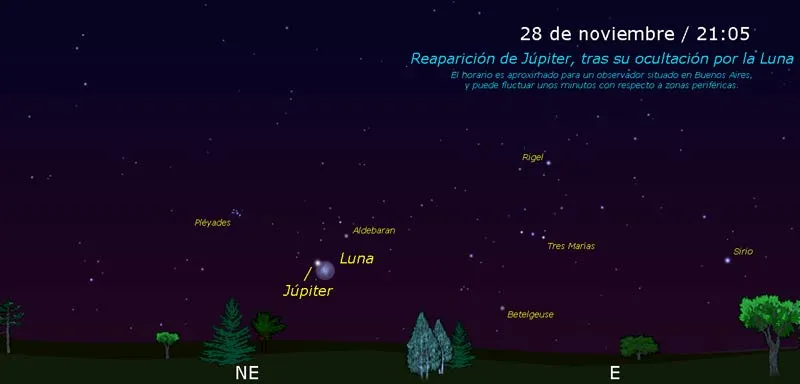
Jupiter peeks out from behind the Full Moon
The phenomenon will be visible to the naked eye in most of the country
Wednesday, November 28, 20:30 h.
The Buenos Aires Planetarium invites us to observe this rare and striking astronomical phenomenon. First, with the naked eye and on a giant screen (with a "live" image taken by a large telescope), to see the brief and precise moment of Jupiter's "reappearance" from behind the Moon. And then, through several telescopes to see both celestial bodies close together in the sky. The meeting is this Wednesday, starting at 20:30 in the Planetarium park.
The Moon will occult Jupiter for almost an hour, but the occultation will not be visible from Buenos Aires, as both objects will be below the horizon. But just after 21:00 h, the planet Jupiter will peek out from behind the lunar limb. The planet's "reappearance"—in what will be a simple game of astronomical perspective—will last almost two minutes. And then, little by little, we will see both celestial bodies slowly separate, forming a striking duo for the rest of the night. It will be one of the most notable astronomical spectacles in recent years. And it will be easily visible to the naked eye.
For an observer in a specific place on Earth, occultations/reappearances of Jupiter usually occur every 13 or 14 years. And not just once, but in series of 3 or 4 episodes, over several months. From Argentina, the last series of Jupiter occultations/reappearances occurred in 1998. And recently, we had the first event of this new series: on Saturday, September 8, in broad daylight, the Moon, in its Last Quarter, occulted and uncovered the giant planet. But what is coming will occur at nightfall. And with a Full Moon.
More info on the Planetarium's page.
Science Fridays at the Planetarium
Third Friday of each month: Important figures in science—researchers, teachers, and scientists from the national and international sphere—attend the Planetarium to present topics of their specialty in a lecture format.
November 30: "Extrasolar planets", by Dr. Pablo Mauas.
The activity will begin at 18:30 with the presentation of "Tonight's Sky", a live description of the Buenos Aires sky in the different months of the year. Myths and legends of the most representative constellations of the Southern Hemisphere; position of the Moon and planets and location of other celestial bodies only visible with telescopes, such as stars, nebulae, clusters, and distant galaxies.
At 19:15 Dr. Pablo Jacobo David Mauas will give the Lecture "Extrasolar planets"
How do we find them? How do we study them? How do we know if they could be habitable?
So far, about 900 exoplanets have been found. Just during 2012, we found about 150, and the number grows day by day. However, as they are very dim compared to the central star, very few can be observed directly.
In this talk we will see how we go about finding them, what kind of observations we can make to study their characteristics, and what conditions they would have to have to be habitable. Could we, eventually, tell if they are inhabited?
Dr. Pablo Mauas.
As always, observations are subject to weather conditions.
Sources and related links
About the images
- Credit: Planetario Galileo Galilei.