A collection of links to music, images and videos relating art and science. Today: Images of N30B; NGC 2359 Thor's Helmet; The GRAIL gravity map of the Moon; "Green bean" galaxies. Music by Our Small Galaxies: The Star Wolf-Rayet. Video: Rubika.

Images of the decade
Hubble photographs a double bubble in neighboring galaxy
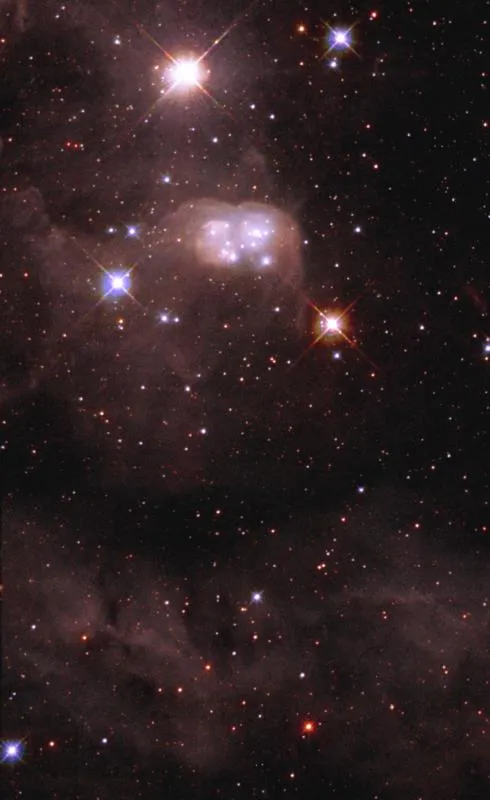
This reflection nebula surrounds a young and hot star cluster. The cluster, called N30B, is located inside a larger cluster: DEM L106. And, like a set of Chinese boxes or Russian dolls, the cluster is contained within the Large Magellanic Cloud, a satellite galaxy of the Milky Way, 160,000 light-years away from Earth.
Hubble captured the light from the hot stars in the cluster. The brightest star, at the top, is Henize S22. The target of study for this area of the sky was precisely S22. Astronomers M.S. Oey, Y.H.Chu and collaborators studied DEM L106 and made clever use of the nebula around N30B. By performing spectroscopic observations at several points in the nebula, they were able to study the spectrum of S22 from different angles. Notably, they found that the spectrum changed depending on the point of view, which suggested that the star is surrounded by a disk of gas at its equator.
The DEM catalog was created by astronomers R.Davies, K.Elliot and J. Meaburn (their initials gave the catalog its name). N30B was discovered by astronomer K. Henize, who later became a NASA astronaut.
Credits:
NASA and The Hubble Heritage Team (STScI/AURA)//M.S. Oey (Lowell Observatory) and Y.-H. Chu (U. of Illinois)
The image was published on HubbleSite on December 5, 2002.
NGC 2359: Thor's Helmet
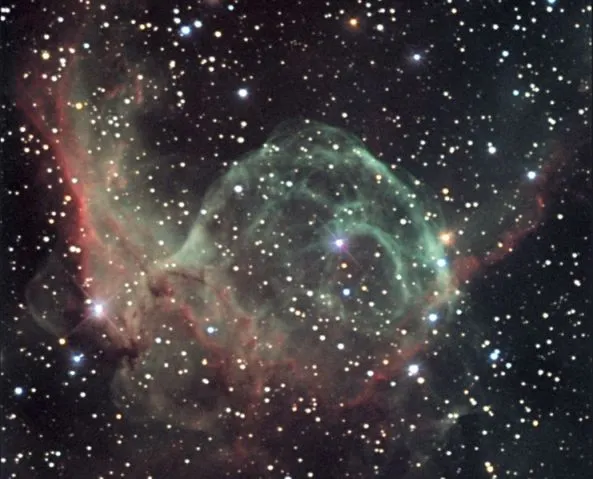
NGC 2359 is an emission nebula with a rather popular name: Thor's Helmet.
The nebula, about 30 light-years in diameter, was formed by energetic winds from an extremely hot star near the center of the Wolf-Rayet type, called WR 7 (HD 56925).
Wolf-Rayet stars are massive blue giant stars that develop stellar winds with speeds of millions of kilometers per hour.
It is thought that interactions with a nearby large molecular cloud are what give this nebula its such complex shape and its irregular structures.
NGC 2359 is about 15,000 light-years away in the constellation of Canis Major (near Sirius).
Credits: Christine and David Smith, Steve Mandel, Adam Block (KPNO Visitor Program), NOAO, AURA, NSF.
It was the Astronomy Picture of the Day (APOD) on December 5, 2002. And at Observatorio.
Images of the week
The GRAIL gravity map of the Moon
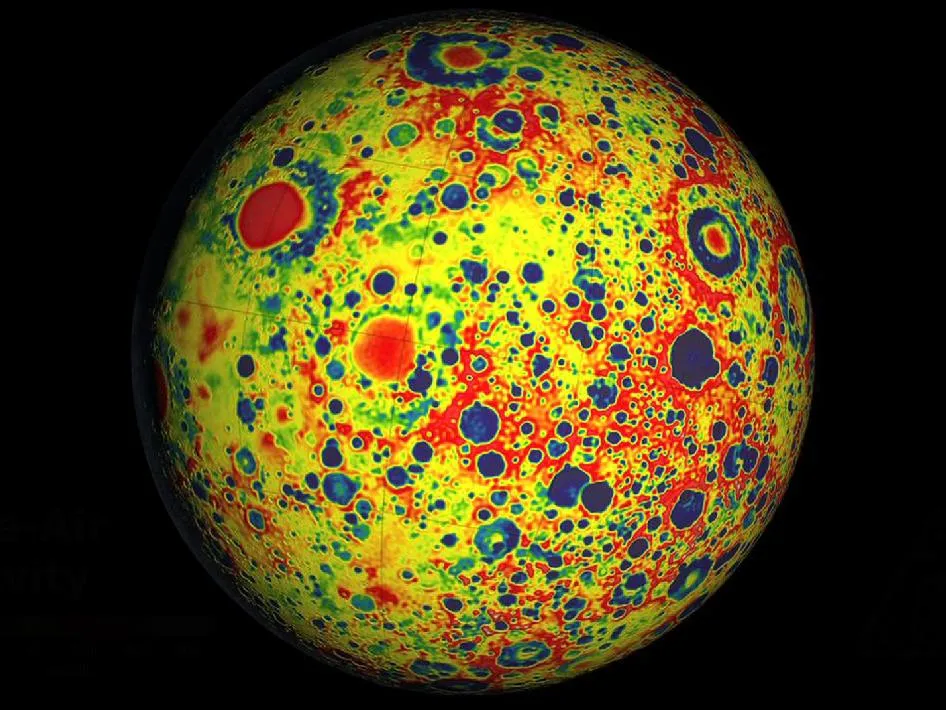
The image shows variations in the lunar gravity field measured by NASA's GRAIL mission during the period March-May 2012. The very precise measurements between two spacecraft, called Ebb and Flow, were used to create the map with high spatial resolution. The field shown is composed of blocks on the surface of about 20 km. Red areas correspond to excess mass and blue to mass deficiencies.
The probes revealed that the apparent density of the lunar highlands crust is much lower than was generally assumed.
More information in NASA's press release.
Much more of the surface can be seen in a set of images assembled as a video on the NASA website and on YouTube.
Credits: NASA/JPL-Caltech/MIT/GSFC
The image was published by NASA on December 6, 2012.
The "green bean galaxies"
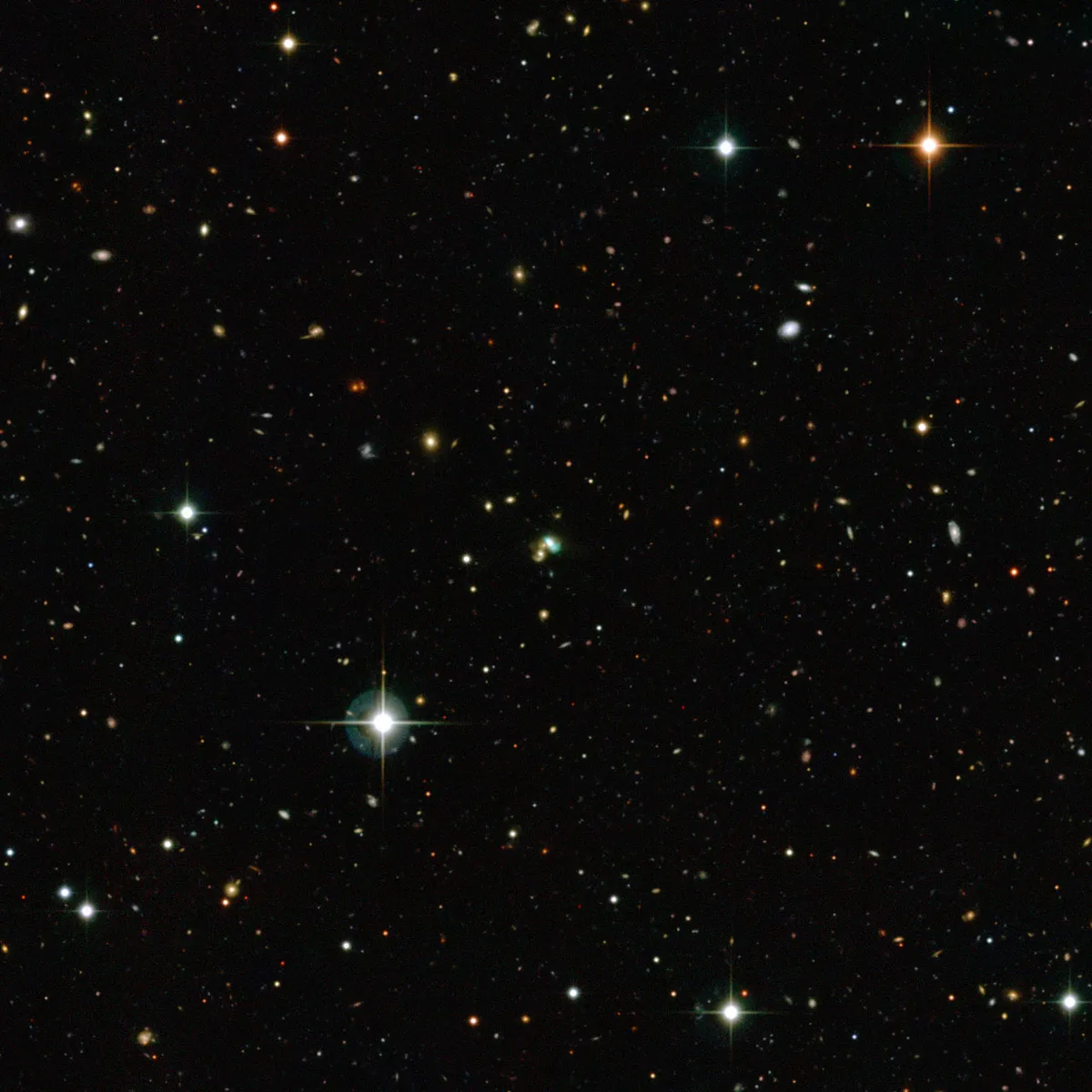
Using observations made with ESO's VLT (Very Large Telescope) telescopes, the Gemini South telescope and the Canada-France-Hawaii Telescope (CFHT), a new type of galaxy has been identified. Nicknamed "green bean galaxies" for their unusual appearance, these galaxies shine amid the intense light emitted from the surroundings of monstrous black holes and are among the objects considered the rarest in the universe.
Many galaxies have a giant black hole at their center that causes the gas in their surroundings to glow. However, in the case of green bean galaxies, not only the center shines: the entire galaxy glows. These new observations reveal the largest and brightest glowing regions found so far, regions believed to be powered by central black holes, previously very active but which seem to be shutting down.
Astronomer Mischa Schirmer, from the Gemini Observatory, has studied numerous images of the distant universe, searching for galaxy clusters, but when he came across this object in an image from the Canada-France-Hawaii Telescope he was astonished — it looked like a galaxy, but it was a bright green color. It was different from all the galaxies he had seen so far, something totally unexpected.
The new object has been labeled J224024.1−092748 or J2240. It is located in the Constellation of Aquarius (The Water Bearer) and its light has taken 3,700 million years to reach Earth.
After the discovery, Schirmer's team searched a list of nearly a billion galaxies from the Sloan Digital Sky Survey (SDSS) and found 16 more with similar properties, which were confirmed by observations made with the Gemini South telescope. These galaxies are so scarce that, on average, we find only one of them in a cosmic cube 1,300 million light-years on a side. This new type of galaxy has been nicknamed "green bean galaxies" for their color and because they superficially resemble "green pea" galaxies, although they are larger.
Credit: CFHT/ESO/M. Schirmer.
More information at ESO.
Space Music
Our Small Galaxies: The Star Wolf-Rayet
From Russia, this user on SoundCloud created the track Star of Wolf-Rayet:
There is another track, related to NGC 2359, also on Soundcloud.
Animated Science
Rubika
Rubika is a short animation that uses pixelated images in the style of the game Minecraft.
It was co-directed by Claire Baudean, Mickael Krebs, Julien Legay, Chao Ma, Florent Rousseau, Ludovic Habas, Caroline Roux, Margaux Vaxelaire.
One of the directors uploaded an excerpt of the work to Vimeo, but it is also possible to see it in full (for now) on YouTube.
I must say I came across the video recently thanks to the excellent short film cycle broadcast by the channel I.Sat on Fridays.
Extract of Rubika ( Le laboratoire - Canal + ) from Ludovic HABAS on Vimeo.
As we will see, in Rubika, gravity seems to work very differently than in our world. But the strangest thing is that it doesn't work differently for everyone, but, apparently, for some. You understand why this happens, in the end, although the short film's title is self-explanatory.
To access previous editions of this section, consult the Multimedia Selection Series. The series attempts to show that the immensity of the universe can be perceived in different ways. I choose some images from a decade ago -so they don't fall into oblivion- and from the current week that is ending, as well as sounds/music and videos that are artistic forms of expression with content related to astronomy and related sciences. I am also compiling these materials in the Pinterest account