A group of physicists from Japan have taken to the skies to grow crystals under zero gravity.
"It can take thousands of years for normal classical crystals to reach their final shape, however, at very low temperatures, helium crystals can reach their final shape in one second. When helium crystals grow larger than 1 mm, they can be easily deformed by gravity, so we conducted our experiments on an airplane," explained Professor Ryuji Nomura, from the Tokyo Institute of Technology, lead author of a study published in New Journal of Physics (the article is open access as of yesterday).
The experiments were carried out on a small airplane in cooperation with the Japan Aerospace Exploration Agency (JAXA). When on a specific trajectory, known as parabolic flight, the airplane provided zero-gravity conditions for 20 seconds. About eight experiments were conducted during a two-hour flight.
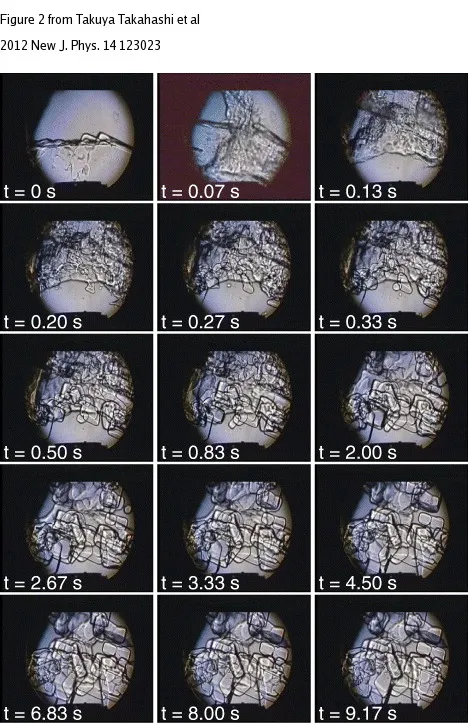
What they did, basically, was place large Helium crystals in a high-pressure chamber and broke them into tiny pieces which were sprayed with a Helium4 superfluid. The experiment was performed to see how those tiny crystal pieces grew under those conditions.
The crystal grew through a process known as Ostwald ripening. This is commonly seen in ice cream when it becomes rough and crunchy as it ages - larger ice crystals begin to grow at the expense of the smaller ice crystals.
"Ostwald ripening is usually a very slow process and has never been seen in these huge crystals over a very short period," continued Professor Nomura.
The helium crystals were grown using high pressures, extremely low temperatures (0.6K/-272 °C) and by spraying them with a superfluid - a state of quantum matter that behaves like a fluid, but has zero viscosity, meaning it has complete resistance to stress. Superfluids can also flow through very small gaps without any friction.
The recording of their zero-gravity flight, which also shows the formation of the crystals up close, can be seen here:
What's the point of "breaking" a large crystal, and then, with the small pieces, making them grow to form, again, a large one?
These experiments attempt to better understand the crystal formation process, as well as see what happens when gravity does not act.
More information at IOP Latin America.
Note written for the XXXVII Carnival of Physics, in this edition hosted by High Ability Dimension. To join and read the entries visit Gravedad Cero.
Sources and related links
- IOP Latin America: Physics on a plane: crystals made under zero gravity
- Takuya Takahashi et al (2012), Ripening of splashed 4He crystals by acoustic waves with and without gravity, New J. Phys. 14 123023
DOI: 10.1088/1367-2630/14/12/123023
About the images
- Initial figure: Time evolution of 4He crystals in a superfluid at zero gravity, initially at 0.63 K. The total volume of crystals was relatively large. Time t is indicated in each frame and an acoustic wave pulse was applied from transducer B at t=0.03 s. Some crystals continued to grow and other smaller ones melted and disappeared in an Ostwald Ripening. Credit: Takuya Takahashi et al (2012)