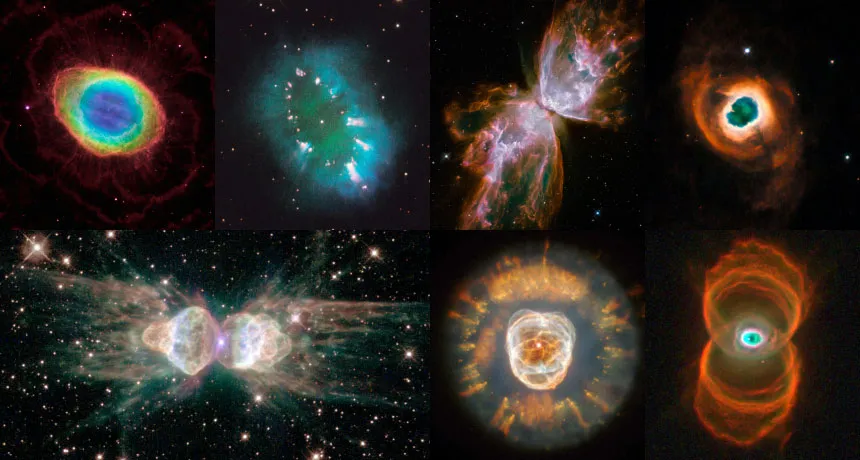
Astronomers detect helium-3 in a nearby nebula, but they did not manage to clarify the so-called "3He problem", even though one model seems to come closer to the results.
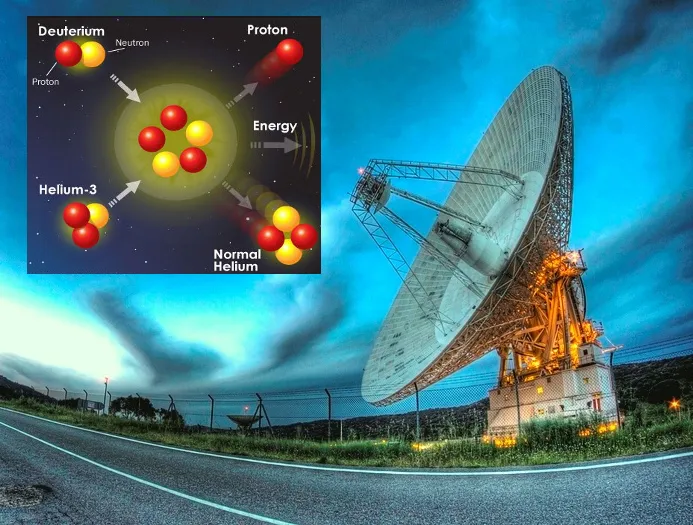
A team of astronomers from the University of Manchester, the Center for Astrobiology and Deep Space Network of Spain and the Autonomous University of Mexico detected a rare gas 4000 light-years away. The discovery, made through the use of the largest antenna at the Madrid Complex (70 meters), could help scientists understand more about the history of this important element.
Helium-3 is a gas (isotope of the noble gas Helium) that has the potential to be used as fuel in nuclear fusion plants in the future and is crucial for its use in cryogenics and medical imaging techniques. There is very little available on Earth, so it is manufactured in nuclear laboratories at great cost. There would be significant amounts on the Moon and several governments have indicated the intention to mine the natural satellite to obtain this isotope.
The gas is produced in low-mass stars, less than twice the mass of the Sun, which expel most of their matter into space at the end of their lives, forming a planetary nebula (the Sun will do that in 5 billion years). Of all the elements produced in stars, helium-3 is one of those that take the longest to reach space.
The team leader, Lizette Guzmán-Ramírez, began investigating helium-3 as a doctoral student at the University of Manchester, before going to ESO. She joined Albert Zijlstra and Malcolm Gray from the same institution and colleagues from Spain and Mexico to search for helium-3 in a planetary nebula 4000 light-years from Earth and measure how much is produced in the star. The team detected an unexpected amount, larger than expected, almost 500 times greater than its relative percentage on our planet, and several times greater than predicted by the models.
The detection proves that the element is produced in the center of stars like the Sun, and ejected into space at the end of the stellar process, but it remains to explain the reasons for such a large quantity.
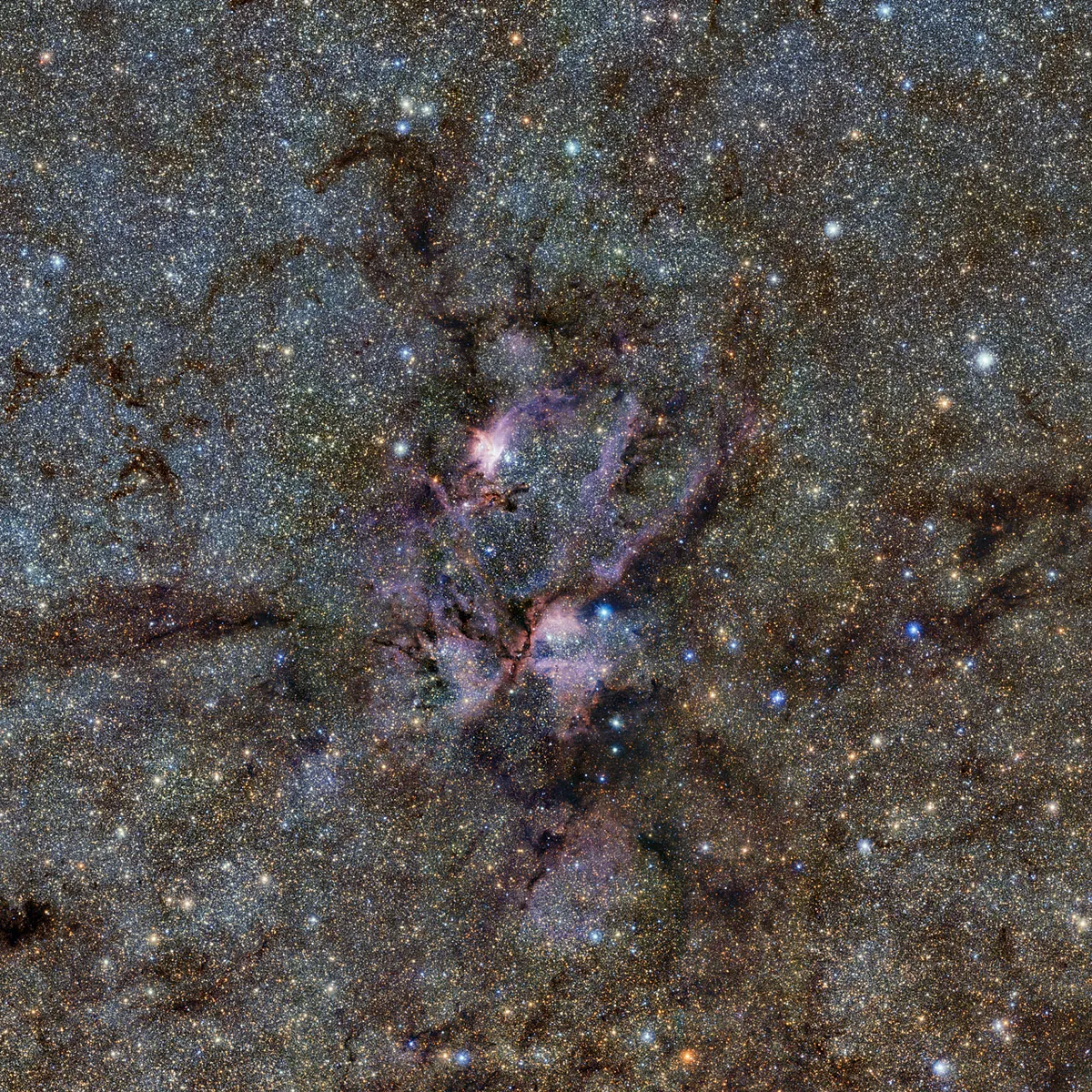
The planetary nebula (PNe) in question is IC 418.
HELIUM 3, future source of energy on Earth
BBN and the 3He problem
Big Bang Nucleosynthesis (BBN, in English) refers to the formation of elements shortly after the great "bang". BBN would be responsible for the formation of the majority of certain elements, such as 4He and 3He, Deuterium and Lithium-7.
But the abundance of 3He is also due to stellar nucleosynthesis, that is, the formation of this isotope and other enriched elements in stars.
In the introduction of their paper, the professionals note that stars with a mass below 2.5 solar masses are natural producers of this isotope via the proton-proton chain (first they produce Deuterium and then with those hydrogen isotopes plus a proton they achieve 3He and radiation). But the abundance is greater than that observed in the interstellar medium (ISM, in English).
The problem was addressed by Galli et al (1995). A suggestion to explain the phenomenon is that in the red giant branch (Red Giants Branch) the isotope is destroyed in stars of 1 solar mass by 90% (according to Eggleton et al, 2006), but only 40-60% in stars of 2 solar masses.
The professionals used the DSS-63 antenna at the MDSCC complex in Robledo de Chavela, Spain, part of NASA's Deep Space Network. They observed the nebula IC 418 (G215.2-24.2)
The following graph shows results of the abundance of 3He relative to H for the planetary nebula IC418 as purple crosses (upper and lower limit). The red arrows are the limits calculated by Guzmán-Ramírez (2013). From the previous work of Balser and others (1997), PNe J320 is indicated with a green cross and the arrows of the same color are a sample of 6 PNe from that work.
The curves in light blue and dotted red are for the abundance of the element in Population I and II according to Weiss 1996. The black line (below) is the primordial value of the 3He/H ratio from BBN.
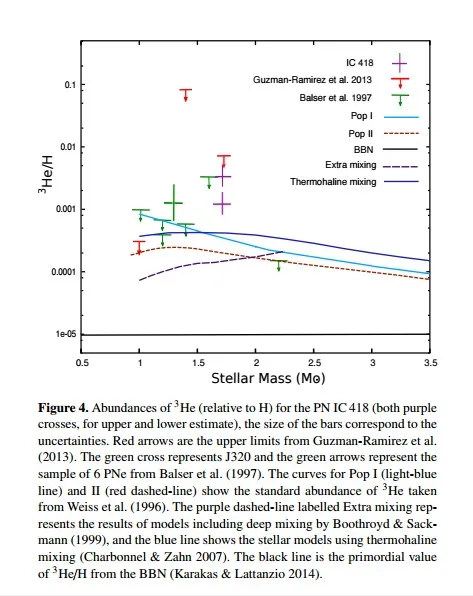
Although the mystery of 3He remains, one model that seems to approach the measurements is the one known as "thermohaline mixing" (Charbonnel & Zahn 2007). Two Argentine professionals have been investigating this model (see below).
Although it may still seem like science fiction, there are enough indications and objective data to suspect that in the near future mining will be done outside Earth, perhaps to obtain Helium-3 and produce energy. But the "problem of high electricity rates" will remain and some will get rich (though not so "nobly") with helium.
Sources and related links
- Manchester astronomers detect precious element in space
http://www.manchester.ac.uk/discover/news/manchester-astronomers-detect-precious-element-in-space/ - First detection of 3He+ in the planetary nebula IC 418
L. Guzman-Ramirez, J. R. Rizzo, A. A. Zijlstra, C. García-Miró, C. Morisset, M. D. Gray
MNRAS (July 21, 2016) 460 (1): L35-L39.
DOI : 10.1093/mnrasl/slw070
First published online April 12, 2016 - arXiv:1604.02679 [astro-ph.SR]
http://arxiv.org/abs/1604.02679 - Thermohaline mixing and the photospheric composition of low-mass giant stars
F. C. Wachlin, M. M. Miller Bertolami, L. G. Althaus
arXiv:1104.0832 [astro-ph.SR]
http://arxiv.org/abs/1104.0832 - Thermohaline Mixing, Matteo Cantiello
http://www.matteocantiello.com/index.php/thermohaline-mixing.html - A.A. MAGALLANES: Helium 3 and the Moon
https://agrupacionastronomicamagallanes.wordpress.com/2011/06/17/el-helio-3-y-la-luna/
About the images
Can we harness energy from outer space?
http://science.howstuffworks.com/environmental/green-science/energy-from-space.htm
Graphic: Guzman-Ramirez et al (2016).
Photo of antenna at Robledo de Chavela, Madrid (University of Manchester)