A collection of links to music, images and videos relating art and science. Today: Images of Adolescent Universe; Light echoes of V838; Jonckheere 900; NGC 4535. Music: Deeply Dazzled and Malevolence Six. Video: The "new" universe of Planck.

Images of the decade
Adolescent Universe
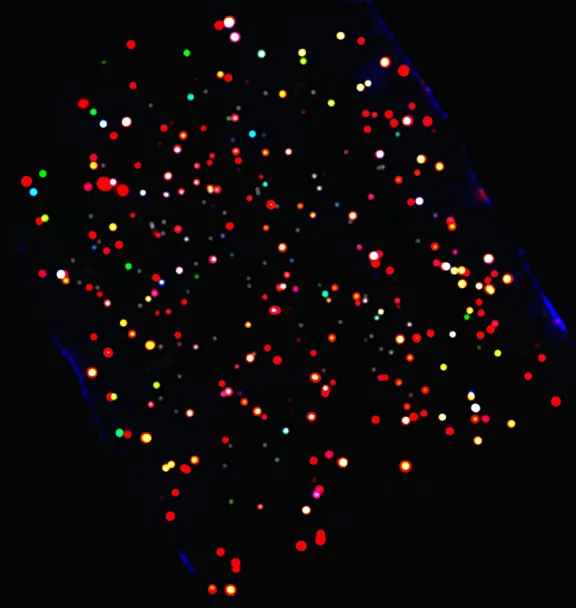
The image above is not just a set of colored dots distributed on a black background. They are galaxies, perceived this way with the Chandra X-ray Observatory, a decade ago. A month earlier, results from the WMAP probe had been presented.
The observations with Chandra focused on the region known as the Lockman Hole in Ursa Major, of not much more than half a square degree in the sky (almost the apparent area of the full Moon). What was detected is a high density of active galaxies, seven times denser than previously detected at other wavelengths. These galaxies are accumulated under the effects of the gravity of invisible dark matter, like a set of pearls strung on a filament impossible to see with the eyes, but which must be there to bind the galaxies together.
This is an image of the universe when it was forming, billions of years after the emergence of galaxies, during a period in which the cosmos began to be adult.
Currently, with the data from Planck we have a much more complete idea than before of the evolution of the universe.
Credit: Yang, Yuxuan (U. of Maryland)
2005PhDT.........1Y
The image was published on the Chandra site on March 25, 2003.
The 15 minutes of fame of V838: The 15 minutes of fame of V838
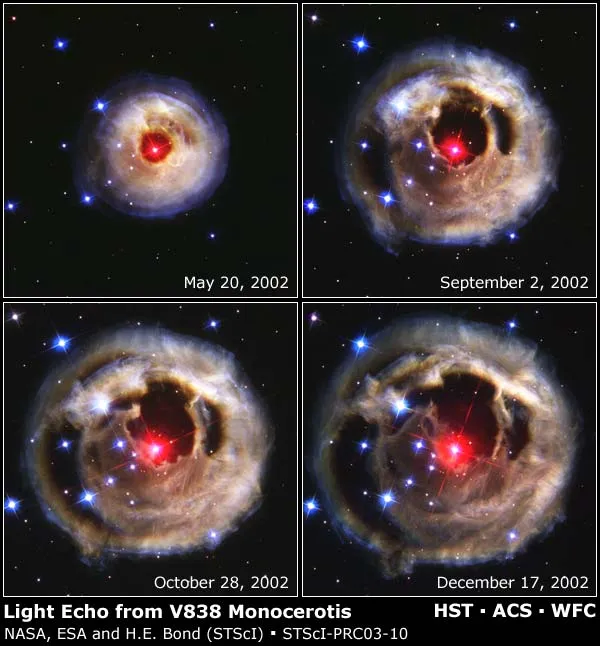
In January 2002, a star became an "astronomical celebrity" by being 600,000 times more luminous than our Sun, temporarily becoming the brightest in the galaxy.
Then it began to "fade," but in March 2003, astronomers observed the "light echoes," captured with delay because previously the star had expelled layers of dust into space. In those layers, the light from its sudden brightness arrived later, and by reflecting towards Earth it was possible to see that outburst again in the dust layers surrounding the star.
The sequence of images from May to December 2002 shows changes in the dust as different parts are illuminated sequentially. This effect is called "light echo." From the first to the last image, the apparent size of the nebulosity grows from 4 to 7 light-years. This does not imply that the dust is expanding, but that the light is reaching different regions of the dust that was already there. The red central star is located 20,000 light-years away in Monoceros (the Unicorn).
Credit: NASA, ESA and H.E. Bond (STScI)
The image was published on HubbleSite on March 26, 2003.
Images of the week
Jonckheere 900
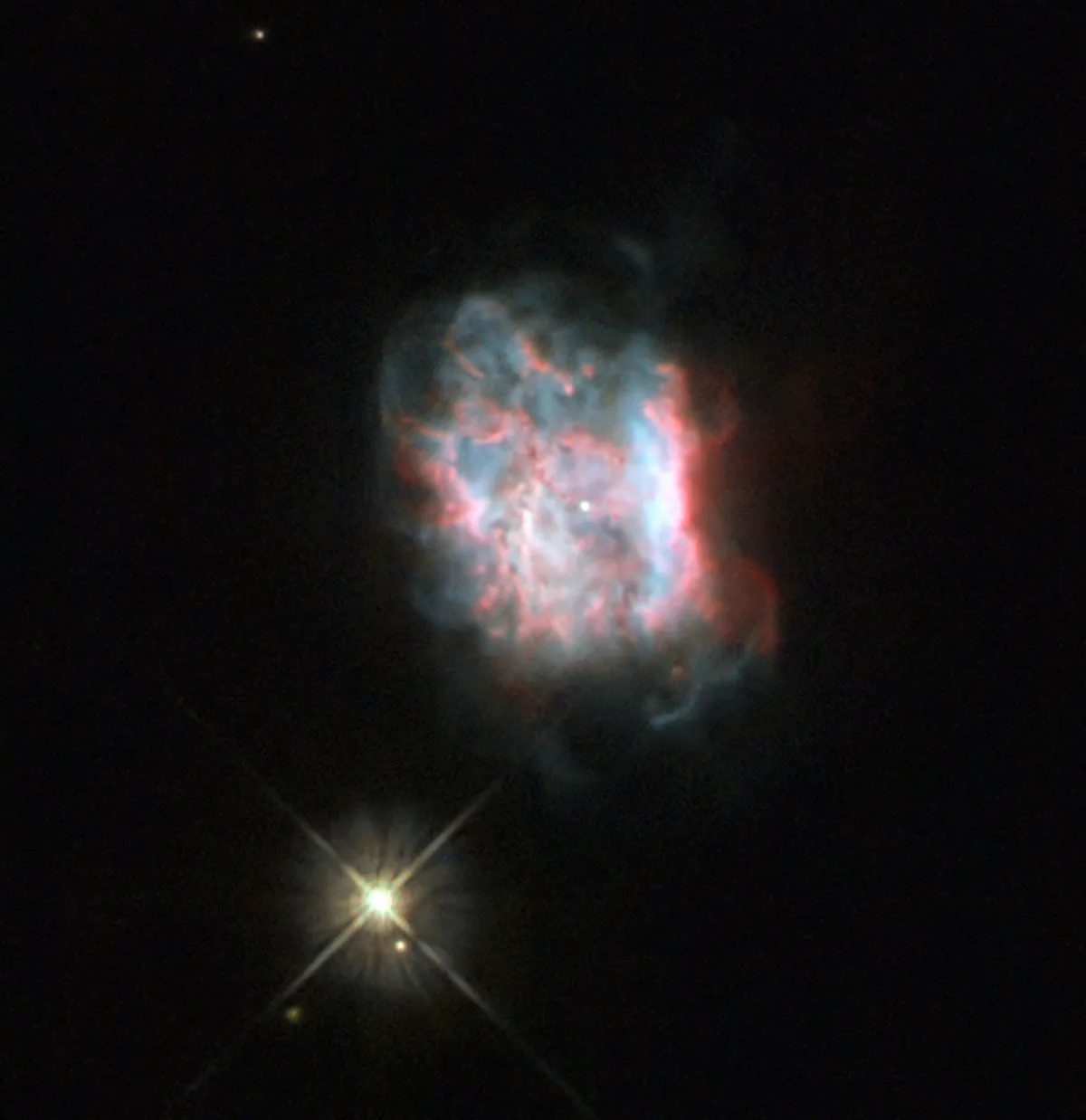
J 900 is the name given to this planetary nebula portrayed with Hubble. It was discovered at the beginning of the last century by astronomer Robert Jonckheere.
Although this photograph seems to make it clear that there are two objects there, the nebula with its central star and a nearby star, in Gemini, it often causes problems for observers who perceive both objects as a double star.
Credit: ESA/Hubble & NASA// Acknowledgement: Josh Barrington
It was the Image of the Week of SpaceTelescope.
The lost galaxy
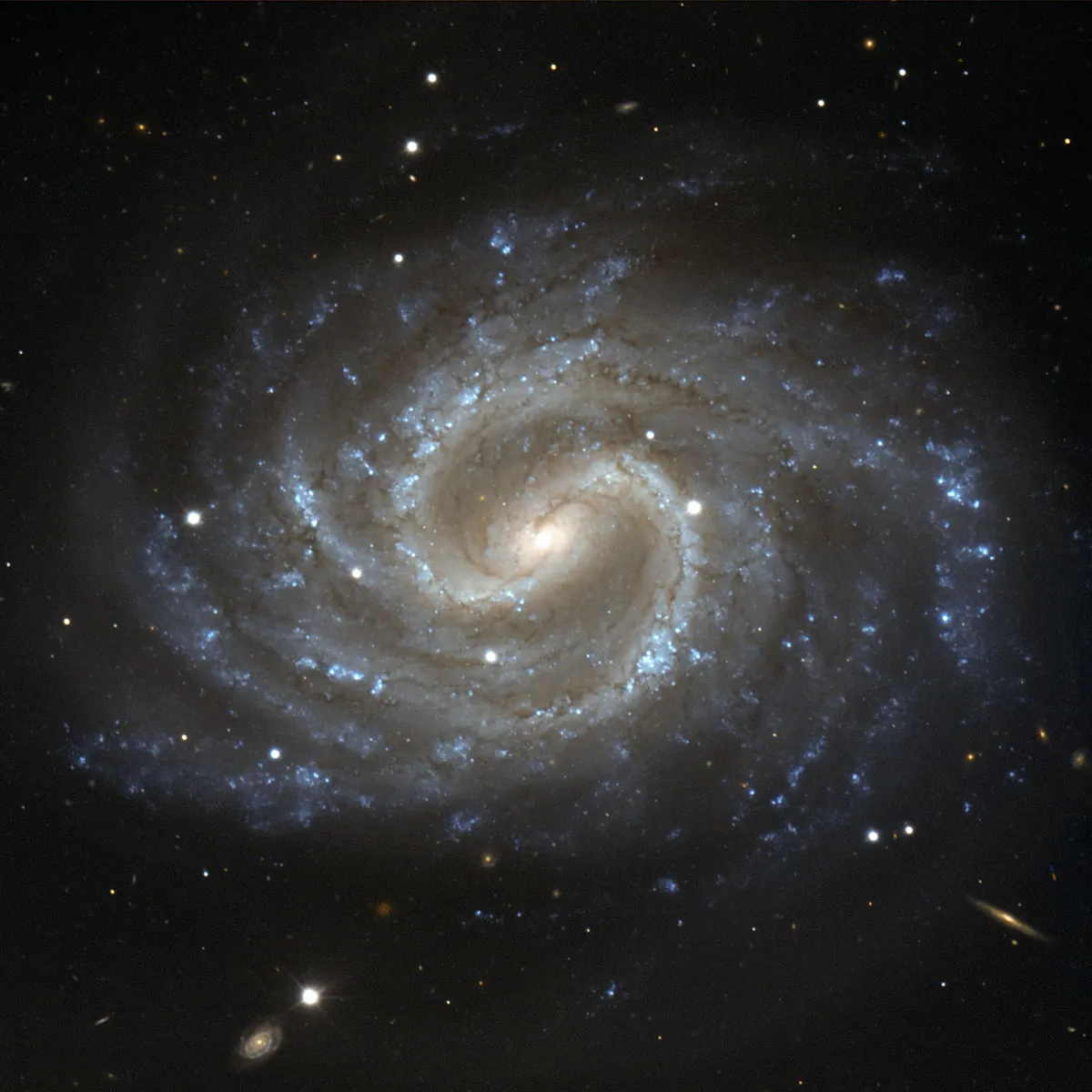
In this image we can see galaxy NGC 4535, in the constellation of Virgo (The Virgin), with a beautiful backdrop formed by numerous faint distant galaxies. Its almost circular appearance tells us that we are observing it almost face-on. In the center of the galaxy there is a well-defined bar-shaped structure, with dust lanes that curve before the spiral arms break off at the end of the bar. The bluish color of the spiral arms indicates the presence of a large number of young hot stars. In the center, however, cooler and older stars give the galaxy's bulge a yellowish appearance.
This visible-light image was captured with the FORS1 instrument, installed on ESO's 8.2-meter VLT (Very Large Telescope). The galaxy can also be seen with small amateur telescopes and was first observed by William Herschel in 1785. When observed with a smaller telescope, NGC 4535 has a ghostly and diffuse appearance, which inspired the well-known amateur astronomer, Leland S. Copeland, to call it "The Lost Galaxy" in the 1950s.
NGC 4535 is one of the largest galaxies in the Virgo Cluster, a massive cluster with at least about 2,000 galaxies, and which is located about 50 million light-years away. Although the Virgo Cluster is not much larger in diameter than the Local Group—the cluster of galaxies to which the Milky Way belongs—it contains almost fifty times more galaxies.
Credit:ESO
It was the ESO Picture of the Week.
Space Music
Deeply Dazzled
From Wales, this performer expresses what light echoes are for him on SoundCloud.
https://soundcloud.com/deeplydazzled/monocerotis-light-echo
Another musician, Malevolence Six, from Portugal, gives us his take on the intriguing V838:
https://soundcloud.com/malevolence-six/malevolence-six-v838
Animated Science
Planck maps the first lights of the origin of the Universe
Thanks to this satellite, launched in 2009 by the European Space Agency, scientists have made a new, much more precise map of the cosmic microwave background radiation that was released 380,000 years after the Big Bang. The conclusions of this experiment have surprised professionals.
To access previous editions of this section, consult the Multimedia Selection Series. The series attempts to show that the immensity of the universe can be perceived in different ways. I choose some of the images from a decade ago—so they don't fall into oblivion—and from the current week that ends, as well as sounds/music and videos that are artistic forms of expression with content related to astronomy and related sciences. I am also collecting these materials on the Pinterest account