A collection of links to music, images and videos relating art and science. Today: Images of the Egg Nebula; A cosmic pacman; NGC 602; A pendant of diamonds. Music: Kopernico. Video: Space for relaxation, from ESA.

Images of the decade
Polarized Egg
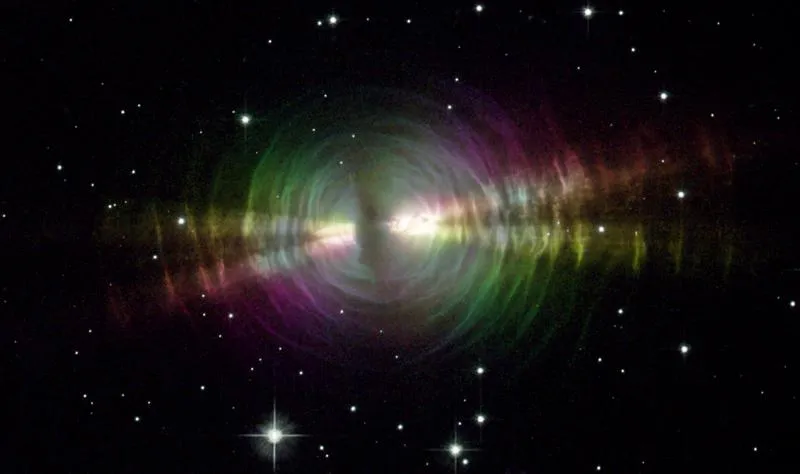
The top image, which looks like water waves illuminated with colored lights, is the Egg Nebula (RAFGL 2688). It is a planetary nebula in formation about 3000 light-years away in Cygnus. The object offers astronomers the chance to observe the dust surrounding an old star. That dust shell, which extends a tenth of a light-year from the star, has an onion-like structure forming concentric rings. A belt of denser dust, running almost vertically across the image, blocks the light from the central star. Two twin beams of radiation from the star illuminate the dust like a flashlight.
Dust in our atmosphere reflects sunlight in such a way that only light waves vibrating with a certain orientation are reflected towards us, a phenomenon known as polarization and used to design sunglasses. Hubble's Advanced Camera for Surveys has polarization filters that accept light vibrating at selected angles. In this composite, light from one of the filters has been colored red and admits light from only one third of the nebula. Another filter accepts light from a different angle, colored blue. And light from a third filter was coded green. The study of polarized light allows scientists to understand the physical properties of the material responsible for that scattering and makes it possible to know the position of the hidden central star.
Credit: NASA and The Hubble Heritage Team (STScI/AURA)//Acknowledgments: W. Sparks (STScI) and R. Sahai (JPL)
The image was published on HubbleSite on April 3, 2003.
NGC 281: A cosmic pacman
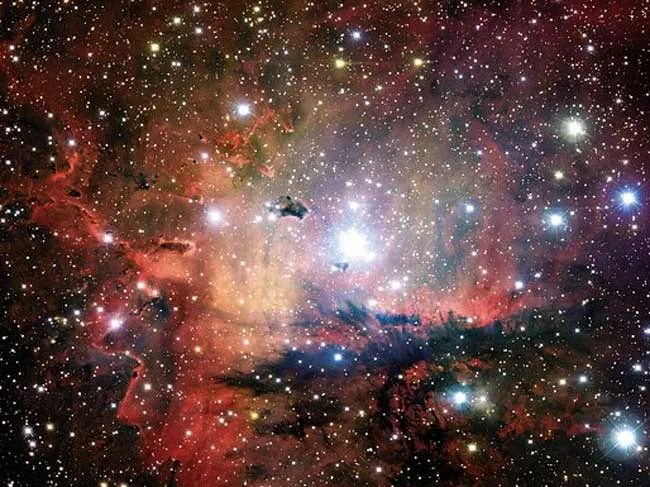
Entry 281 of the New General Catalogue is a region of the sky that functions as a star formation workshop. Among the notable objects it includes a small open cluster, a diffuse reddish emission nebula, large lanes of gas and dust, as well as knots of material in which stars could be forming. The cluster IC 1590 visible near the center is relatively young. The brightest member of the cluster is a multiple system whose radiation ionizes the surrounding gas causing the reddish glow. Bok globules are also perceived in the image against the bright nebula, which is located 10 thousand light-years away, in Cassiopeia.
Credit & Copyright: Jean-Charles Cuillandre (CFHT), Hawaiian Starlight, CFHT
It was the Astronomy Picture of the Day (APOD) on April 7, 2003.
In Spanish at Observatorio.
Images of the week
NGC 602
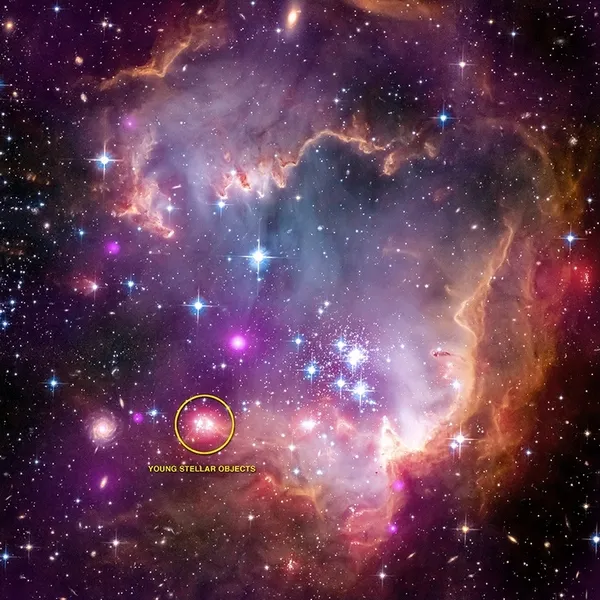
The Small Magellanic Cloud (SMC) is one of the galaxies closest to the Milky Way. Although it is a dwarf galaxy, it is so bright that it is visible to the naked eye from the Southern Hemisphere and near the equator, from places far from urban centers.
With the Chandra X-ray Observatory, the first X-ray emission from young stars with masses similar to that of our Sun outside the Milky Way was discovered. The new observations of these low-mass stars were made in a region known as the "Wing" of the SMC (marked with a circle in the image). In this composite of the Wing, Chandra data are shown in purple, Hubble data in the optical range are shown in red, green and blue. Spitzer infrared data are also shown in red.
This region is known to have fewer heavy elements compared to most areas of our galaxy. Due to its characteristics, the region is an excellent place to study the life cycle of stars.
Much of the star formation near the tip of the wing occurs in a small region known as NGC 602, which contains a collection of at least three star clusters. One of them, NGC 602a, is similar in age, mass and size to the cluster of the Orion Nebula.
A paper describing these results was published in the March 1 edition of The Astrophysical Journal. Its first author is Lidia Oskinova (University of Potsdam) and among its co-authors are a Spaniard, a Mexican and a Brazilian.
Credits: X-ray: NASA/CXC/Univ.Potsdam/L.Oskinova et al; Optical: NASA/STScI; Infrared: NASA/JPL-Caltech
Oskinova, L. et al, 2013, ApJ, 765 73; arXiv:1301.3500
The image was published on the Chandra site on April 3, 2013.
A cosmic image that hooks the gaze
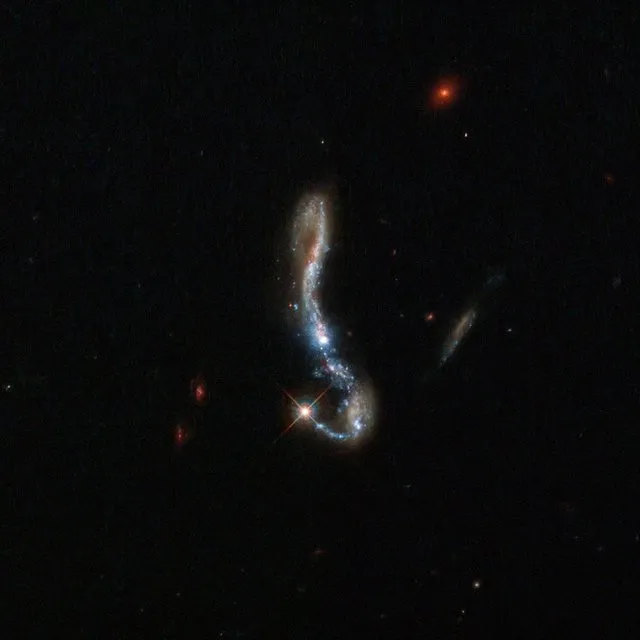
If I tell you this object is known as J082354.96, you'll tell me it's a not very "romantic" name. If I tell you its shape looks like a hook that traps our gaze, perhaps you'll like the idea more. Women, perhaps, will be attracted by the idea that the image above is of a pendant of diamonds. It is, in reality, a galaxy. A galaxy so full of life that it would be deadly for any of us.
When we speak of the "life" of stars, it is in a figurative sense, since stars do not have emotions or feelings, nor consciousness. But they do transform over time, which metaphorically can be considered as the human life cycle of birth, development and death.
In this case, the galaxy in question is of the "starburst" type, meaning it has a high rate of star formation. Astronomers study its nature and structure through Lyman-alpha emission that occurs when electrons in hydrogen fall to their energy level and emit light.
Studies of Lyman-alpha emission are common in very distant galaxies, but now a study called LARS (Lyman Alpha Reference Sample) [1] is investigating the same effect in closer galaxies, through 14 galaxies, among which is the one in the photograph above.
Credit: ESA/Hubble & NASA, M. Hayes
[1] Hayes, Östlin et al., The Lyman Alpha Reference Sample: extended Lyman alpha halos produced at low dust content, The Astrophysical Journal, 2013.
http://iopscience.iop.org/2041-8205/765/2/L27
It was the Image of the Week from SpaceTelescope.
Space Music
Kopernico: Feel the Stars
This Mexican trio, from Cancún, makes instrumental rock and released their album The End at the end of last year (available on iTunes and partially on SoundCloud).
From their Facebook page they state: "We seek to express in sound from the most melodic harmony to an aggressive, emotional gallop, by expressing it without lyrics we do it thinking that this fulfills us, that this has a purpose, and that purpose is the same that music has as a story written in the stars for millions of years, and the goal is to reach the ear of every human being, writing, dreaming, mixing emotions to inspire freedom with the best of our senses."
https://soundcloud.com/kopernico/siente-las-estrellas
Animated science
Space to relax
A journey through galaxies, passing through star-forming clouds, around giant stars and inside gas and dust nebulae with images from ESA's instruments.
http://youtu.be/9ztYoRoIvSo
Also...
NASA presented its First Google+ Hangout...in Spanish!
Celebrating National Women's History Month with the Science4Girls initiative with interviews with prominent NASA scientists, in our language. You can watch the video on YouTube: http://youtu.be/zkrQ2mXANjQ.
To access previous editions of this section, consult the Multimedia Selection Series. The series attempts to show that the immensity of the universe can be perceived in different ways. I choose some images from a decade ago -so they don't fall into oblivion- and from the current week that ends, as well as sounds/music and videos that are artistic forms of expression with content related to astronomy and related sciences. I am also collecting these materials on the Pinterest account