A collection of links to music, images and videos that relate art and science. Today: Images of SN 2002dd; TWA 5B; IC 1295. Video I: The height of mountains. Video II: Manuel Sadosky.

Images of the decade
Distant supernovae shed light, in a double sense
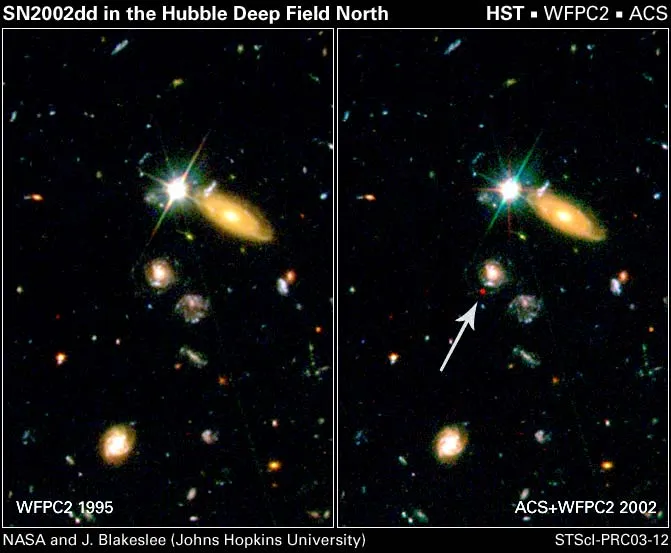
In April 2003, astronomers used the Hubble Space Telescope's Advanced Camera for Surveys and found two supernovae so long ago that they provided new clues about the accelerating universe and its mysterious "dark energy". The supernovae lie 5 and 8 billion light-years away from Earth. What scientists believe they have found is that the more distant one occurred when the universe was not yet in accelerated expansion.
"We are trying to fill in a blank region when the expansion rate of the universe changed from deceleration due to gravity to acceleration due to the repulsive force of dark energy," stated John Blakelee of Johns Hopkins University.
These two supernovae are Type Ia, consisting of binary systems composed of a white dwarf that steals material from a companion star, usually a red giant, up to a critical point beyond which it consumes its heavy elements, immolating itself in a few seconds in a bright explosion. The supernovae were found through comparative analysis of previous Hubble images of the same region of the sky with new images taken with the ACS camera.
Five years earlier astronomers had found that galaxies seem to be moving away from each other at an increasing speed and attributed that accelerated expansion to mysterious dark energy.
In the image we see on the left a region of the Hubble Deep Field North, a region of the sky photographed in 1995 with the WFPC2 Camera.
On the right we see a composite of the same field, made with ACS, combined with the original image. The ACS observations are from May and June 2002. The red dot is the glow of a very distant supernova (SN 2002dd) 8 billion light-years away.
Credit: NASA and J. Blakeslee (JHU)
The image was published on HubbleSite on April 10, 2003.
TWA 5B: Between planet and brown dwarf
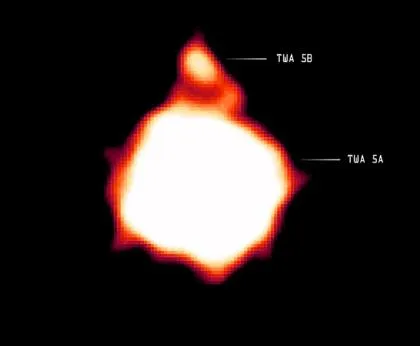
An observation made with the Chandra telescope revealed X-rays produced by TWA 5B, a brown dwarf that orbits a young binary system known as TWA 5A located 180 light-years from Earth, in Hydra.
The brown dwarf orbits its companion at an approximate distance of 2.75 times that of Pluto around the Sun.
The sizes of the sources in the image are due to an instrumental effect that causes the spreading of point sources.
Brown dwarfs are also known as "failed stars" because they are below the mass limit (about 80 Jupiter masses, about 8 solar masses) needed to ignite the nuclear fusion of hydrogen into helium that provides energy for stars like our sun. Young brown dwarfs have turbulent interiors. Combined with rapid rotation, a magnetic field is generated that heats their upper atmospheres or coronas. The X-rays from both stars in the system are from their hot coronas.
TWA 5B has between 15 and 40 times the mass of Jupiter, making it one of the least massive brown dwarfs known. If brown dwarfs have a mass range between 12 and 80 Jupiter masses, TWA 5B is much closer to the lower limit than the upper, making it more like a giant planet than a star.
To get an idea of sizes, the Chandra staff made the following illustration:
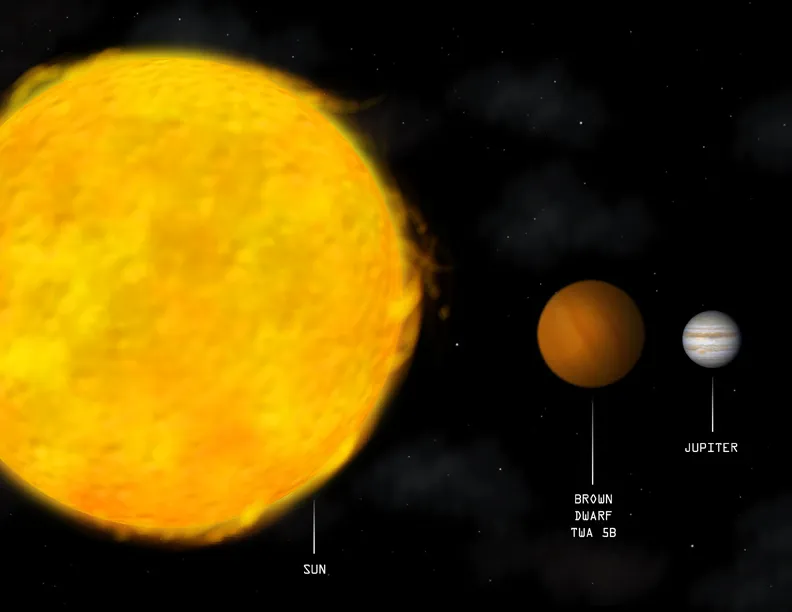
The images were published on the Chandra site on April 14, 2003.
Images of the week
A ghostly green bubble
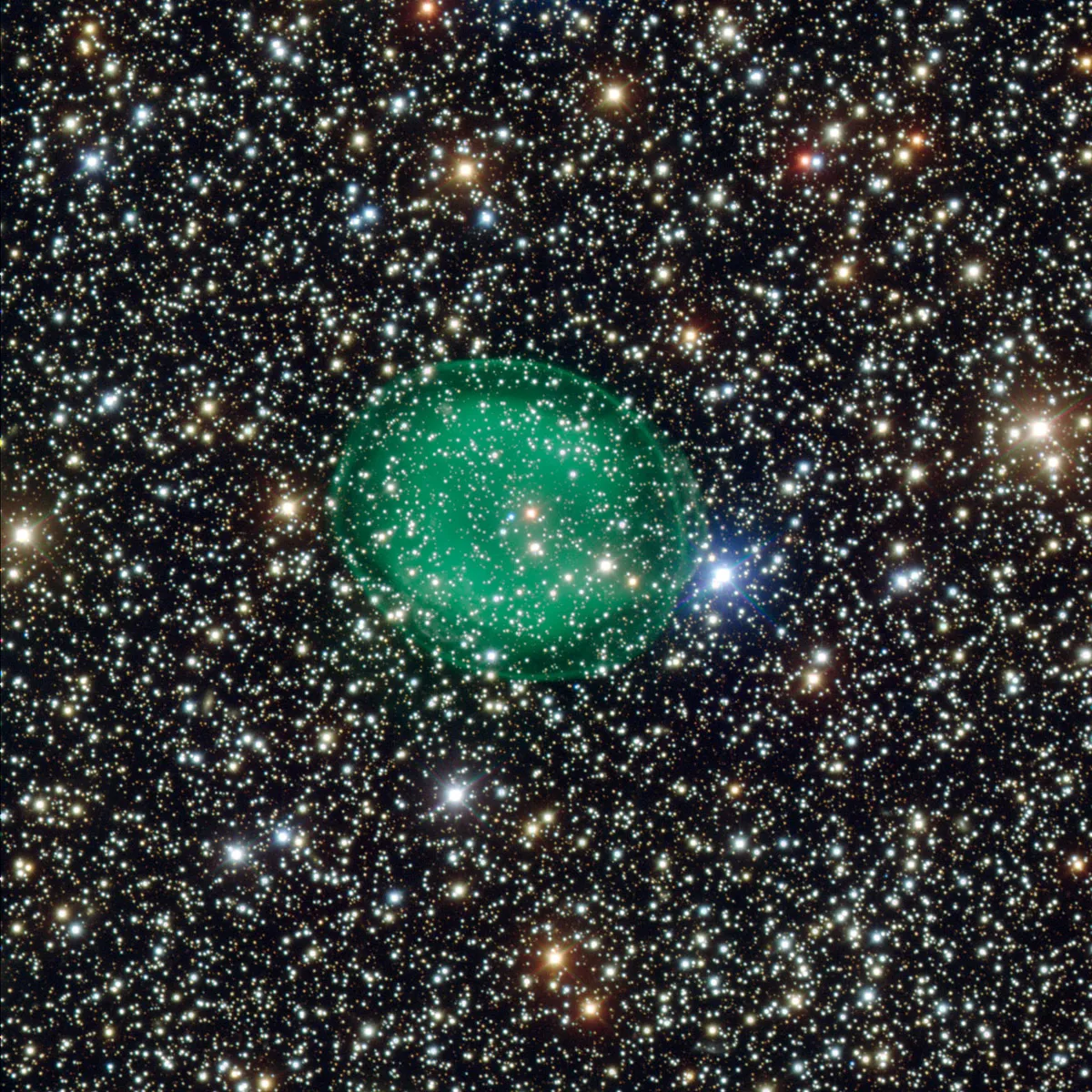
This new and fascinating image, obtained by ESO's VLT (Very Large Telescope), shows the green and bright planetary nebula IC 1295 surrounding a faint dying star, located about 3,300 light-years away, in the constellation of Scutum (The Shield). It is the most precise image ever obtained of this object.
Stars the size of the Sun end their lives as small, faint white dwarf stars. But, in the final stretch, on their way to retirement, their atmospheres are thrown into space. For a few tens of thousands of years they are seen surrounded by a spectacular and colorful glowing cloud of ionized gas known as a planetary nebula.
In this new image obtained by the VLT we see the planetary nebula IC 1295, which is located in the constellation of Scutum (The Shield). It has the strange characteristic of being surrounded by multiple layers that make it look like a microorganism seen under a microscope, with the layers being the cell membranes.
These bubbles are composed of gas that previously formed the star's atmosphere. This gas was expelled by unstable fusion reactions in the star's core that generated sudden expulsions of energy, similar to huge thermonuclear eruptions. The gas is bathed in strong ultraviolet radiation from the ancient star, which causes the gas to glow. Different chemical elements glow in different colors and the prominent greenish hue that stands out in IC 1295 comes from ionized oxygen.
In the center of the image you can see the burned remnant of the star's core as a bright bluish-white dot in the heart of the nebula. The central star will become a very faint white dwarf star and, over billions of years, will slowly cool down.
The image was published on ESO, on April 10, 2013.
Credit: ESO
Animated science I
The height of mountains
This week we are not incorporating music into this section because we considered it better to use two videos.
In the first turn, we will examine thanks to MinuteEarth, how big a mountain can be. Since we talked above about "dwarf" stars, let's take the size comparison to what happens on our planet.
Video created by Henry Reich, with Alex Reich, Peter Reich, Rose Eveleth, Emily Elert, and John Guittar. Music by Nathaniel Schroeder. Translated by Ever Salazar. Spoken in Spanish.
Animated science II
The "height" of people
In the images above we talk about white dwarfs and brown dwarfs. Stars are "condemned" by their mass and the laws of Nature, among them Gravity. In the universe, white dwarfs are a phase that most stars will go through.
With human beings it is not the same, although among people there are those who are bigger and smaller in several senses. "To have height" can refer to the number of centimeters in a person's length, as well as to their moral behavior. In other cases, in reference to intelligence or knowledge, there are also those who are bigger than others. If the "giants" are few, most of us are "dwarfs". But unlike stars we are not "condemned" to be so, although we are conditioned by culture, society. Hence education is a key element in human development. Thanks to it, there are "giants" among us.
On April 13, 1914, Manuel Sadosky was born in our country. Considered one of the fathers of computing in Argentina, he stood out for thinking of education, science and computing as instruments for social and national development.
Bernardo Alberto Houssay, born on April 10, 1887, was an Argentine physician and pharmacist. For his discoveries about the role played by pituitary hormones in regulating the amount of sugar in the blood (glucose), he was awarded the Nobel Prize in Medicine in 1947. In his honor, April 10 was established as Scientific Researcher Day in Argentina.
Here, a video about Sadosky made by CESSI.
To access previous editions of this section, consult the Multimedia Selection Series. The series attempts to show that the immensity of the universe can be perceived in different ways. I choose some images from a decade ago -so they don't fall into oblivion- and from the current week that ends, as well as sounds/music and videos that are artistic forms of expression with content related to astronomy and related sciences. I am also collecting these materials on the Pinterest account