A collection of links to music, images and videos relating art and science. Today: Images of the Crescent Nebula; M106; Horsehead Nebula; ALMA and galaxies. Music: Poiesis, by Planoprojetivo. Video: How fiction can change reality.

Images of the decade
The Crescent Nebula
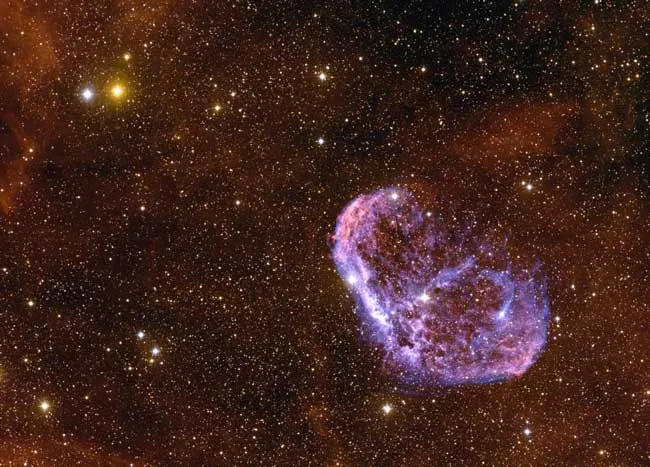
A telescope atop Kitt Peak captured the object cataloged as NGC 6888, also known as the Crescent Nebula. It looks like a cocoon emerging from space. This emission nebula began to form 250 thousand years ago. The massive central star became a Wolf-Rayet star (WR 136). This is the name given to certain massive and evolved stars that lose mass due to intense stellar winds. They were discovered by Charles Wolf and Georges Rayet. According to astronomers, star WR 136 would have shed its outermost layer in a strong stellar wind, ejecting the equivalent of the mass of our sun every 10,000 years. The wind impacted the gaseous environment left previously by an earlier phase of the star, thus generating a series of complex and compact cocoons and illuminating them. Within a few million years, WR 136 will experience a supernova explosion. Luckily, it is not near home, but about 4700 light-years away, in Cygnus.
Credit & Copyright: T. A. Rector (NRAO), NOAO, AURA, NSF
It was the Astronomy Picture of the Day (APOD) for April 15, 2003. In Spanish at Observatorio.
M106
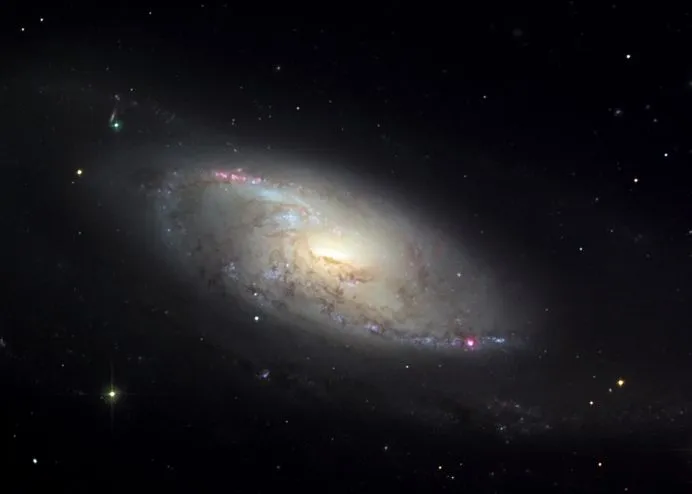
Close to Ursa Major and surrounded by stars of the Hunting Dogs, this nebula is entry 106 in the Messier catalog. It was not until the third decade of the 20th century that it was certain whether objects like M106 (NGC 4258), generically called nebulae, were island universes or not. Today we know that it is indeed a galaxy located 21 million light-years from ours. In this superb photograph, the young and reddish clusters of newly forged stars can be seen, as well as the bright active nucleus, which is why it is classified as a Seyfert galaxy.
Credits: Bernie and Jay Slotnick, Adam Block, AOP, NOAO, AURA, NSF.
It was NASA's Astronomy Picture of the Day (APOD) for April 17, 2003.
In Spanish, at Observatorio.
Images of the week
Hubble celebrates its 23 neighs
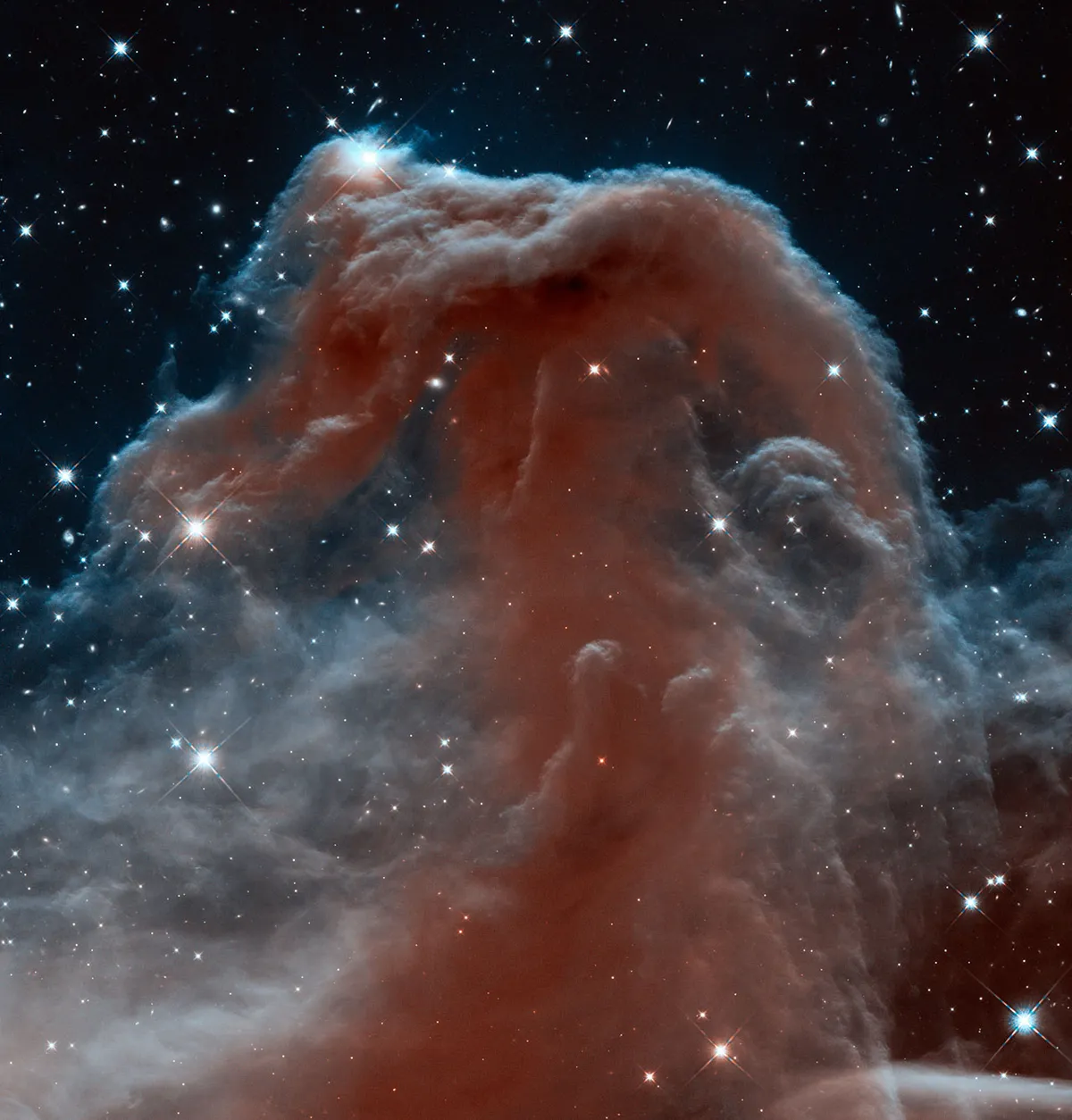
To celebrate its 23rd year in orbit, scientists from the NASA and ESA Hubble Space Telescope published a new image of object Barnard 33, the popular Horsehead Nebula, which is part of the Orion Nebula, about 1500 light-years away.
Hubble was launched aboard Discovery on April 24, 1990. Its replacement, the James Webb Telescope, is scheduled to be launched in 2018.
Image credit: NASA, ESA, and the Hubble Heritage Team (STScI/AURA)
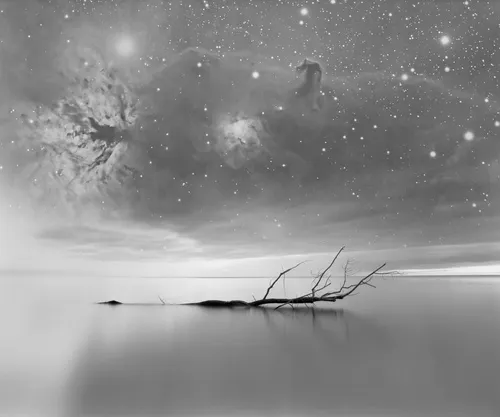
In addition to the formidable Hubble image, on Tumblr, an artistic image combining a landscape photographed by Mark Hoeksema with an astronomical photograph by Terry Hancock of the nebula in question and the Flame Nebula was republished. The image was published on Flickr.
The Hubble team on Tumblr wrote:
Imagine, if you will, standing with your feet in the sand on the shore of a lake on a world somewhere in Orion. A cool breeze runs through your fingers and hair. The Horsehead and Flame Nebulae loom in the night sky. Can you imagine it?
ALMA locates early galaxies in record time
A team of astronomers has used the new ALMA array (Atacama Large Millimeter/submillimeter Array) to locate the position of 100 of the most star-forming galaxies in the early universe. ALMA is so powerful that, in just a few hours, it has been able to observe these galaxies as many times as all telescopes of its kind in the entire world have done over a period of more than a decade.
This image shows close-ups of a selection of those galaxies. ALMA's observations, in submillimeter ranges, are shown in orange/red and reveal an infrared image of the region seen by the IRAC camera, installed on the Spitzer space telescope.
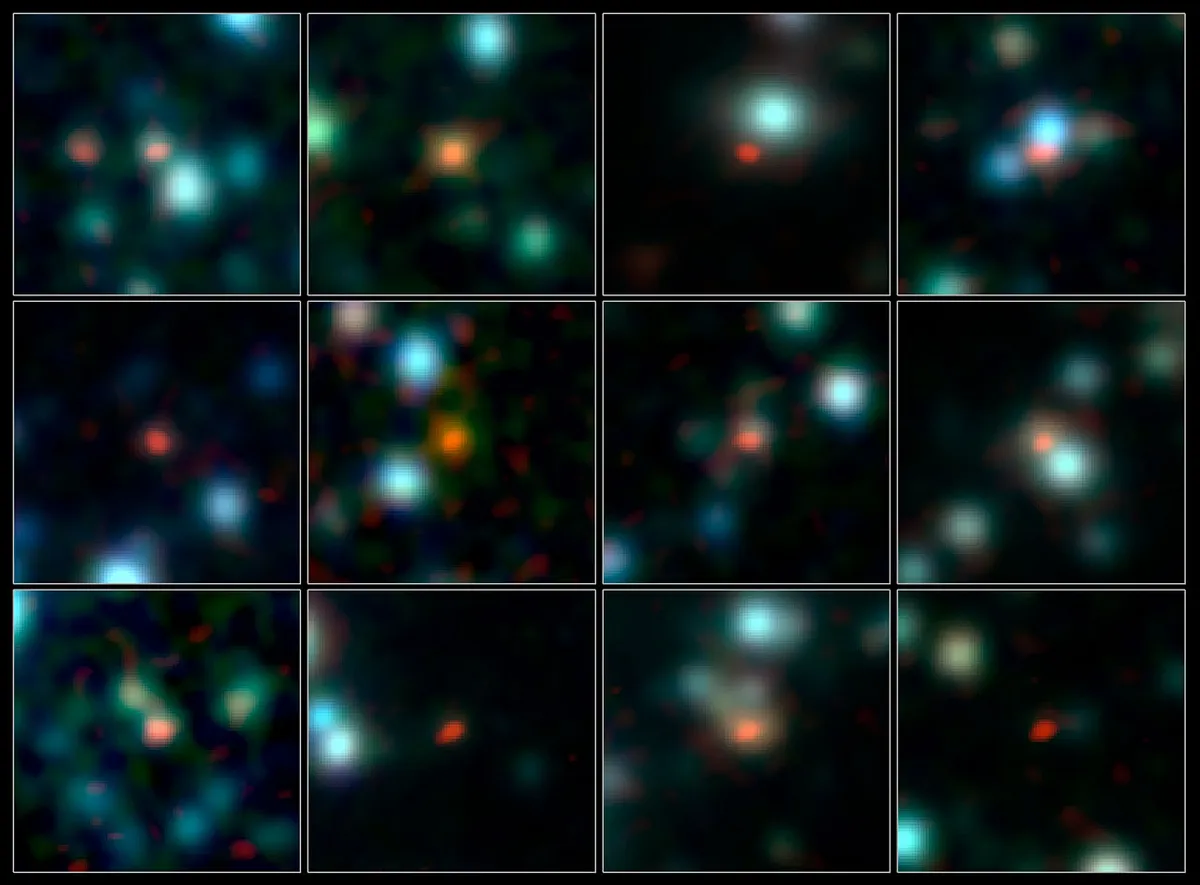
The best map made so far of those dusty distant galaxies was carried out using the APEX telescope (Atacama Pathfinder Experiment), but the observations were not precise enough to unambiguously identify these galaxies in images taken at other wavelengths. ALMA needed just two minutes per galaxy to locate each one in a tiny region 200 times smaller than the broad APEX blotch, and with three times greater sensitivity.
More information at ESO.
Credit: ALMA (ESO/NAOJ/NRAO), J. Hodge et al., A. Weiss et al., NASA Spitzer Science Center
Space Music
Poiesis, by planoprojetivo
The talented Brazilian musician Orlando Moreira, known artistically as planoprojetivo (Plan projective), recently published on SoundCloud the content of the 2011 set/album titled Multiverso. The third track is the one I share here with the public, but I invite you to listen to his complete production.
Poiesis is a term used by the German philosopher Martin Heidegger, as well as by Cornelius Castoriadis (who gives his name to a journal). The term comes from Greek and translates as "creation" or "production" and was used by Plato in The Symposium.
According to Wikipedia, for Heidegger, poiesis as "the blooming of the flower, the coming out of a butterfly from its cocoon, the falling of a waterfall when the snow begins to melt."
In the first photo today we talked about a cocoon. And in the second I referred to island universes and the change in worldview that discovering that those spiral nebulae were indeed other galaxies implied.
It is in these cases that science, like literature and other art forms, puts us, fascination included, in front of new ideas that change our point of view.
https://soundcloud.com/planoprojetivo/03-poiesis
Animated Science
How fiction can change reality - Jessica Wise (Subtitles in Spanish)
In this audiovisual production by TEDeducation we are invited to think about how artistic production, or to put it more broadly, cultural creation, influences us and makes us change our ideas.
Have you ever stopped to think why we humans think the way we do? At one point we thought there was no other galaxy except the Milky Way, which we inhabit. Then, we changed our minds. Why? Not only because there were people who used telescopes, but because among those people there was creativity and communication. We live in a world where information reaches us every instant. But only some of those messages are deep, creative and innovative enough to present us with new ideas, which change our way of appreciating the world.
We people create, produce texts, tell stories that influence and generate change. So, paraphrasing the video's text, the final question is this:
What story will you read or write now?
To access previous editions of this section, consult the Multimedia Selection Series. The series attempts to show that the immensity of the universe can be perceived in different ways. I choose some images from a decade ago -so they don't fall into oblivion- and from the current week that is ending, as well as sounds/music and videos that are artistic forms of expression with content related to astronomy and related sciences. I am also collecting these materials on the Pinterest account