A collection of links to music, images and videos relating art and science. Today: Images of Jet in Centaurus A; M17; V* PV Cephei; C/2012 S1 (ISON).
Music: Gravitational Effect - M17. Video: Dr. Michio Kaku.

Images of the decade
There are jets even in Centaurus A
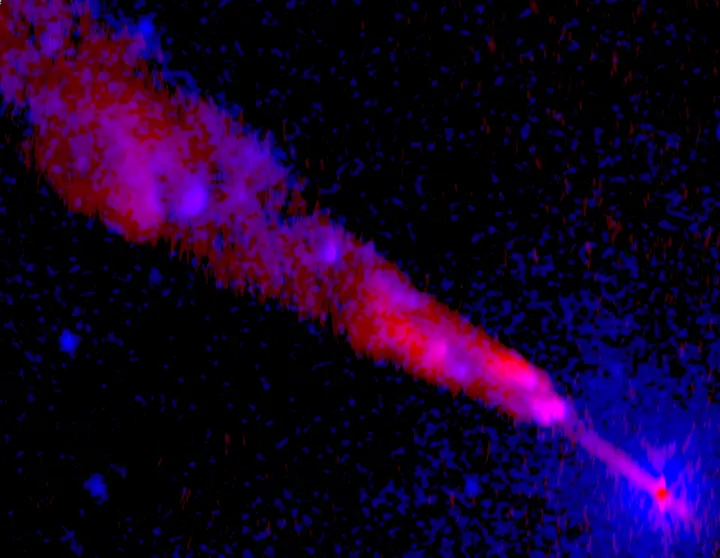
This is a composite image made with the Chandra Observatory in X-rays (blue) and radio data from the VLA (in red) showing the inner 4,000 light-years of a magnetized matter jet in Centaurus A. The purple regions are bright in radio and X-rays. This jet originates in the vicinity of a supermassive black hole at the center of the galaxy (lower right corner of the image).
The radio observations, made between 1991 and 2002, showed that the inner portion of the jet moves away from the galaxy's center at speeds close to half the speed of light. The collision of the particle jet with galactic gas generates a powerful shock wave that produces the high-energy particles responsible for the X-rays.
Since the Centaurus A jet is relatively close, at a distance of 11 million light-years, the image offers one of the most detailed views of a matter jet with gas in its galaxy.
Certainly, this (matter) jet steals our gaze.
The image was published on the Chandra site on April 23, 2003.
Credits: X-ray: NASA/CXC/Bristol U./M. Hardcastle et al.; Radio: NRAO/AUI/NSF/Bristol U./M. Hardcastle
The perfect storm
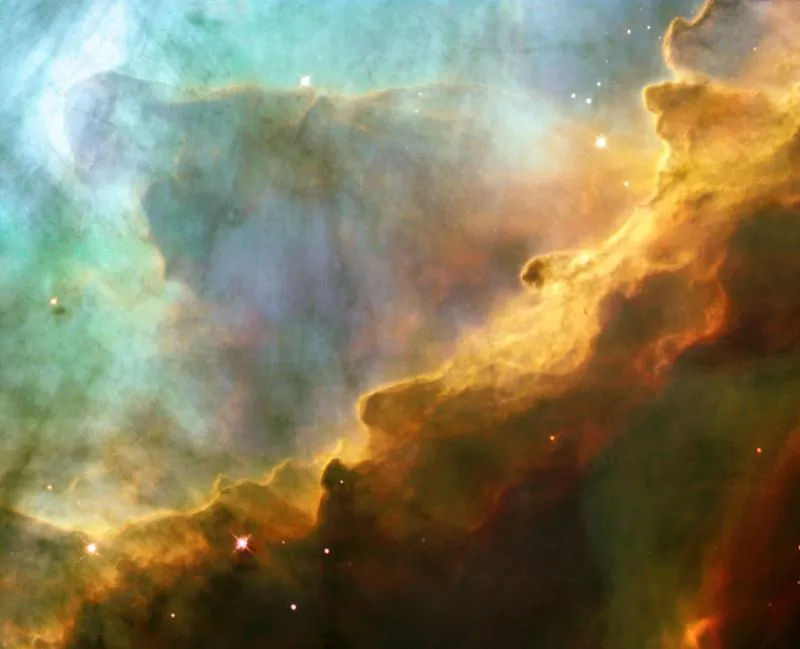
Although the image seems to show the fury of an enraged sea, it is actually an "ocean" of hydrogen gas and small amounts of other elements, such as oxygen and sulfur. The photograph, taken by Hubble, captures a small portion of M17, a stellar formation cradle. The Messier 17 object is also known as the Omega Nebula or Swan Nebula and is located 5000 light-years away in Sagittarius.
Credit: NASA, ESA and J. Hester (ASU)
The image was published on April 24, 2003, commemorating the 13 years since Hubble's launch.
Images of the week
The variable cosmos
The universe is rarely static, although the time scales involved can be very long. Since modern astronomical observations began we have been observing the births of new stars and planets, searching for and studying the subtle changes that help us understand what is happening in them.
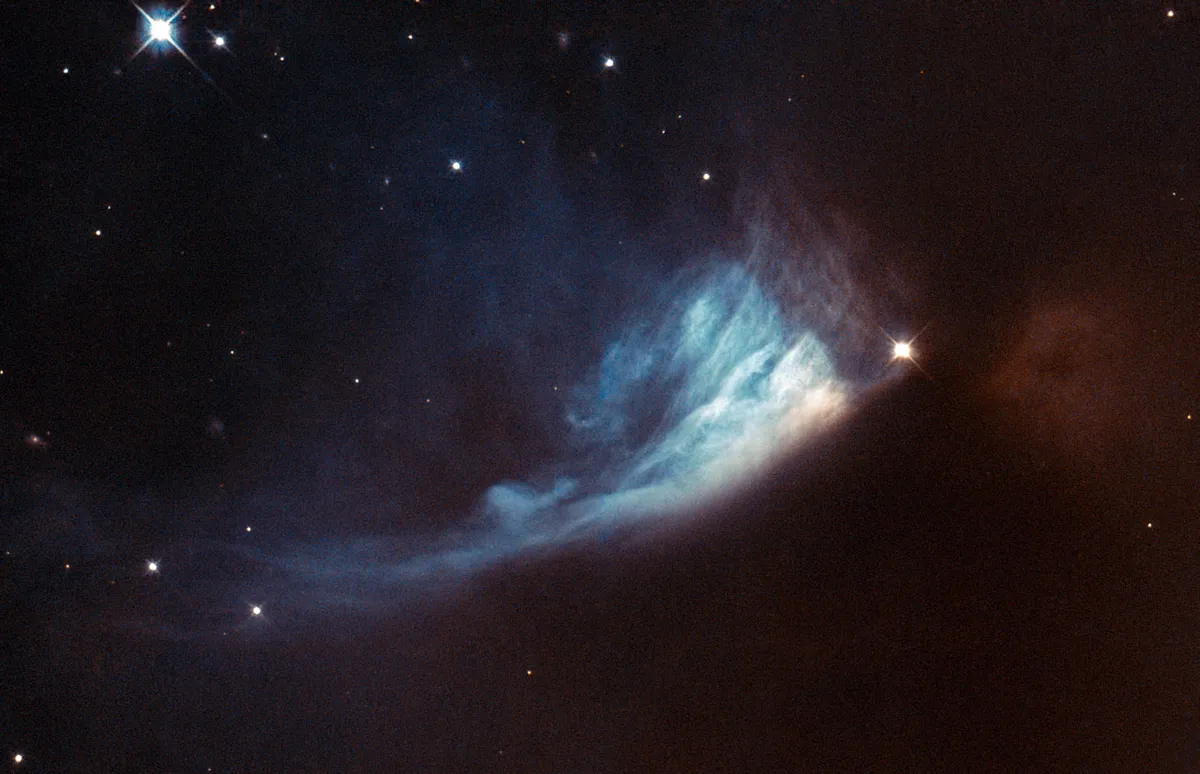
The bright point at the edge of this fan-shaped blue structure, in this Hubble image, is a young star called V* PV Cephei, or PV Cep. It is a target for amateur astronomers because this nebulosity, known as GM 1-29 (Gyulbudaghian's Nebula) changes on a time scale of months. The brightness of the star also varies over time.
Images of PV Cep taken in 1952 showed a nebulous streak or stripe, similar to a comet's tail. However, they faded when new images were taken 25 years later. Instead, this blue fan shape appeared. But twenty-five years is a very short period on the cosmic scale, so astronomers think what was recorded before was a temporary phenomenon, like the remnant of a stellar flare, like those our Sun has.
At the same time, the star itself was getting brighter and that light is what illuminates the nebulosity. That increase in brightness could be related to the beginning of a new phase in the star and its entry into stellar maturity.
PV Cep is located in Cepheus at 1600 light-years away.
Credit: ESA/Hubble & NASA.//Acknowledgement: Alexey Romashin
It was the Image of the week from SpaceTelescope.
The comet of the century
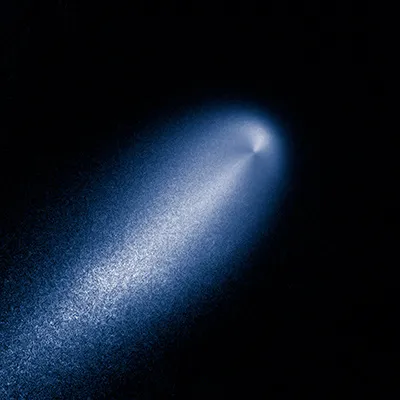
Comet ISON is potentially "the comet of the century" because near the time it makes its closest approach to the Sun, on November 28, it could briefly be brighter than the full Moon. Currently the comet is not visible to the naked eye, but it was possible for astronomers using Hubble to photograph this fossil of the solar system on its headlong journey towards our star. When this photo was taken, on April 10, the comet was slightly closer than Jupiter's orbit at a distance of 620 million kilometers from the Sun. At that great distance, the Sun heats the comet enough to cause the outgassing of frozen gases from the solid nucleus. Preliminary measurements suggest the comet's nucleus is about 6 kilometers in diameter. The comet was discovered in September 2012 by the Russian network called International Scientific Optical Network (ISON), using a 16-inch telescope.
The image we see above is contrast-enhanced to reveal the subtle structure of the coma of C/2012 S1 (ISON).
Credits: NASA, ESA, J.-Y. Li (Planetary Science Institute), and the Hubble Comet ISON Imaging Science Team
The image was published on HubbleSite on April 23, 2013.
Space Music
Gravitational Effect: M17
We talked earlier about the Omega Nebula and I found this track on SoundCloud created by Gravitational Effect, from Belgium.
https://soundcloud.com/gravitationaleffect/m17-the-omega-nebula
Animated Science
Why Kids Don't Want to Be Scientists
What follows is an excerpt from an interview given by Dr. Michio Kaku to Todd Sierer as part of the Embedded Systems Conference (April 2010). The original interview (in English) divided into two parts can be seen on EETimes and on Youtube.
http://youtu.be/fjkVoW4Y3x0
To access previous editions of this section, consult the Multimedia Selection Series. The series attempts to show that the immensity of the universe can be perceived in different ways. I choose some images from a decade ago -so they don't fall into oblivion- and from the current week that ends, as well as sounds/music and videos that are artistic forms of expression with content related to astronomy and related sciences. I am also collecting these materials in the Pinterest account