A collection of links to music, images and videos that relate art and science. Today: Images of Two "neighboring" nebulae; The seasons on Neptune; 4C+29.30; The hidden loop of Orion. Music: Seasonable Project - Shadows of the Moon. Video: Silhouettes of the Moon, by Mark Gee.

Images of the decade
A tale of two nebulae
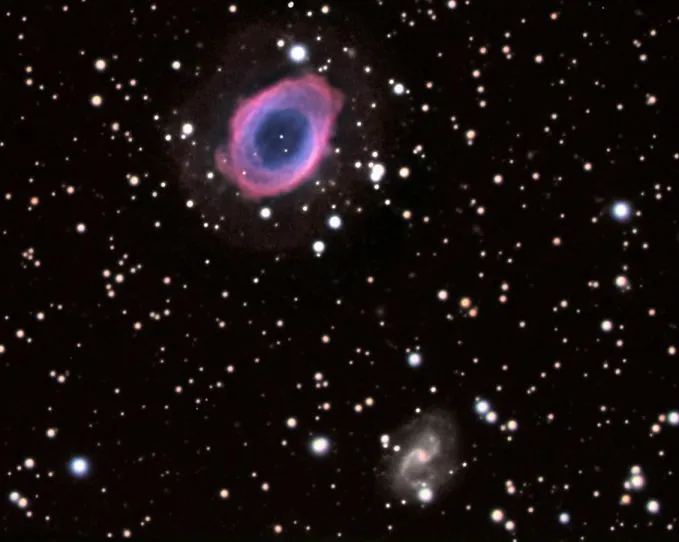
In this colorful image we see the outer regions of M57 in Lyra, popularly known as the Ring Nebula, a planetary nebula. With almost the same apparent size, the fainter barred spiral galaxy IC1296, at the bottom right, was known as a spiral nebula. Although they are in the same image, and have a similar size, the eye deceives: M57 lies 2,000 light-years away, within our galaxy, while IC1296 is another galaxy 200 million light-years away, that is 100 thousand times farther, so in reality, the barred spiral must be 100 thousand times larger than M57. Sometimes, the large seems small and vice versa. Optical phenomena. And cultural ones.
It was the Astronomy Picture of the Day (APOD) on May 16, 2003. In Spanish at Observatorio.
Credit: Brian Lula
Seasonal changes on Neptune
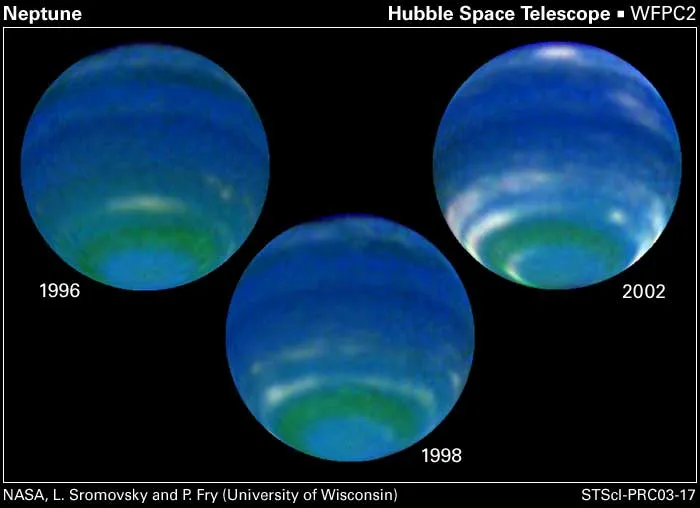
Spring was blooming on Neptune, according to these images. This might sound like an oxymoron because Neptune is the farthest and coldest of the planets in the Solar System. But observations made with Hubble revealed an increase in the planet's brightness in the southern hemisphere. Astronomers considered that such an increase was a sign of a seasonal change.
The observations were made in 1996, 1998 and 2002.
As on Earth, on the cold blue planet there are also four seasons and for the same reasons: the tilt of the axis. With the difference that each season can last more than 40 years, given that the planet's orbit around the Sun is almost 165 years. A clue that these brightness increases could indicate seasonal changes is the apparent absence of changes at low latitudes, near the planet's equator. As on Earth, seasonal changes are felt more strongly at high latitudes, near the poles.
Credit: NASA, L. Sromovsky, and P. Fry (University of Wisconsin-Madison)
The image was published on HubbleSite on May 15, 2003.
Images of the week
4C+29.30
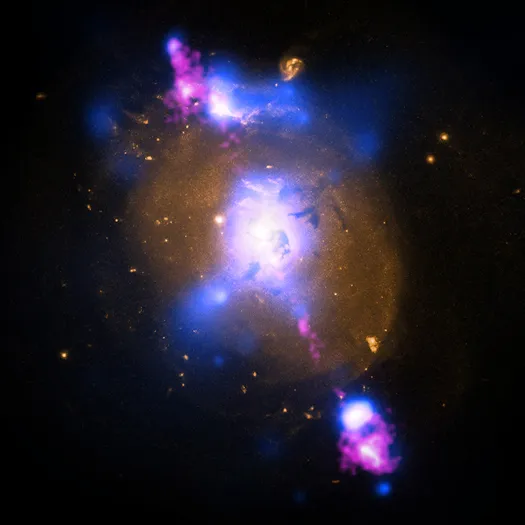
This composite image of a galaxy illustrates how the intense gravity of a supermassive black hole can be harnessed to generate immense energy. The image contains X-ray data from Chandra (blue), optical light data from Hubble (gold) and radio wave data from the VLA (in pink).
This multi-wavelength view shows the object cataloged as 4C+29.30, a galaxy located 850 million light-years from Earth. The radio emission comes from two jets of very fast particles that emerge from the black hole in the center of the galaxy. The estimated mass of the black hole is about 100 million times the mass of our Sun.
The X-ray data show another aspect, tracking the location of hot gas. The bright X-rays in the center of the image mark a region of extremely hot gas around the black hole.
These images were taken for scientific purposes. The published images, however, are "conditioned" for viewing by the general public. The research was published in two papers by teams led by Aneta Siemiginowska (CfA) et al. and Malgorzata Sobolewska et al.
Credit: X-ray: NASA/CXC/SAO/A.Siemiginowska et al; Optical: NASA/STScI; Radio: NSF/NRAO/VLA
The image was published on the Chandra site on May 15, 2013.
The hidden loop of Orion
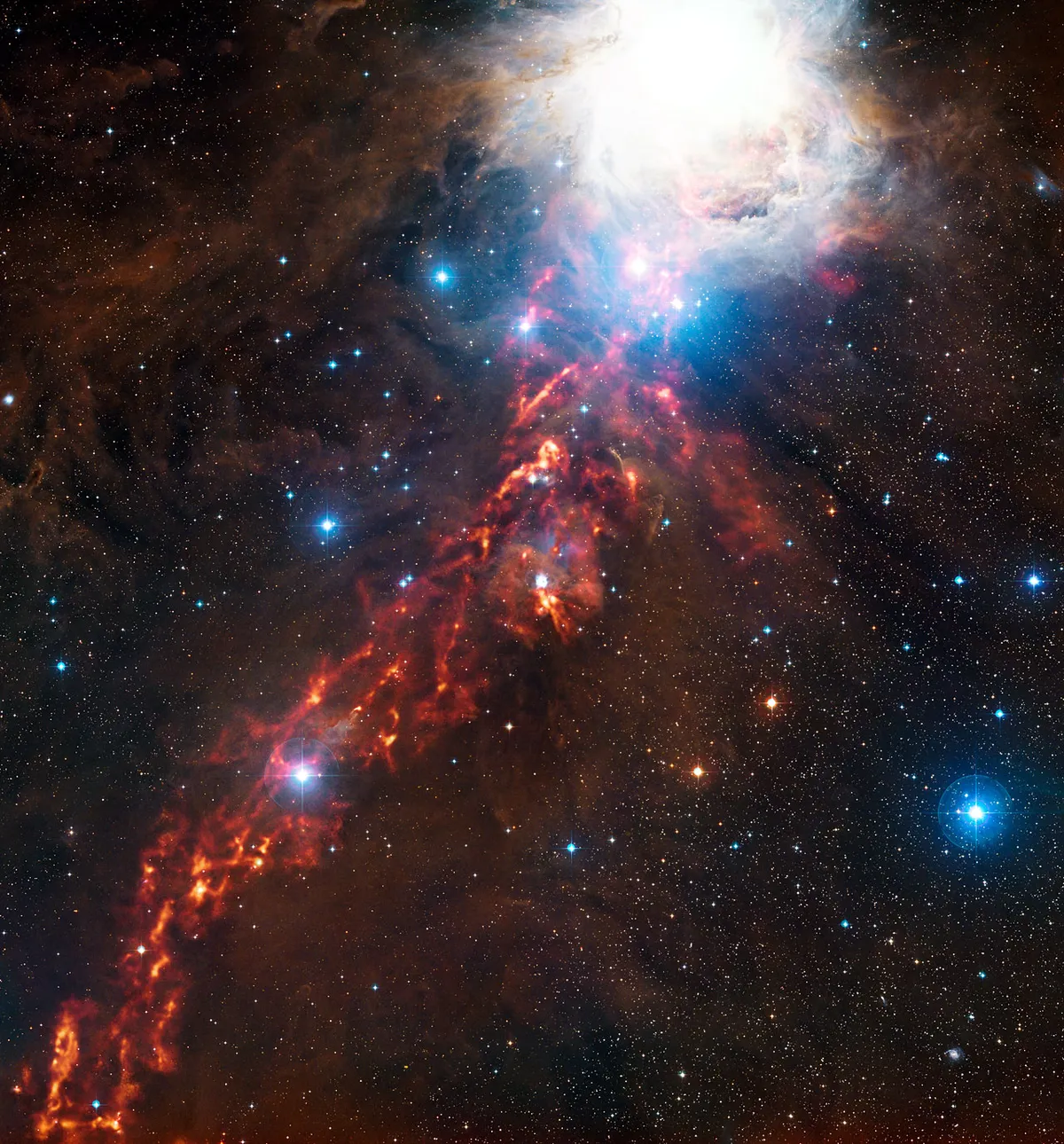
This new and striking image of cosmic clouds in the constellation of Orion reveals what appears to be a fiery loop in the sky. This orange glow represents the faint light coming from grains of cold interstellar dust, at wavelengths too long to be seen by the human eye. It was observed by the APEX experiment (Atacama Pathfinder Experiment), operated by ESO in Chile.
Clouds of interstellar gas and dust are the raw material from which stars are made. But those tiny dust grains block our view of what lies inside and behind the clouds — at least at visible wavelengths — making it difficult to observe the star formation process.
This is why astronomers need to use instruments capable of seeing at other wavelengths of light. At submillimeter wavelengths, instead of blocking light, the dust grains glow due to their temperatures of a few tens of degrees above absolute zero. The APEX telescope, with the LABOCA camera, which works in the submillimeter range, located at an altitude of 5,000 meters above sea level, on the Chajnantor Plateau in the Chilean Andes, is the ideal tool for this type of observation.
This new and spectacular image shows only a part of a larger complex called the Orion Molecular Cloud, in the constellation of Orion (The Hunter). This region, a rich mix of bright nebula, hot young stars and cold dust clouds, is hundreds of light-years in size and is located about 1,350 light-years from us. In this image, the submillimeter-range glow, coming from the cold dust clouds, is seen in orange colors, and is overlaid on an image of the region taken in visible light.
More info at ESO.
Credit: ESO/Digitized Sky Survey 2.
Space Music
Seasonable Project: Shadow of the Moon
Vladimir Shtykov, alias Seasonable Project from Saint Petersburg created this piece titled "Shadow of the Moon" and uploaded it to SoundCloud.
https://soundcloud.com/seasonable-project/shadow-of-the-moon
Animated Science
Full Moon silhouettes
The following video was referred to me by a blog reader, Reinaldo, to whom I thank for his recommendation. The reader asked me if this video was real.
Full Moon Silhouettes from Mark Gee on Vimeo.
The following video was made by Mark Gee, an independent professional photographer based in New Zealand. He has an extensive career and has collaborated on major productions, including Avatar and The Hobbit.
On his blog, Mark says that this video is "real", that is, a real-time capture of the moon rising over Mount Victoria Lookout in Wellington on the night of January 28 of this year.
With his camera, after waiting for the appropriate conditions, he achieved 8 minutes of footage and the final edit shows the first 3 minutes.
Technically, the video images were achieved from a distance of 2.1 km away with a Canon 1D MkIV in video mode, with a Canon EF 500mm f/4 lens and a Canon EF 2x II Extender, to obtain an equivalent of 1300mm focal length. On his blog, the photographer explains how it is possible that this video is "real".
First, let's answer the following question: If we look at the Moon with a small telescope, we will see the Moon in great detail. If we take a photo, will that photo be real? Yes, it will be, but at the same time we will say that the image we will see will not be possible to see with the naked eye, but only with the help of magnification.
Something similar happens here. The video was made with a DSLR camera with a telephoto lens, that is, a lens whose focal length is significantly greater than that of a normal lens, and therefore has a narrower angle of view. DSLR cameras are digital SLRs, meaning cameras to which the lens can be changed. By adding a lens of this type, magnification is obtained, so it's like looking through a telescope. The people in front of the Moon, standing on a bridge, look small because the photographer was 2 km away from them. He couldn't see them with his naked eyes, but they were captured by the camera. If the shot had been taken at half the distance, at 1 km, the people would have appeared twice as large and although the Moon would look the same size, it would appear smaller in relation to the people.
On his blog, Mark has uploaded a photo of how the shot looked in his camera, with an image taken with another camera.
In short: We will never see the Moon "that" large as it appears in the video using only our eyes. But with the help of technology, our perception of reality can change. And certainly, this video is an example of what many people call art. And, at the same time, it is also a sign of what we call science.
To access previous editions of this section, consult the Multimedia Selection Series. The series attempts to show that the immensity of the universe can be perceived in different ways. I choose some images from a decade ago -so they don't fall into oblivion- and from the current week that ends, as well as sounds/music and videos that are artistic forms of expression with content related to astronomy and related sciences. I am also compiling these materials on the Pinterest account