A collection of links to music, images and videos that relate art and science. Today: Images of illuminated crystals; 1998 QE2. Music by Andy Phillip Hatchett. Video: Mae Jemison between art and science.

Images of the decade
To be frozen: Frizion Illume
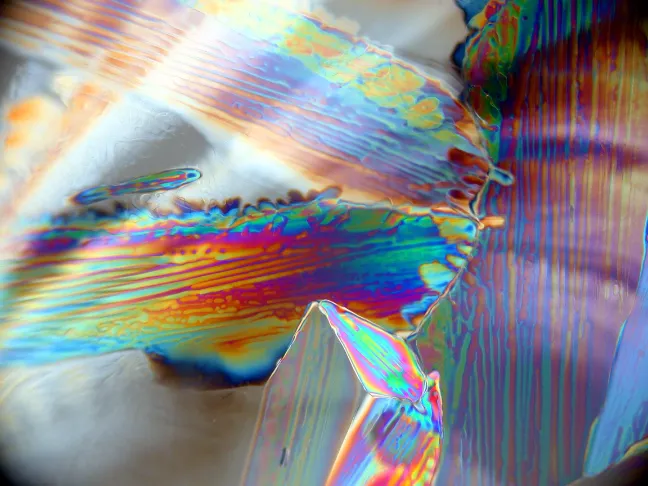
Scientific images of cosmic dust clouds or even frozen water can also be aesthetic. In fact, this image of thin layers of ice crystals uses scientific knowledge of the properties of light waves for purely artistic purposes. Titled "Illumine", the image was created by astrophysicist Peter Wasilewski. To create the image, the crystals were illuminated by light through a polarized filter, that is, a filter that restricts light that would otherwise be randomly oriented, so that it vibrates in only one direction. As it passes through the ice, the different colors of polarized light are refracted and reflected onto different paths by the delicate crystalline layers.
Painting with "light, the laws of physics and an attitude", Wasilewski created several series of these evocative ice images which can be viewed on his website Frizion.
Credit & Copyright: Peter Wasilewski (Goddard Space Flight Center)
It was the Astronomy Picture of the Day (APOD) for May 29, 2003. In Spanish at Observatorio.
Images of the week
The accompanied asteroid
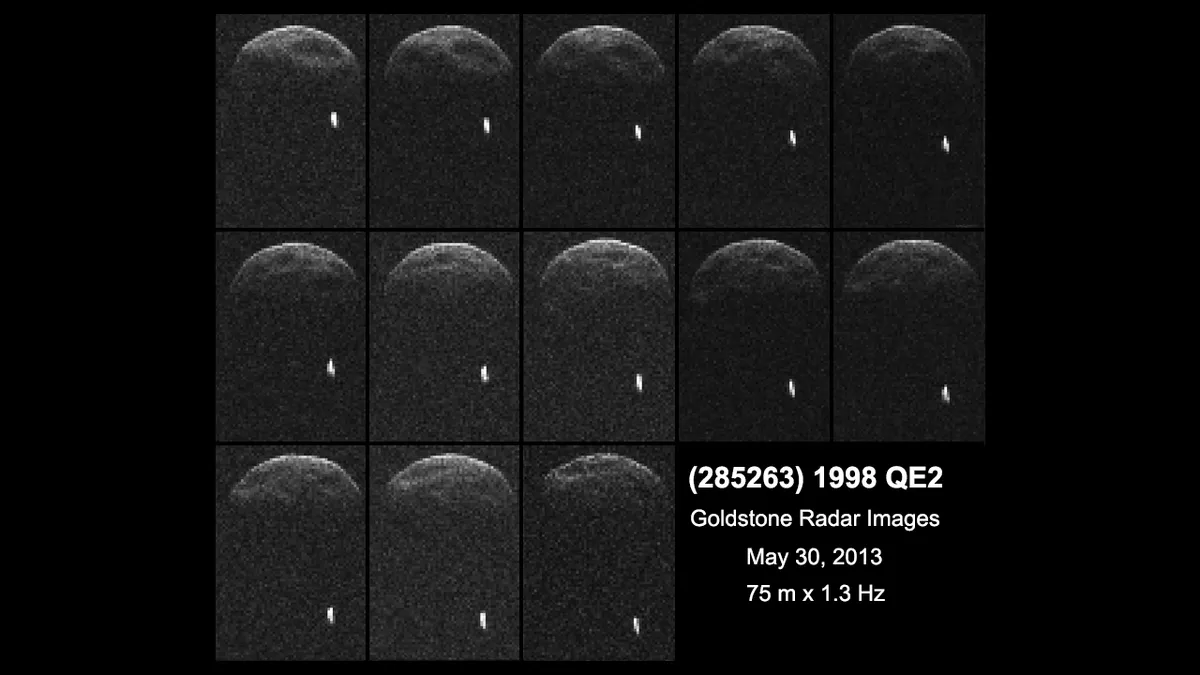
A sequence of images of asteroid 1998 QE2 was obtained on the afternoon of May 29, 2013 by NASA scientists using the 70-meter DSN antenna in Goldstone, California, as the asteroid passed 6 million kilometers from Earth.
The radar images revealed that it is a binary asteroid. In the population of objects near our world, about 16% of asteroids that are 200 meters or larger have company, they are binary or multiple systems. The images show that the main object is about 2.7 km in diameter with a rotation period of four hours. The other object, its small moon, is about 600 meters in diameter.
The name 1998 QE2 comes from a provisional designation given by NASA's Minor Planet Center which uses the following criteria to complete the designation:
First, the year of discovery is indicated. Then each month is divided in two, assigning each half-month a letter from A to Y (without using i or z).
Since the asteroid was discovered on August 19, 1998, according to this criterion it corresponds to the letter Q (for objects discovered between the 16th and 31st of that month). Then, since it is possible that several objects are discovered in that date range, a letter is used for the order, according to the alphabet (omitting i). Since the object in question was the fifth to be discovered in that date range, it corresponds to the letter E. Since 25 letters of the alphabet are used, if there were more discoveries, a number is added.
That is why it receives the provisional designation 1998 QE2 and not because of the association of this object's size with the ship Queen Elizabeth 2. That ocean liner was 293 meters long (length), so the asteroid is 9 times larger.
The radar technique is very powerful for studying the size, shape, rotation and surface of an asteroid, turning a faint point of light into a discernible object.
In the photo we can observe the asteroid and the white dot is another object, its natural moon, that accompanies it on its journey.
Credits: NASA/JPL-Caltech/GSSR
NASA published a video on its website on May 30, 2013.
Space Music
Andy Phillip Hatchett: 1998 QE2
This British artist shared on SoundCloud very recently a musical piece inspired by the asteroid that passed "close" to Earth and was observed by radar.
https://soundcloud.com/andy-phillip-hatchett/asteroid-1998-qe2
Animated Science
Mae Jemison: Integrating the teaching of arts and sciences
Am I very wrong if I think the following?
In the mass media, the "message" seems to be: sciences are difficult, require a lot of effort, it is analytical, structured, hard, distant, cold thinking, alien to the "human"; while art is liberating, simple, does not require "knowing" anything, just letting go.
If that is the message, then we have a problem. Everything worthwhile, everything we are truly interested in and want to do well, requires effort, knowledge, practice. And it also requires creativity, ingenuity, power of abstraction. The following video is from a TED talk and lasts 21 minutes. A small effort must be made to watch it.
Mae Jemison is an astronaut, doctor, art collector, dancer... She tells stories of her own education and her space travels, and asks educators to teach the arts and sciences, intuition and logic as a whole... to create bold minds.
To access previous editions of this section, consult the Multimedia Selection Series. The series attempts to show that the immensity of the universe can be perceived in different ways. I choose some images from a decade ago -so they don't fall into oblivion- and from the current week that ends, as well as sounds/music and videos that are artistic forms of expression with content related to astronomy and related sciences. I am also collecting these materials on the Pinterest account