A collection of links to music, images and videos relating art and science. Today: Images of SNR 0103-72.6; NGC 253; The poetry of J125013.50+073441.5; Admiring the galaxy. Music: Femme Orchestra. Video: Lee Smolin, on science and democracy.

Images of the decade
SNR 0103-72.6
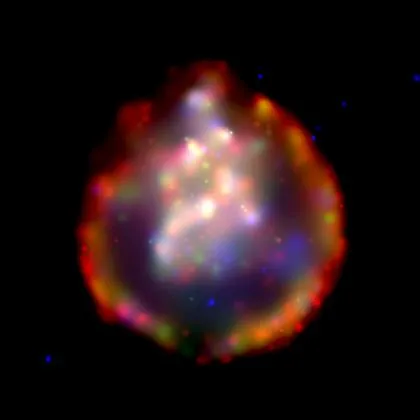
The colorful ring in the image corresponds to a supernova remnant cataloged as SNR 0103-72.6 which is 150 light-years in diameter. The ring surrounds a cloud of gas enriched with oxygen. This ring-shaped region marks the boundaries of a shock wave produced by material ejected in the supernova explosion that made its way through the interstellar gas. From the size of the ring, it is inferred that we see the remnant as it was 10 thousand years after its progenitor star exploded.
The most abundant elements in the remnant are oxygen and neon, which implies that the star was at least ten times more massive than our Sun.
This remnant is located in the Small Magellanic Cloud, about 190 thousand light-years from Earth, which means these X-ray images from the Chandra Observatory took 190 thousand years to reach us. That, in turn, implies that the supernova explosion occurred 200 thousand years ago, according to our measurement of time.
The image was the product of research led by Dr. Sangwook Park of Penn State University and was published on the Chandra site on May 26, 2003.
Credits: NASA/CXC/PSU/S.Park et al.
NGC 253
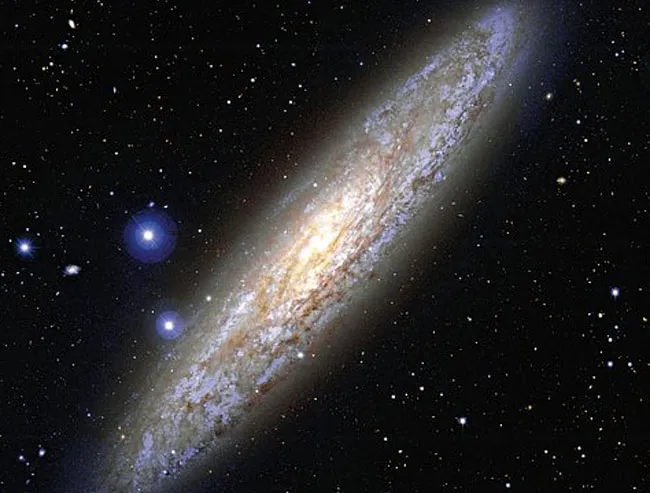
This impressive photograph shows us NGC 253, a spiral galaxy that we see from Earth almost edge-on. It is the largest member of the Sculptor Group of Galaxies, the group of galaxies closest to the Local Group to which the Milky Way belongs. This jumble of gas, dust, stars and surely also planets and moons is so bright that, from the Southern Hemisphere, it can be seen with binoculars from dark skies. This galaxy, of type Sc, lies 10 million light-years away and is considered a "starburst" galaxy due to its high star formation.
Credits & Copyright: Jean-Charles Cuillandre (CFHT), Hawaiian Starlight, CFHT
It was NASA's Astronomy Picture of the Day (APOD) for May 25, 2003. In Spanish at Observatorio.
Images of the week
The poetry of J125013.50+073441.5
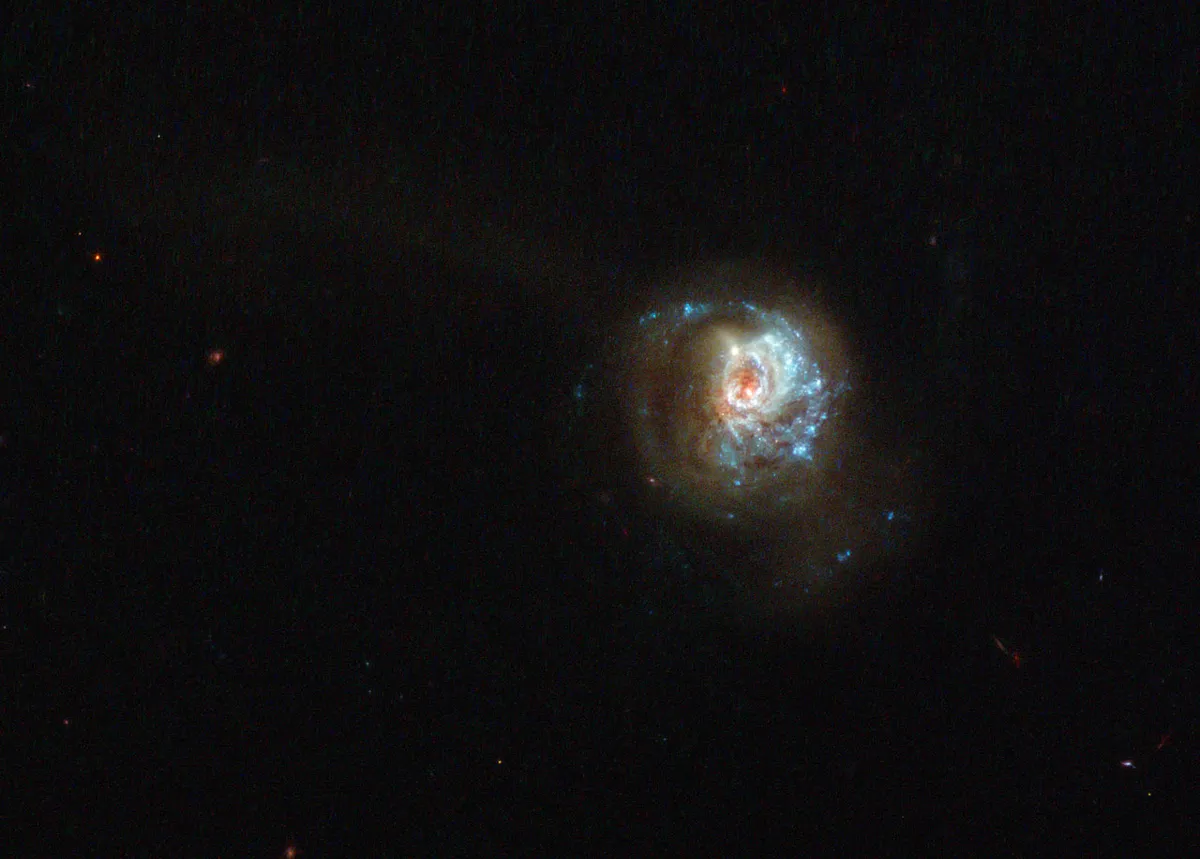
I have titled this section with a sort of oxymoron or contradiction, since the designation of this object (J125013.50+073441.5) seems to be the complete opposite of poetic. This bright cosmic nebula envelops a starburst-type galaxy, like the one in the previous image, that is, a galaxy with a lot of star formation. The regions where stars are being born are highlighted by being bright and blue along the galactic arms.
The data for this image were collected as part of a study called LARS, which investigates the interaction between radiation and matter in relatively nearby starburst galaxies. J125013.50+073441.5 is one of the 14 targets that make up the study.
Credits: ESA/Hubble & NASA, M. Hayes
It was the SpaceTelescope Image of the Week.
Admiring the galaxy
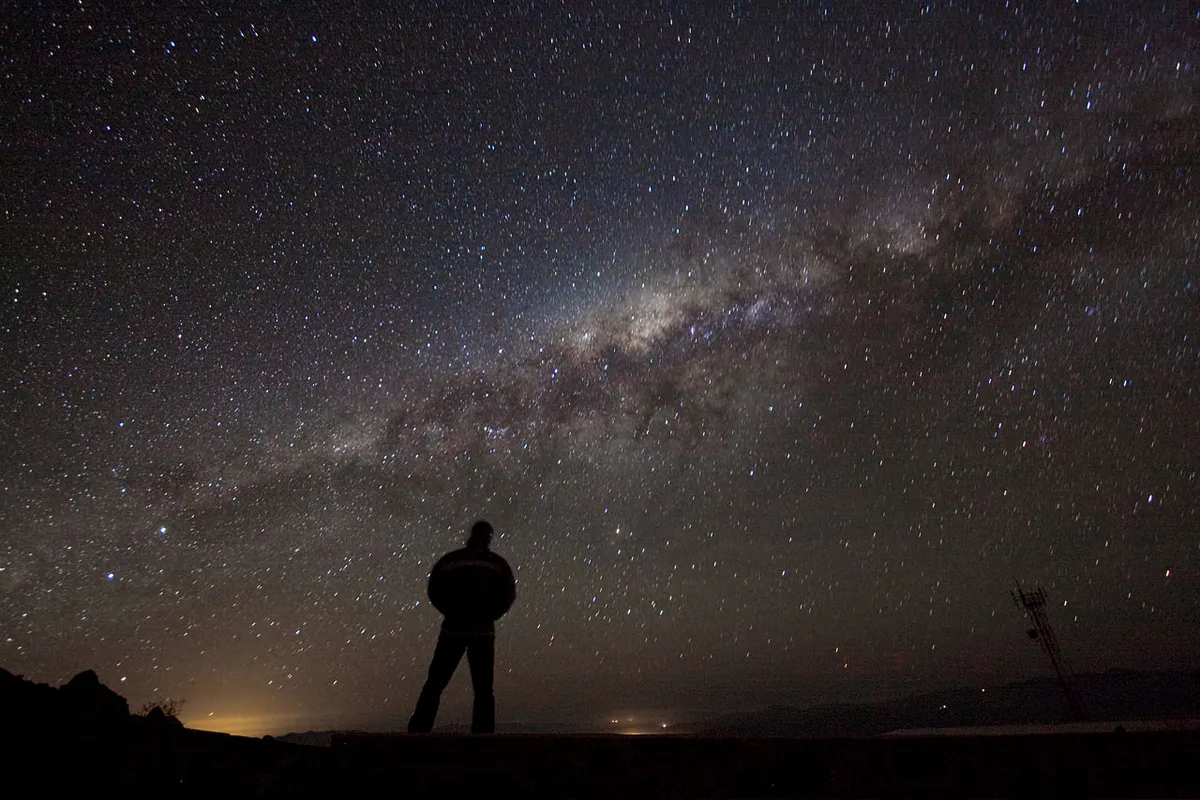
Even for the most veteran astronomer it is difficult to resist the temptation to take a breather, during a tight observing schedule, and look up at the glorious and rich southern sky. This image is a self-portrait taken by astronomer Alan Fitzsimmons, who captured this photograph between two observing sessions at ESO's La Silla Observatory.
This bold photo shows the contrast between a simple, still, dark figure on Earth and the bright, luminous starry night sky. In this image, the sky is dominated by the huge stream of stars and dust that adorns the center of the Milky Way, our host galaxy.
Alan sent this photograph to the Flickr group “Your ESO Pictures”. The Flickr group is regularly reviewed and the best photos are selected to feature in the well-known ESO Picture of the Week section.
Credit: ESO/A. Fitzsimmons
Space Music
Femme Orchestra: Thousands of Light-Years Away
This band, which contrary to what its name might suggest, is made up of men, has its roots in Mexico. From their Facebook BandPage, its members point out that in their sound you can immediately recognize the mark of musicians like Yann Tiersen, Philip Glass, John Mayer or John Frusciante, and of bands as diverse as Pink Floyd, Interpol and Muse.
Here, their song Años Luz, available on SoundCloud.
https://soundcloud.com/femme-orchestra/a-miles-de-a-os-luz
Animated Science
Lee Smolin: How science resembles democracy
It is often read and we have said that science is not democratic, in the sense that in science it is not enough for all of us to agree that the moon is square to think that it is. It's not just a matter of majorities.
But saying that alone is a problem for notions of science and democracy.
In this TED talk, Lee Smolin, a theoretical physicist, talks about how ideas of science relate to those of democracy (or politics) and how it has been throughout time. That historical view, I think, invites us to think about why we think the way we do.
http://www.ted.com/talks/lang/es/lee_smolin_on_science_and_democracy.html
To access previous editions of this section, consult the Multimedia Selection Series. The series attempts to show that the immensity of the universe can be perceived in different ways. I choose some of the images from a decade ago -so they don't fall into oblivion- and from the current week that ends, as well as sounds/music and videos that are artistic forms of expression with content related to astronomy and related sciences. I am also collecting these materials in the Pinterest account