A collection of links to music, images and videos relating art and science. Today: Images of the Pencil Nebula; A twisted galaxy; Technicolor Butterfly; Dance of three planets over La Silla. Music by Adanedhel The Green. Video: Eduard Punset on Redes - The brain does not seek truth.

Images of the decade
Cosmic drawing
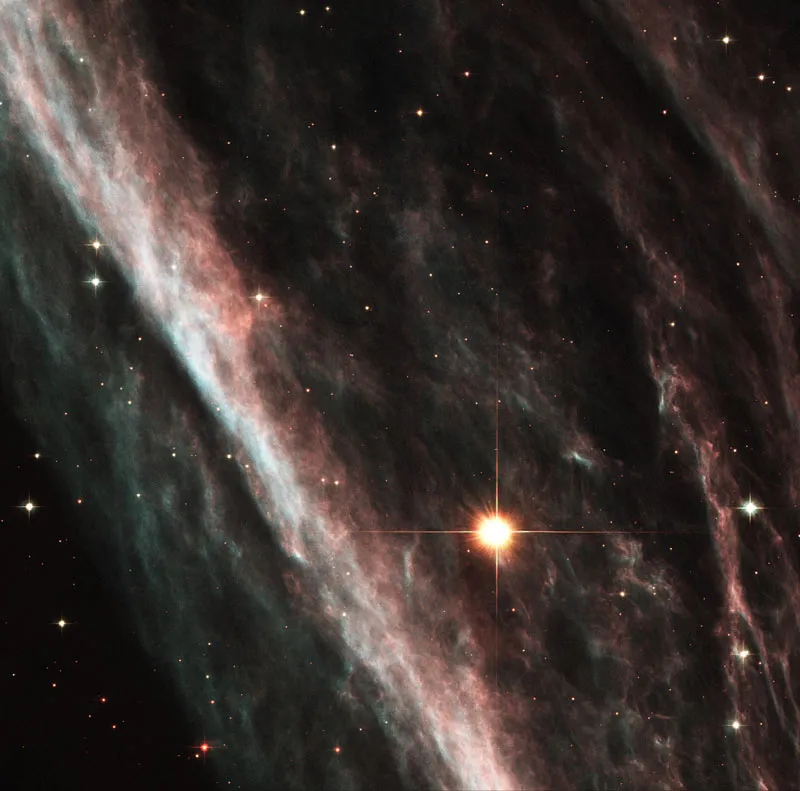
The remnants of a star that exploded thousands of years ago created an abstract celestial landscape: the Pencil Nebula, captured here by Hubble. Officially known as NGC 2736, the Nebula is part of the gigantic Vela supernova remnant. The morphology of this remnant, resembling a pencil, suggests it is part of the supernova's shock wave that recently encountered a region of dense gas. The remnant is located 815 light-years from Earth.
Credits: NASA and The Hubble Heritage Team (STScI/AURA)//W. Blair (JHU) and D. Malin (David Malin Images)
The image was published on HubbleSite on June 5, 2003.
The twisted galaxy ESO 510-13
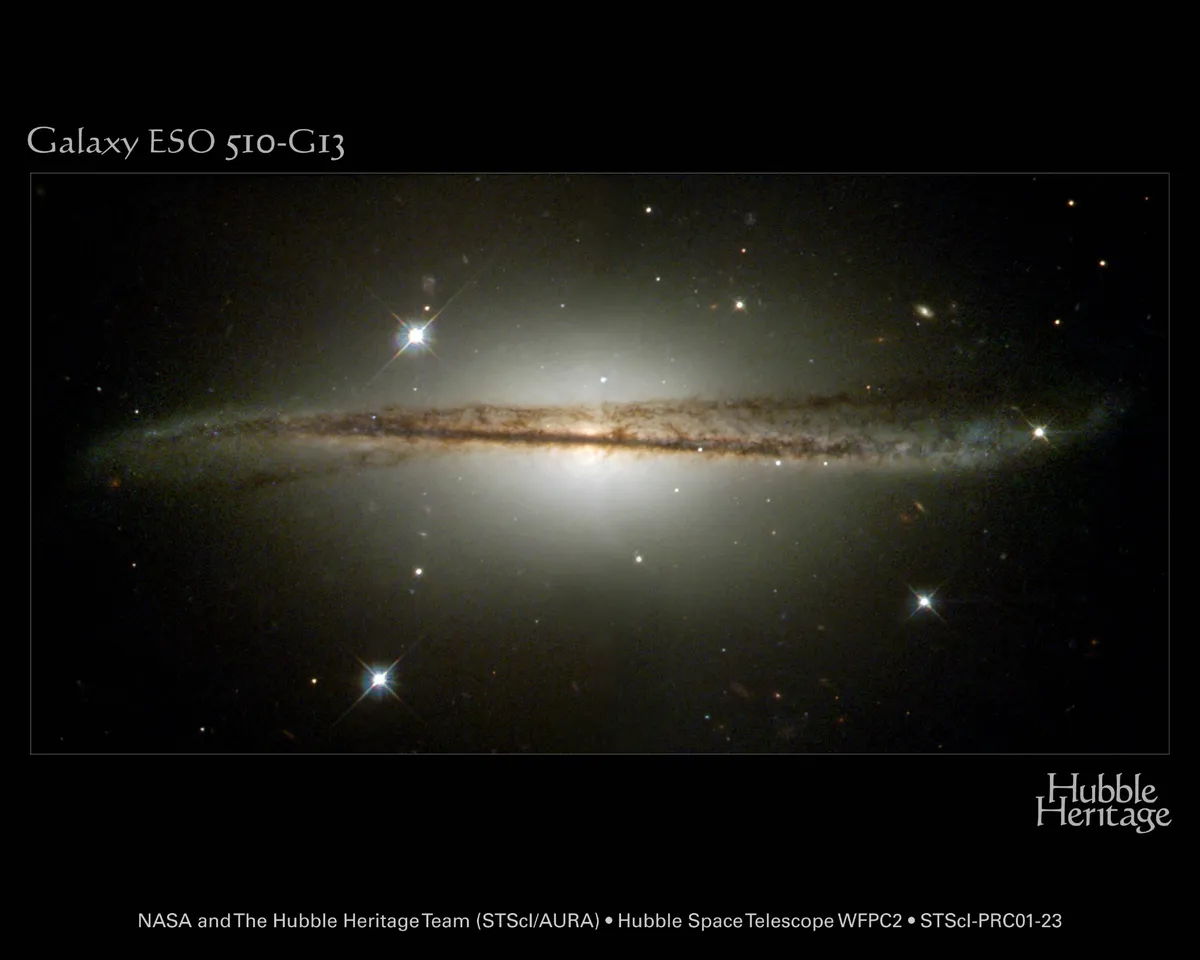
The spiral arms of galaxies appear flat when viewed edge-on. But in the case of galaxy ESO 510-G13 it is unusual, as a twisted structure is seen. The galaxy is located in Hydra, almost 150 million light-years from Earth.
The strong deformation of the disk indicates that the galaxy had interactions with another nearby one and is in the process of merging. Gravitational forces distort the structures of galaxies as stars, gas and dust merge in a process that takes millions of years.
The galaxy owes its name to having been observed from the European Southern Observatory in Chile (ESO).
Credits: Hubble Heritage Team (STScI / AURA), C. Conselice (U. Wisconsin / STScI) et al., NASA
It was the Astronomy Picture of the Day (APOD) on June 7, 2003. In Spanish at Observatorio.
There is supplementary information and other images on the Hubble Heritage site.
Images of the week
Technicolor butterfly
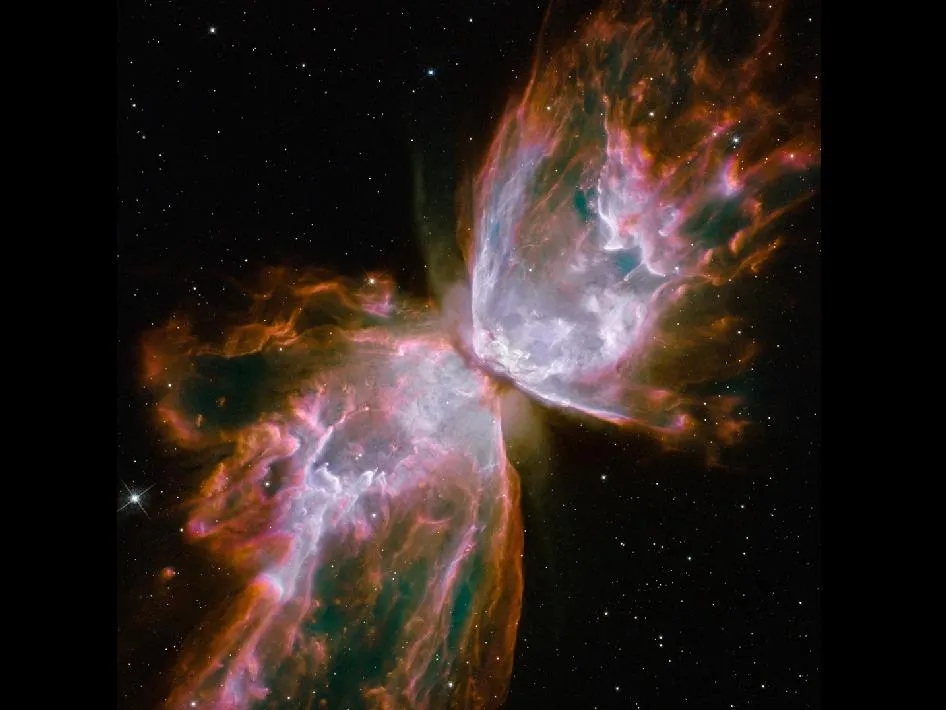
The bright clusters and nebulae we observe in the sky have often been named with references to flowers or insects. NGC 6302 has evoked by its shape a butterfly. It is a planetary nebula. Its shape and color were recorded in 2009 by Hubble. The Butterfly Nebula "flies" 4,000 light-years away, in Scorpius.
Certainly there is an astronomical metamorphosis in Planetary Nebulae (in stars in general), like caterpillars turning into the beautiful (and not so beautiful) Lepidopteran insects known as butterflies.
Transformations, mutations, changes or conversions are words that possess a variety of meanings and allow us to establish different metaphors. What would Gregor Samsa have seen here?
It was NASA's Image of the Day on June 7, 2013.
Credits: NASA/ESA/Hubble
More information at ESO.
The dance of three planets over La Silla
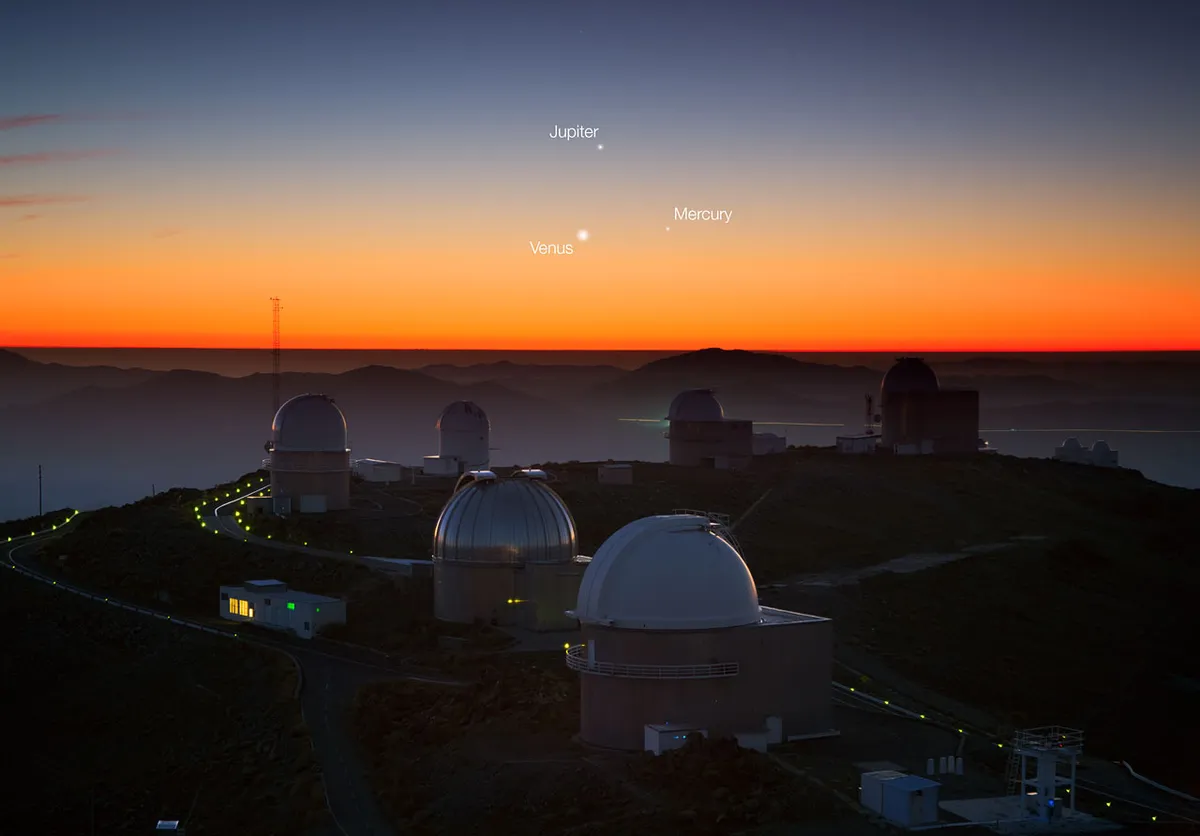
This image was taken by ESO Photo Ambassador Yuri Beletsky, who was lucky enough to capture this spectacular image of a planetary syzygy and a triple conjunction from the La Silla Observatory in northern Chile last Sunday, May 26. After sunset, above the round domes of the telescopes, three of the planets in our Solar System could be seen — Jupiter (top), Venus (bottom left), and Mercury (bottom right) — linked in a cosmic dance.
Syzygy is a word that comes from Greek and means "united by the same yoke." It is used to account for the configuration of three celestial bodies in a straight line, for example it occurs in conjunctions and oppositions, although it is used in a general way for interesting configurations of planets in general.
Credit: ESO/Y. Beletsky
More at ESO.
Space Music
Adanedhel The Green
Under that artistic name, the Italian musician Alberto Bonadonna has produced several albums since 2007, starting with "Journey Beyond The Stars" and then in 2009 he released The Green Album whose fourth track I share here, titled Planetary Nebula.
https://soundcloud.com/albertobonadonna/04-nebulosa-planetaria
Animated Science
Redes 78: The brain does not seek truth but to survive
Our human brain has evolved over time. But we still have instincts.
How does our brain work?
In the images above, we can see a pencil, a butterfly, a triangle.
If we start from the idea that the Universe "is thought out," perhaps those images "indicate" to us that it is so, since it is beautiful.
But, isn't that a prejudice?
In this episode of Redes, Eduard Punset dialogues with psychologist Cordelia Fine about our brain and prejudices.
To access previous editions of this section, consult the Multimedia Selection Series. The series attempts to show that the immensity of the universe can be perceived in different ways. I choose some images from a decade ago -so they don't fall into oblivion- and from the current week that ends, as well as sounds/music and videos that are artistic forms of expression with content related to astronomy and related sciences. I am also collecting these materials on the Pinterest account