A collection of links to music, images, and videos that connect art and science. Today: Images of NGC 3603; The planetary nebula show; Composite of the Sun and the Moon. Music: Jonny Berliner. Video: Horizons, the sky from South Dakota.

Images of the decade
Blowin' in the Wind
before he can see the sky?
Excerpt from Blowin' in the Wind. Bob Dylan.
The answers about massive stars are blowin' in the wind
After many observations with different telescopes and instruments, ESO astronomer Dieter Nürnberger obtained evidence that allowed understanding the first stages in the formation of heavy stars.
That critical initial phase of stellar evolution is difficult to study because massive protostars are deeply embedded in clouds of gas and dust impenetrable to visible wavelengths.
But to make such studies possible, the astronomer stated: "You have to look in the right place and remember Bob Dylan.."
And that's what he did.
"Blowin' in the Wind" is a famous song by the American musician. The lyrics of the song are a succession of rhetorical/ironic questions of various kinds.
The astronomer in question realized that the answer to how the stellar evolution of heavy stars at the moment of formation was in the winds of nearby stars.
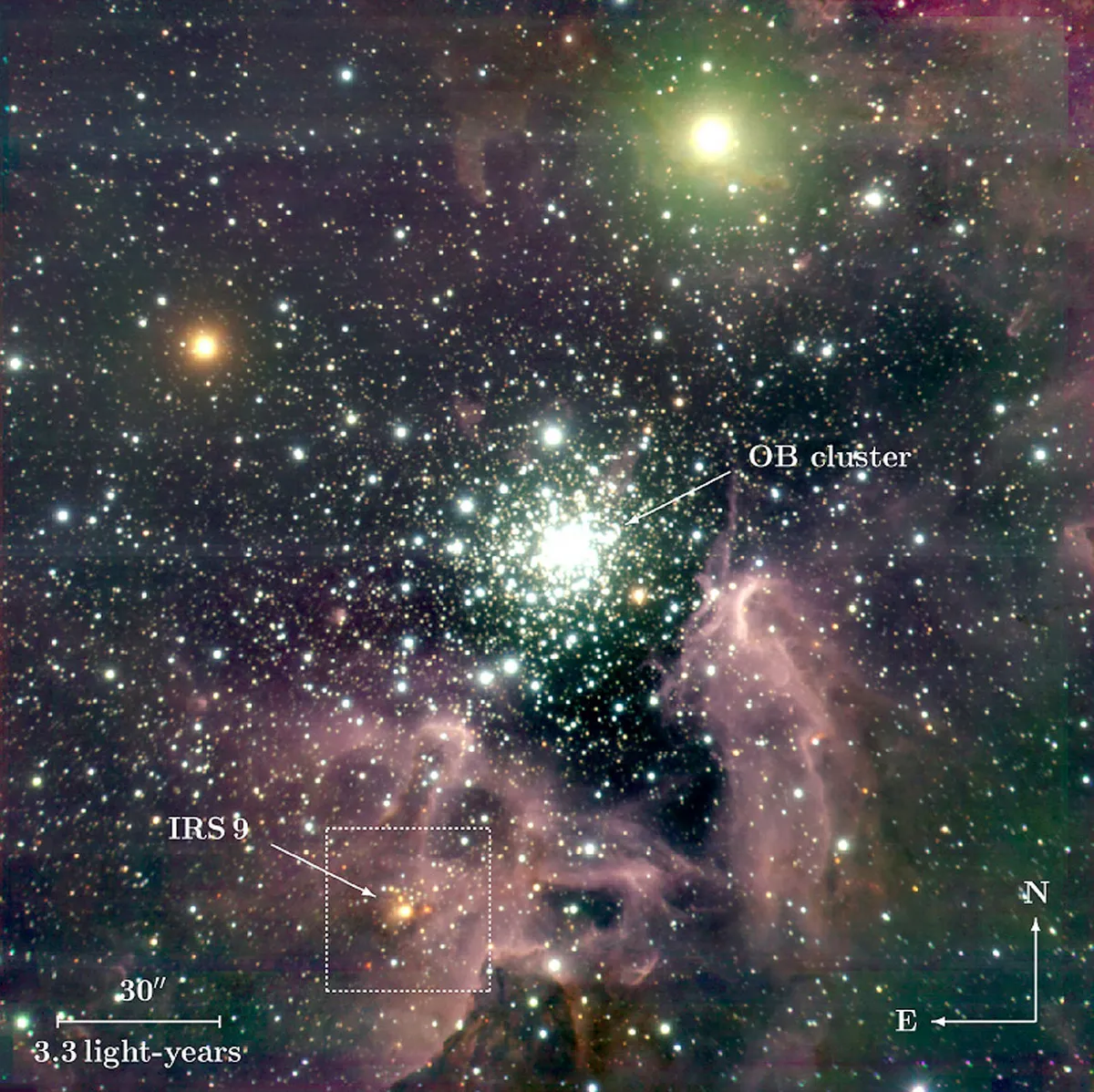
Near the cluster NGC 3603 he found several candidate objects to be massive protostars, about 100,000 times intrinsically brighter than the Sun and 10 times the mass of our star. Those objects, designated as IRS 9A-C, are surrounded by gas and dust.
How to sweep away that dust? Astronomers cannot, although it is possible to use instruments sensitive to different wavelengths, and also make use of prior knowledge and look for the appropriate area to use the universe itself as a laboratory.
The stars in NGC 3603 (22,000 light-years from Earth) constitute what is known as an HII region at whose center there are massive and evolved stars designated as type OB.
Such stars impact their surroundings with a large number of energetic photons that ionize the interstellar medium and sweep away the surrounding dust.
In this way, the dust that obscures the stars to be studied is partially removed, and they are normally hidden from the sensitivity of the instruments.
In the image we see the region around NGC 3603, a young cluster of O and B stars partially embedded in its natal cloud of gas and dust. A small group of nascent very massive stars was found south of the cluster, indicated in the image as IRS 9. The image was obtained with the ISAAC instrument on the 8.2m Antu telescope of the VLT at Paranal.
The image and press release were announced on the ESO website on June 16, 2003.
Credit: ESO.
The Planetary Nebula Show
What do the Owl, the Cat's Eye, the Ghost of Jupiter, and the Saturn Nebula have in common?
They are all planetary nebulae. Their association with planets has nothing to do with the objects themselves, but with how they were perceived by humans. In the past, with less sophisticated instruments than today's, these circular, nebulous objects were interpreted by astronomers of yore as nebulae that looked like planets. But they have nothing physically to do with them.
These clouds of material ejected by dying stars are often symmetrical and beautiful. Astronomer Adam Block took some of the digital images exposed at Kitt Peak Observatory and created this delightful animation. The animated image contains ten nebulae: NGC 1535; NGC 3242 (known as the Ghost of Jupiter), NGC 6543 (known as the Cat's Eye), NGC 7009 (Saturn Nebula), NGC 2438, NGC 6772, Abell 39, NGC 7139, NGC 6781, and M97 (the Owl Nebula).
Here are the 10 planetary nebulae in order.
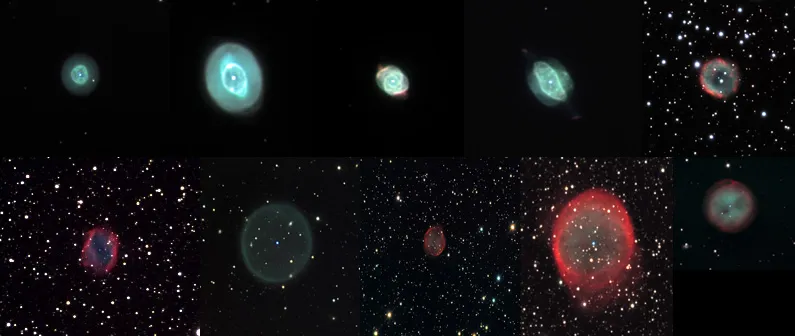
It was the Astronomy Picture of the Day (APOD) on June 14, 2003.
In Spanish, at Observatorio.
Images of the week
The Sun and the Moon
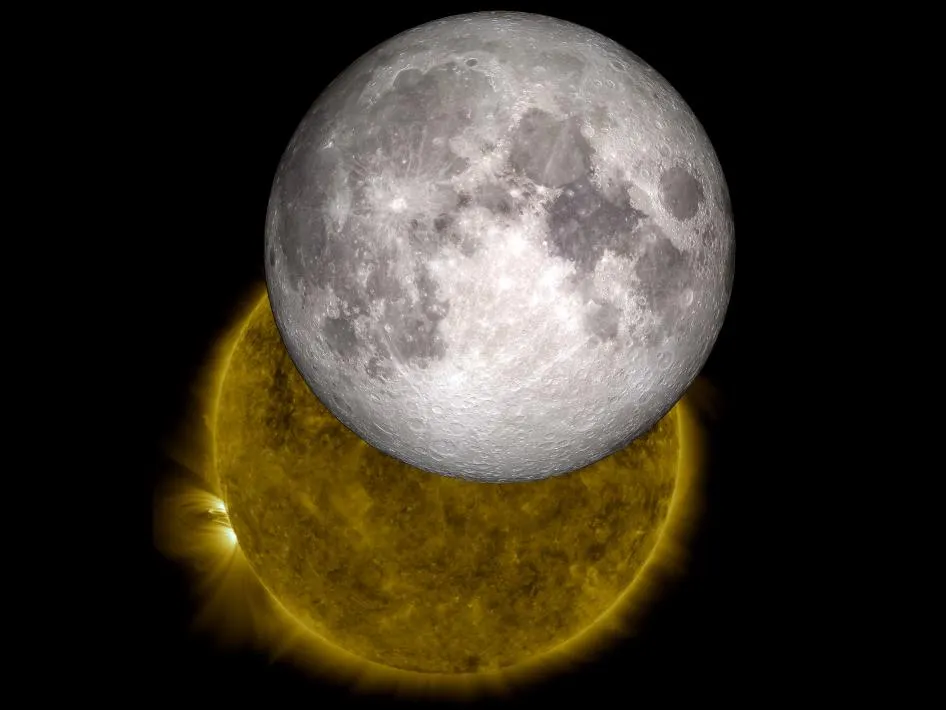
Two or three times a year, NASA's Solar Dynamics Observatory (SDO) observes the moon passing in front of the Sun. Although that obscures solar observations for a time, it offers the possibility of an interesting view of the moon's shadow. The moon's sharp horizon can be seen against the sun, because the moon has no atmosphere. (At other times of the year, when Earth blocks SDO's view, Earth's horizon appears fuzzy due to its atmosphere).
If you look carefully at the sharp edge, the Moon's topological features are visible, as in this image from October 7, 2010.
See the images from the NASA release. Below in that release there are two images: The SDO image showing the Moon's shadow passing in front of the Sun. It is possible to see the image in high resolution. If we do, we will notice that the lunar edge is not perfectly smooth.
So the idea was to take a precise 3D model of the Moon (based on the LRO mission) and make it match very precisely with the shadow (captured by SDO).
This recently inspired two NASA visualizers to overlay a three-dimensional model of the moon based on data from the LRO mission onto the moon's shadow in the SDO image.
Such a task is difficult, as the visualizers, Scott Wiessinger from SDO and Ernie Wright from LRO, had to match very precisely data from the correct moment in time and point of view of two separate instruments. The final result is this composite.
The image was published on the NASA website on June 13, 2013.
Credits: NASA/SDO/LRO/GSFC.
Space Music
Jonny Berliner
Berliner is a songwriter of science. We can learn about his work on SoundCloud and Bandcamp, as well as on his website.
Just as at the beginning of this Selection, an astronomer related his work to a previously created song, here, science inspired this British musician to create songs.
On BandCamp it is possible to read (in English) the lyrics of the songs. In this case, about the famous Heisenberg Uncertainty Principle.
Animated Science
Horizons
Randy Halverson made this video from South Dakota. The landscape of the place, although unique, includes a shared heritage: the sky.
Actually, not so shared, among other things, due to the ever-increasing urban lighting...
Horizons from Randy Halverson on Vimeo.
To access previous editions of this section, consult the Multimedia Selection Series. The series attempts to show that the immensity of the universe can be perceived in different ways. I choose some images from a decade ago -so they don't fall into oblivion- and from the current week that ends, as well as sounds/music and videos that are artistic forms of expression with content related to astronomy and related sciences. I am also collecting these materials in the Pinterest account