A collection of links to music, images and videos relating art and science. Today: Images of The X-ray Glow of N63A; Nova Centauri. Music: Light Pollution, by Admit One. Video: NightFall, by Colin Rich.

Images of the decade
The X-ray Glow of N63A
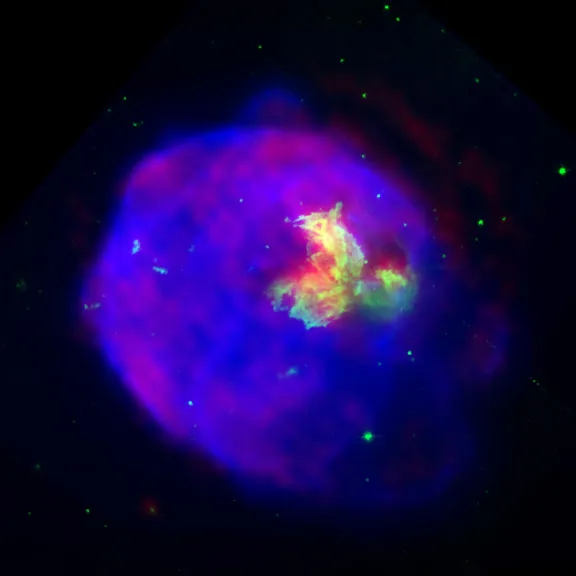
With the Chandra telescope astronomers captured the glow created by the destruction of a massive star. The X-rays detected by the instrument (in blue) were combined with optical data (in green) and radio data (in red) revealing new details of the supernova remnant N63A, located in the nearby galaxy Large Magellanic Cloud.
This X-ray glow is generated by material reaching millions of degrees Celsius due to the shock wave generated by the supernova explosion. The remnant is estimated to be between 2000 and 5000 years old.
The optical and radio light is brighter in the central region of the remnant, which appears as a triangular-shaped "hole" in the image. That "hole" is produced by the absorption of X-rays in a dense cloud of colder gas. A comparison of these data with the image of optical and radio data suggests that the shock wave is wrapping around this massive cloud, so we only see the edge closest to Earth. Collisions like this trigger the formation of new stars.
Credits: X-ray: NASA/CXC/Rutgers/J.Warren et al.; Optical: NASA/STScI/U. Ill/Y.Chu; Radio: ATCA/U. Ill/J.Dickel et al.
The image was published on the Chandra site on December 19, 2003.
Images of the week
RS Puppis and Nova Centauri
On December 17, an image of RS Puppis, a Cepheid variable star, was published on HubbleSite. It is a beautiful image that can be seen in image and video at HubbleSite.
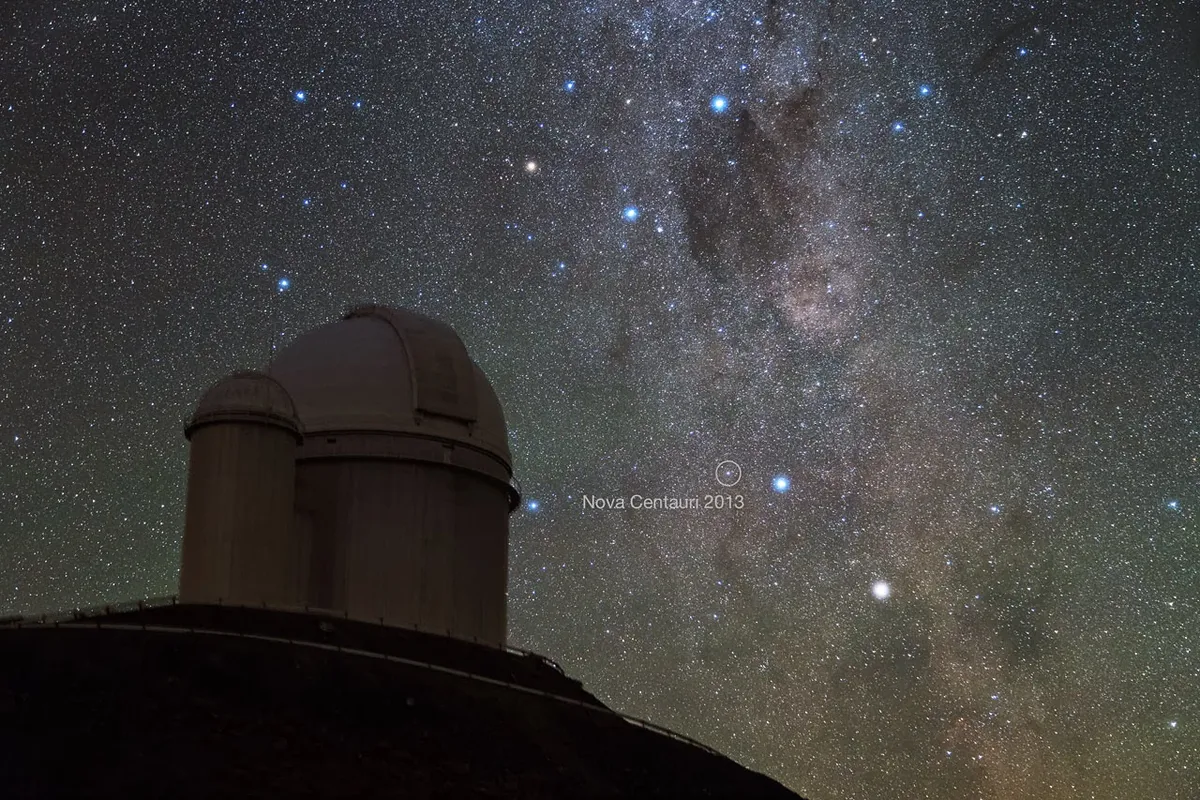
A week earlier, this photo of Nova Centauri 2013 was published at ESO. Alpha and Beta Centauri, the brightest stars in Centaurus and which serve as "pointers" to the Southern Cross, now have a naked-eye companion: Nova Centauri 2013.
This photo was taken by Yuri Beletsky at La Silla, in Atacama, on December 9, 2013. The nova was discovered by John Seach from Australia on December 2. It is the brightest nova of this millennium.
A classical nova should not be confused with a supernova. Classical novae occur in a binary system when hydrogen from one star is accreted onto the surface of the primary star, causing a thermonuclear event on the recipient of the material that increases its brightness. But that primary star is not destroyed in the event, as happens in supernovae.
Credit: ESO/Y. Beletsky
It was the Picture of the Week (for 9/12) at ESO.
Space Music
Light Pollution, by Admit One
Admit One is a band from Hendersonville, North Carolina, USA. Their album Light Pollution contains 7 tracks, among which City Lights stands out. A video of the band for this song can be seen on YouTube.
There are many other bands, especially in English, that have written music and lyrics related to the problem of light pollution. And in Spanish?
Ah, another band, from NYC, that has a very good electronic track is The Dirty Grand.
Animated Science
NightFall, by Colin Rich
This is a three-minute video about nightfall in Los Angeles, USA.
Its author is Colin Rich who published this video a year ago. It is part of a trilogy that was completed recently.
What the video shows is how we humans illuminate the night through the use of energy. That urban lighting is justified because... we produce more, we entertain ourselves, but is it really necessary? And in such quantity and manner?
While we illuminate the city, we illuminate the sky and miss seeing stars like Nova Centauri from large urban centers.
NightFall from Colin Rich on Vimeo.
To access previous editions of this section, consult the Multimedia Selection Series. The series attempts to show that the immensity of the universe can be perceived in different ways. I choose some images from a decade ago -so they don't fall into oblivion- and from the current week that ends, as well as sounds/music and videos that are artistic forms of expression with content related to astronomy and related sciences. I am also collecting these materials in the Pinterest account