A collection of links to music, images and videos relating art and science. Today: Images of HH 46/47; The Sun's rainbow of wavelengths. Music: The invisible universe, by Stephen Dubois. Video: Journey to the stratosphere.

Images of the decade
Young star, dark cloud
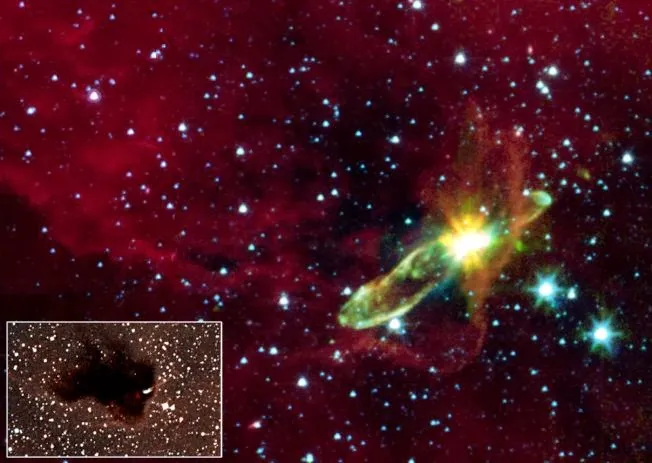
High-speed molecular gas flows, from a young stellar object, glow in infrared light in this false-color image from the Spitzer Space Telescope.
Cataloged as HH 46/47 (it is a Herbig-Haro object), the infrared source is embedded in a dark nebula or "Bok globule", near the lower right corner of the inset image, which is almost completely opaque when observed in visible light.
The energetic jet of matter extends to a distance of nearly a light-year, excavating the dark interstellar matter, and is related to the initial stages of the life of a star similar to our Sun.
Something similar must have happened 4,500 million years ago with our Sun along with the formation of our solar system from a planetary disk.
This young stellar system is an interesting object to explore and is relatively close, only about 1,140 light-years away in the constellation Vela.
Why is the image in "false color"? It's because it was taken with Spitzer, a telescope that captures infrared light. Humans cannot observe that wavelength with our eyes. What we call color is a visual perception of people when detecting light in the optical or visible spectrum.
Credit: A. Noriega-Crespo (SSC/Caltech) et al., JPL, Caltech, NASA (Inset: Digital Sky Survey).
It was the Astronomy Picture of the Day (APOD) of December 26, 2003.
In Spanish at Observatorio.
Images of the week
The Sun's rainbow of wavelengths
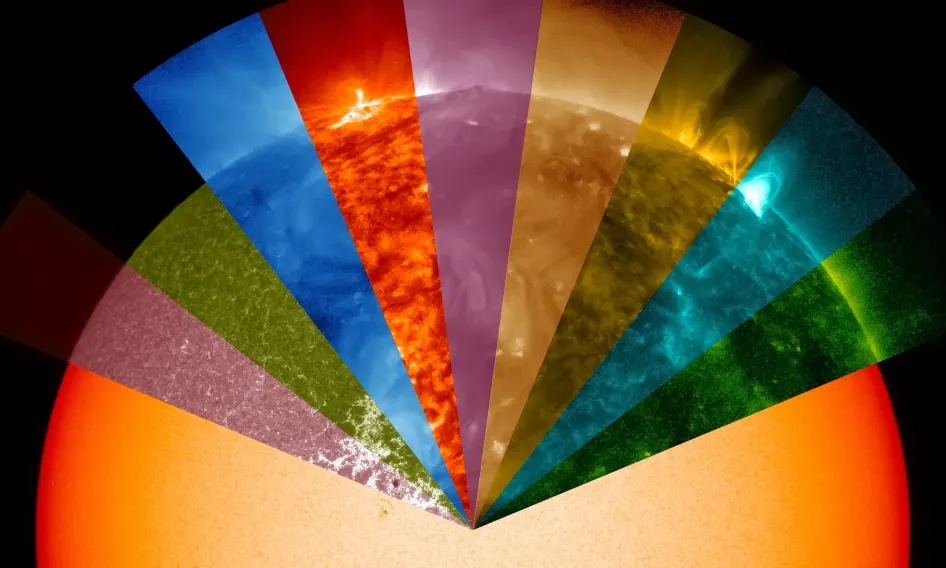
This image was composed from a movie of the Sun based on data from NASA's Solar Dynamics Observatory (SDO), showing the wide range of wavelengths -invisible to the human eye- that the telescope can detect. SDO converts the wavelengths into an image we can see and the light was color-coded with a rainbow of colors.
The yellow light of 5800 Angstroms, for example, generally emanates from material at about 5,700 degrees Celsius, representing the surface of the Sun. The extreme ultraviolet light of 94 Angstroms, typically colorized green in SDO images, comes from atoms that are at about 6.3 million degrees Celsius and is a good wavelength for looking for solar flares. By examining images of the Sun in a variety of wavelengths, scientists can track how particles move through the solar atmosphere.
Credit: NASA Goddard Space Flight Center.
It was NASA's Image of the Day for December 18, 2013.
More information in English and the video in this NASA press release.
Space Music
Our invisible universe, by Stephen Dubois
Dubois has composed three albums of music for planetarium shows like the one in Buffalo. In this case, about wavelengths. He explains it on his BandCamp page:
In the spring of 2012 the Whitworth Ferguson Planetarium, in Buffalo, New York presented an original program about the invisible frequencies of the electromagnetic spectrum, dark matter and dark energy. I wanted the soundtrack to match the wavelengths of light discussed with an appropriate sound. The longer waves (like radio, microwave and infrared) are represented with sustained, ethereal and staccato notes while the high frequency of UV rays, X-rays and gamma rays have abundant sequencing and arpeggios. Visible light is conveyed through the use of acoustic piano in order to seem natural, like the things we see every day. Creating the "sound" of dark matter and dark energy was another story. The music had to capture the inexplicable and mysterious: an intangible feeling of isolation, as well as being overwhelming. "Our Invisible Universe" attempts to musically bring into view what is invisible to human eyes. The album cover is a grid representation of 100 squares where only 4 are filled with images. This represents the 4% of the universe that can be "seen" by various telescope equipment while the rest is the 96% of dark matter and dark energy.
Animated Science
Journey to the stratosphere
Not only can we not see those wavelengths outside the range called visible, but we also cannot see what is very far away.
Maxime Dehaye shared a couple of videos this week about an experience carried out on December 8 when a team launched a 1200g weather balloon from France.
The balloon carried a box containing cameras, batteries and sensors. It reached an altitude of 23.4 km and a temperature of -32°C.
It was filmed with several cameras and what is seen in the video is an edit, but the complete footage can be seen on YouTube.
The music is Baltimore's Fireflies by Woodkid, and Marion's Theme by M83.
Journey to the Stratosphere from Maxime Dehaye on Vimeo.
To access previous editions of this section, consult the Multimedia Selection Series. The series attempts to show that the immensity of the universe can be perceived in different ways. I choose some images from a decade ago -so they don't fall into oblivion- and from the current week that ends, as well as sounds/music and videos that are artistic forms of expression with content related to astronomy and related sciences. I am also collecting these materials in the Pinterest account