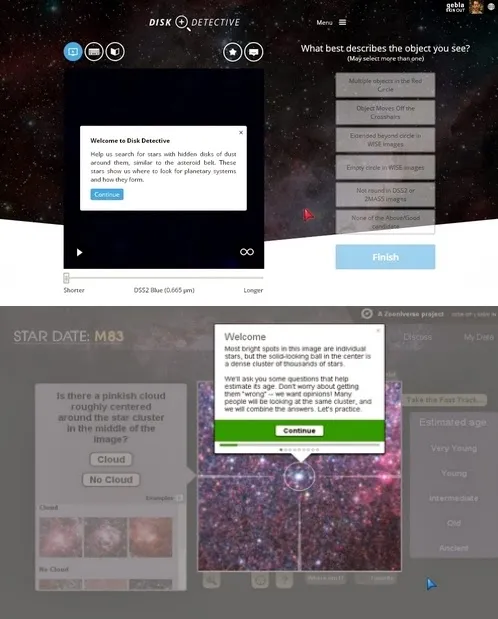
Star Date: M83 and Disk Detective. The first one proposes using our eyes on Hubble data to identify the ages of star clusters in galaxy M83. In the other we will act as "detectives" of planet-forming disks.
Disk Detective
Finding planets around other stars is hard. But there is a trick we can use to study exoplanets that also teaches us about where those planets come from.
Planets form from large clouds of gas, dust, and rock, which take the shape of a disk with a star at the center. We can find where planets are forming by looking for stars surrounded by those disks. Finding those disks, called "debris disks" or "YSO disks" (young stellar object disks) depending on their age and gas content, has been one of the greatest searches in the last thirty years.
NASA's WISE mission probably took images of hundreds of these disks. But in those images there are also many other objects like galaxies and nebulae, plus instrument artifacts. In Disk Detective we will help astronomers find those disks.
Disk Detective is a project by NASA and Zooniverse.
How to use it
After logging in and the welcome, we find sets of images of the same place in the sky at different wavelengths.
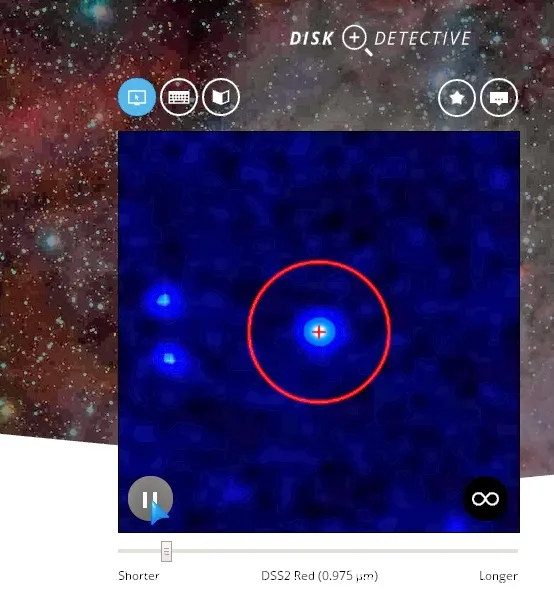
The ideal disk does not move from image to image and does not break into two or more objects. It is pure, clean, and rounded. For a star to have a disk, it should be contained mainly within the red circle.
To go through the images we can press the Play button or use the mouse on the bar below. Each image is from a different survey.
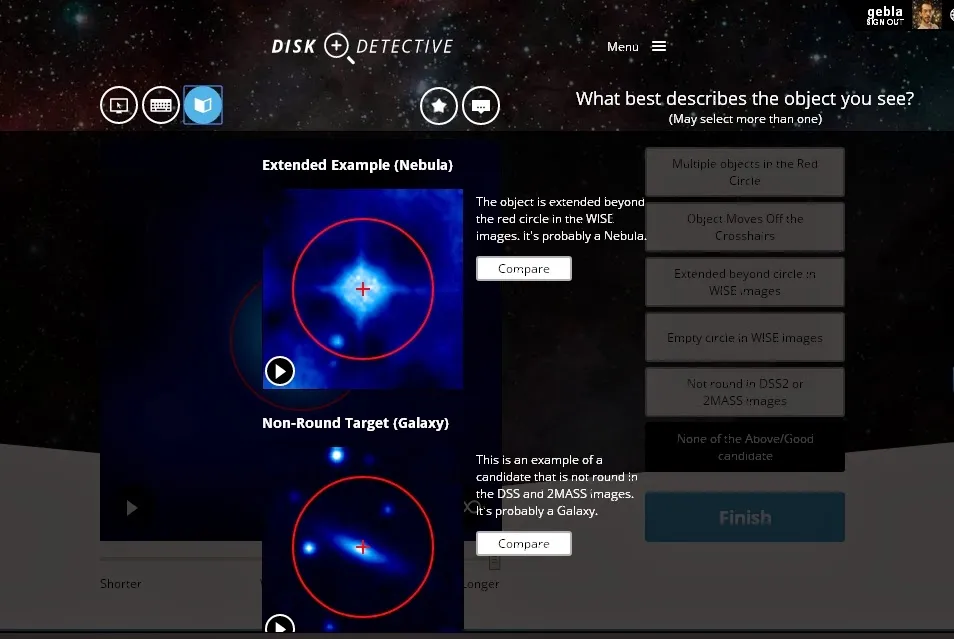
Hint: Non-circular objects in the DSS2 and 2MASS survey images are a sign that it is not a disk.
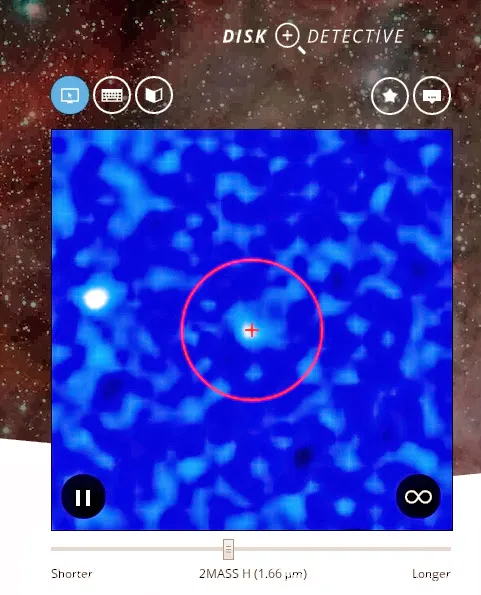
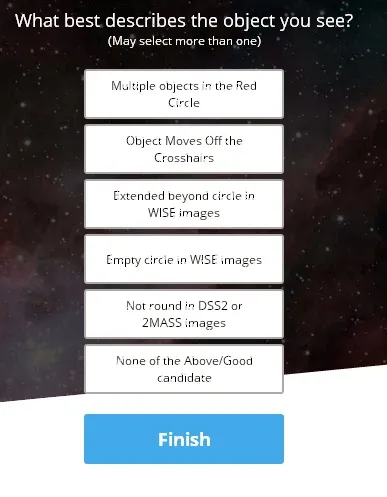
After viewing that series (flipbook) we can say among the options that appear on our right:
Multiple objects in the red circle (do not confuse with other "red circles")
Object moves from the cross
Extension larger than the circle in WISE images
Empty circle in WISE images
No round object in DSS2 or 2MASS images
None of the above/Good candidate
If we click on the icon that looks like an open book, we will have a guide to compare a good candidate with a bad candidate.
Star date: M83
The team in charge of Star Date was inspired for this project after they made observations of this galaxy using Hubble's WFC3 in 2009.
In 2011 they wrote a paper with their results. They showed that by looking at the images and using the same criteria that citizen astronomers will now use, it is possible to identify the ages of clusters in the galaxy that have a very good correlation with their previous estimates using Spectral Energy Distribution (SED) techniques used by professionals.
SED is a way to compare various colors and the presence or absence of hydrogen emission with models of star clusters that have different ages.
Tutorial
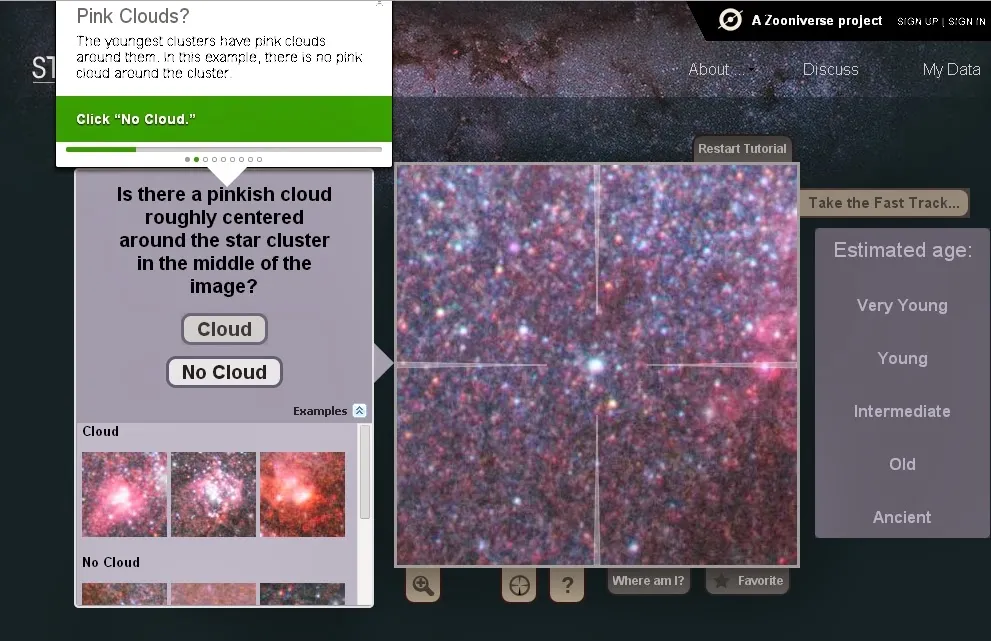
We start with an interface that tells us that most of the bright dots in the image are individual stars, but what looks more solid in the center is a dense cluster of thousands of stars.
We will be asked questions that will allow estimating its age. Don't worry if we answer wrong. It's not that it doesn't matter, but the results are averaged among many.
First question: Is there a pinkish cloud almost in the center around the cluster in the middle of the image?
Second: Can you see individual stars in the cluster or is it blurry?
Third: What color is the cluster?
Fourth: Zoom: we go to the measurement. It is necessary to use the zoom (icon).
We must measure the size using the mouse to create an ellipse that wraps around the cluster. With the mouse we make an ellipse. If it doesn't stay in place (quite likely) we can move it and then adjust the size. With the black circle we can rotate and with the square we can change the size/shape.
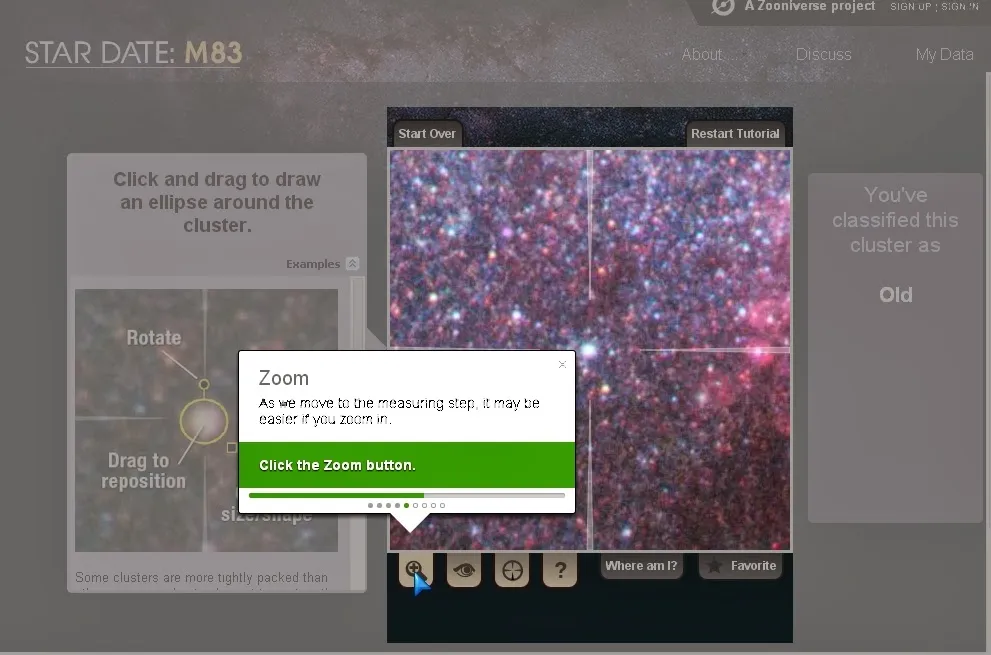
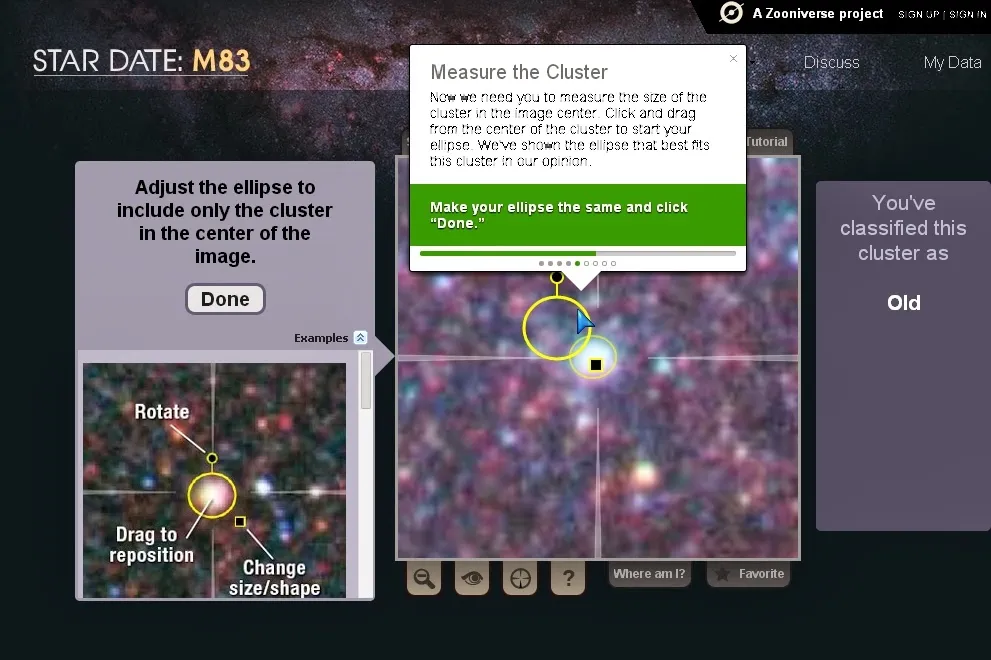
On our right there is a set of age possibilities indicated with words: very young, young, intermediate, old, ancient.
As we answer, those options shrink.
Fifth: Then we will be asked to measure the pinkish cloud, if there was one.
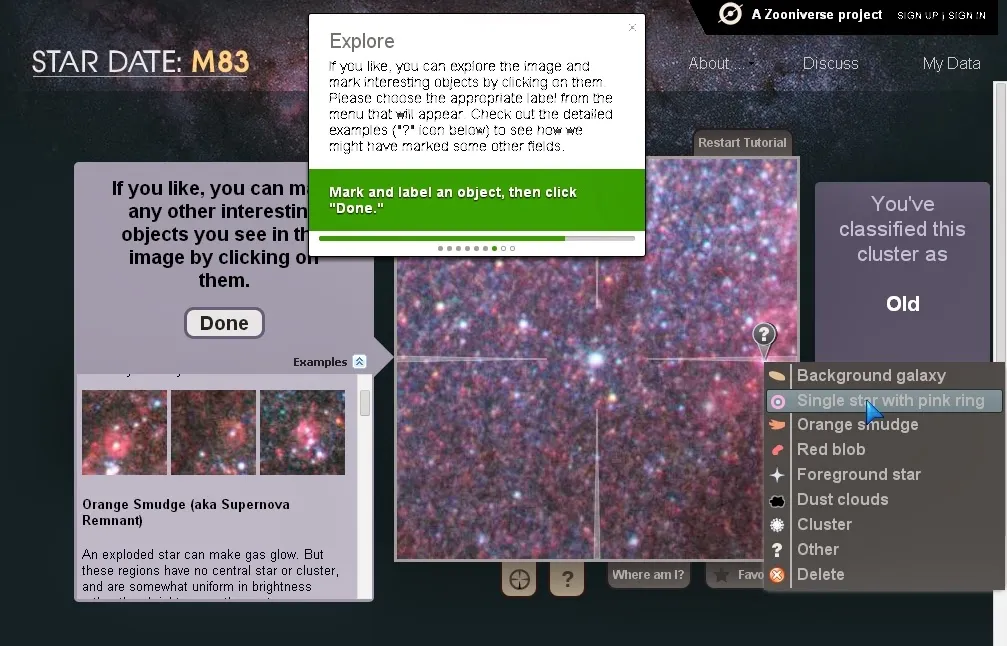
Sixth: Finally we can mark other interesting objects or features such as:
Background galaxies, another star with a pinkish ring, orange spot (supernova remnant), etc.
For that we position the mouse where we detect something and click to see the options.
In My Data we can see a map with the clusters we have classified.
Why citizen science?
A question that may arise with this type of projects is why citizens should help professional astronomers if they receive money from national States. What does the citizen gain from this? Why do work/effort for free?
There is no commitment in these projects, except the moral one that arises from each person. It is not mandatory, but voluntary.
But is this cause necessary or are they just using us as cheap labor?
They are "necessary" insofar as processing a lot of data would require many people or a lot of time or both. And yes, it is a form of work, in the sense of effort. It appeals to altruism and depends on our interest. Those interested in music will be supportive in musical projects and those of us interested in astronomy will be (or not) in these projects.
Certainly, participation demands a certain community awareness. There lies its meaning, I believe, for the participants, although many would have to be interviewed to better know why people participate.
And what is the scientists' argument? Partly what was said before and partly that these are tasks that can only be partially automated. There are operations that not even the most important machines can perform like human beings.
These projects can be, at the same time, a way to bring science to society. It is true that it should not be the only one. Socializing science demands something more than this. I would say much more. That is what I aim for in my series on the meaning of modern astronomy.
Sources and related links
About the images
- All images are screenshots from the sites. Credits: NASA/Zooniverse.