Does astronomy influence political ideas? And vice versa?
Here I have asked myself: What is the meaning, the "utility," what is astronomy "for"? What "is" astronomy?
The question admits different types of answers. I have explored the topic in a series of notes. What follows is framed in that context.
Nicholas Campion earned his doctorate at the University of the West of England for his study of contemporary belief in astrology.
He is the director of the Sophia Centre for the study of cosmology in culture at the University of Wales.
The center publishes the journal Culture and Cosmos.
Wikipedia reports that this man was the writer of a horoscope in the Daily Mail, as well as several books.
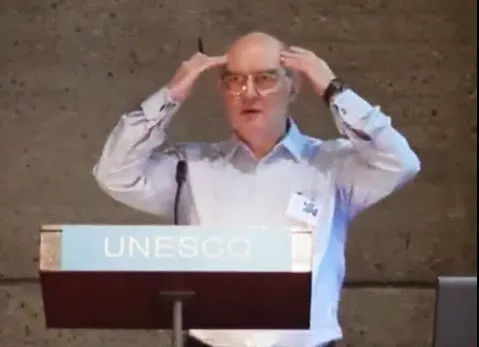
I bring him here, despite those antecedents, for his lecture at the IAU Symposium in 2009 on "The role of astronomy in society and culture."
The lecture can be viewed on video on Canal C2 and on Youtube. In both cases in English, as well as in the paper from the Proceedings.
What follows is an excerpt translated into Spanish from that paper.
The ties between astronomy and politics
Campion begins by citing the French sociologist Bruno Latour from his work We Have Never Been Modern. Latour's thesis is that theories of political and social organization are connected with astronomical or cosmological models and although the details may change, similar connections can be identified in all societies at every level of historical development.
"No one ever heard of a collective that did not mobilize in its composition the sky, the earth, bodies, goods, law, gods, souls, ancestors, forces, animals, beliefs, fictional beings...Such is the old anthropological matrix, the one we have never left". This is the quote from Latour's text on which Campion's discourse is based. (1)
The development of political astronomy in ancient societies is the consequence of what we could call an "environmental theology." From the book "The Cosmos as a State" (by Thorkild Jacobsen) Campion takes the concept of "Cosmic State" to describe societies in which human systems are thought of as inseparable from the celestial system.
He then brings up the Gudea cylinders. Cylinder A contains one of the most studied Sumerian hymns which recounts a dream sent by a god so that a temple may be built. Then a goddess helps in its interpretation of the dream.
There is no doubt: already then (the Sumerian renaissance dates from the 22nd century BCE) the political (in this case the King) was related to the "religious."
Then he cites Plato's Timaeus in which the Greek philosopher establishes that individuals are composed in the same way as the cosmos and that the organization of the state and politics must be in accordance with the mathematical principles that regulate the movement of the stars and planets.
Campion takes ideas from Ernest Baker to say that Plato assumed the Pythagorean view that represented God as a shepherd of the world and kings as the image of God. Such a view postulates a theocracy or a theory of the divine right of kings. The Platonic cosmos was one in which political obedience and respect for the order established by the celestial harmonies were emphasized.
He then points out that Plato's popularity in the 15th century was comparable to that of Hermes Trismegistus and that Copernicus was fascinated by Hermeticism, as glimpsed in De Revolutionibus. (See in JSON)
From there would derive what Campion calls "political Copernicanism" whose argument would be that if the Sun was the unquestionable center of the cosmos, then the King was the unquestionable center of the State. These authoritarian qualities acquire their final form in the cosmos as a clock of Thomas Hobbes, an admirer of Galileo.
In the 17th century Hobbes, showing his debt to Galileo and considering the universe of natural forces instead of divine ones, arrives at the conclusion that
"The Universe is corporeal, it is a body and has the dimensions of magnitude, namely, those of length, width, and depth; that is, each part of the body is, in turn, body and has in itself the same dimensions, consequently, each part of the Universe is body and what is not body is not part of the Universe. And since the Universe is everything, what does not form part of it is nothing and, consequently, does not exist anywhere". (Leviathan, Ch. XLVI, pg. 461, Libertador editions, Buenos Aires, 2004).
Thus, the Political Body, like the Celestial Body, must be strongly regulated so that the machine of the state functions well.
Until the 17th century, the political consequences of astronomy tended towards authoritarianism, either because they were designed to support royal power or to account for the presumed subordination of human action to celestial laws.
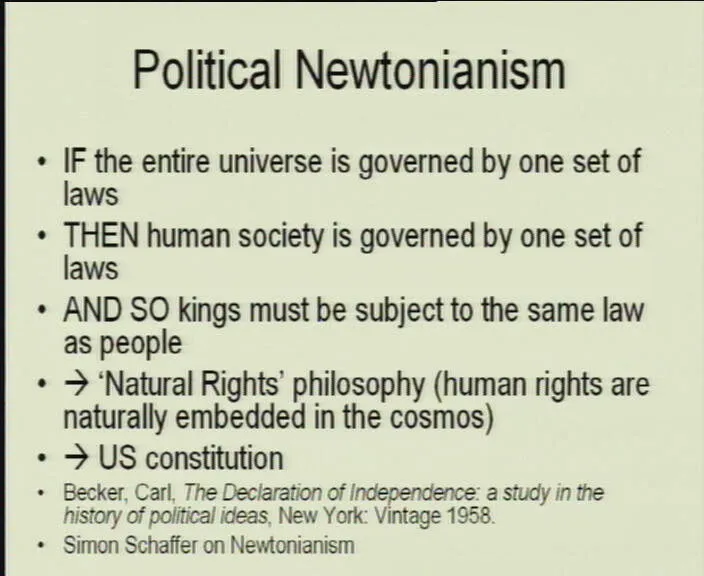
This equation is reversed in Newtonian Politics. The impact of Isaac Newton was based on the logic that if the universe is subject to a simple set of laws, then human society must be subject to the same laws. More: if kings are subject to the same laws, then the elevation of one above the others is contrary to natural laws. Monarchical power as an expression of the cosmos had to be replaced by the will of the people as an expression of the celestial laws. These ideas are then taken, says Campion, by John Locke.
When human rights theorists base their arguments on nature, they owe much to Newton since in the Newtonian sense, they are inherent to the very human condition.
Carl Becker, according to Campion, demonstrated that in the 18th century American radicals took the Principia in a political rather than a mathematical sense. And he points out that the same has been said of the English. In France, we have the case of Voltaire.
Newton's vision of the cosmos was egalitarian, although it was also interpreted as imperialist and as an anthropomorphic projection of human insecurities.
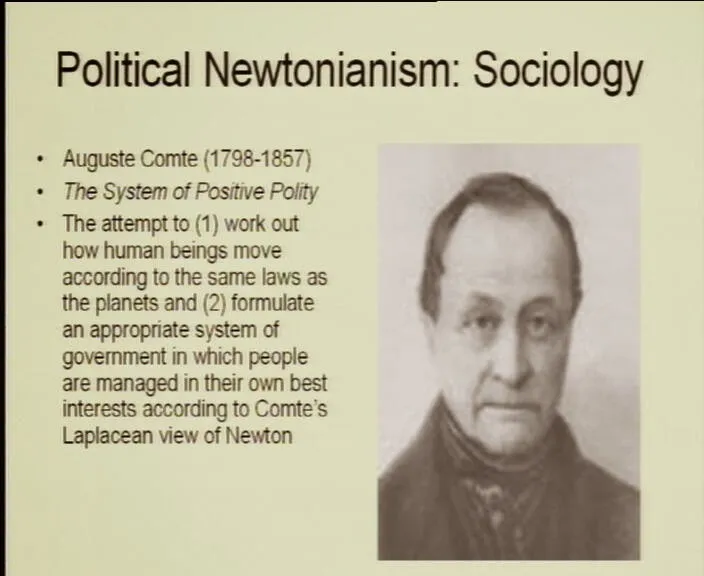
Among the Newtonians, the political Platonism in which the State should be more efficient by adhering to the mathematical order of the cosmos, assumed a radical form in the work of Auguste Comte, founder of sociology.
The French Revolution, he argued (according to Campion), followed by Saint-Simon, fatally wounded the old order but failed to destroy it completely, followed by Napoleon and the Bourbon kings. Comte believed that through the traumas and crises of the French Revolution, the world was gradually becoming a better place and that by the revolution of 1848 the law of progress was in its final stage. The one of 1789 was the negative revolution, the new revolution was the positive one.
His fundamental proposition was that if Kepler and Newton had discovered the laws of celestial motion and if they were universal, then they must apply to all things on Earth, including human behavior and relationships.
These laws were mathematical, therefore logic dictated the rules that governed our behavior.
People moved in the same relation to each other as the planets, so human behavior could be studied in the same way as astronomy-physics.
Thus, the philosophers of the Enlightenment tried to model human societies under celestial laws in order to maintain peace and restore harmony. The consequences of Newtonianism permeated all of the West in economics, sociology, and psychology.
Then Campion looks for references to Einstein's relativism in culture. Sokal & Bricmont noted that the notion of relativity in time and space was used by postmodernists to account for the fact that culture has no single center. The idea of the expanding universe and that our Milky Way is one galaxy among many became a metaphor for political insecurity in the 1930s. Dennis Cosgrove argued that photographs of Earth taken by Apollo astronauts in 1969 encouraged the concept of a world without political divisions or boundaries.
Zohan & Marshall tried to adapt the uncertainty principle from the subatomic level to the social, arguing that quantum mechanics can be used as an argument against the power of tradition and in favor of personal freedom.
And finally, Campion says that Latour's argument challenges the notion that modern political thought is necessarily more rational than it was in earlier periods (hence the name of Latour's title).
Conclusion
I have taken this conference for two reasons:
1-I understand that what Campion (and Latour) postulates is true: astronomy, cosmology influences social, political, and economic senses.
But, does that answer what the meaning of astronomy is? Does it imply that astronomy is a "necessity"? Does this argument justify the economic investment in researching black holes, for example?
In my view, Campion's reasoning is part of the answer, but it is incomplete.
2-What does Campion NOT say? What he does not say is that there is also an inverse relationship: politics influences astronomy. Not in the same terms.
Although it is possible to seek similar terminology (the "inflation" of space-time; the "hierarchical organization" of galaxies, etc.) I am not aiming at a metaphorical relationship between politics and astronomy, but at the political restrictions that give a certain meaning to astronomical activity.
What I say is this: Since the mid-19th century, early 20th century, a production system has dominated the global scene: capitalism. Astronomy is not isolated from that system, on the contrary.
We celebrate astronomical discoveries. But who OWNS that knowledge? To whom is it directed? For what purposes is it carried out? Only to increase our knowledge, out of pure curiosity, or also because behind it there are technical innovations that will later be used in other industries?
Who makes and who accesses astronomical knowledge? Is it not a "heritage" of humanity? But is it effectively so?
In my view, paraphrasing McLuhan, "the System is the message." Structures strongly condition the results. Note that I appeal to the term conditioning and not to predeterminism. The result is not guaranteed, but it is directed, favored, encouraged.
Astronomy cannot be understood today outside of that system. What I am saying is not that there is no alternative, but that what we currently call astronomy is not isolated from a larger configuration that conditions the activity.
The political-economic-social system leads to astronomy today being a certain way and not another. Regardless of value judgments (which I have), if I do not understand that what we call astronomy is a subsystem of a larger structure, then I do not understand what astronomy is.
Campion's paper establishes relationships between cosmology and politics. In other words, science is subsumed in an ideology, but also in a production system, a power relationship. We cannot ask ourselves what astronomy is today without inquiring into the political, ideological question.
About this series
This series was conceived in its general outlines before publication, but each part is published as I develop it. I hope in the end to be able to gather all the notes into a single text.
Meanwhile, I advance what follows: the next note in the series will attempt to inquire into the question "The system is the message" in a general way.
The next one will attempt to show how those ideas apply to current astronomy. (And also to other non-scientific activities).
In those two notes there will be no clear ideological positioning or the proposal of alternatives, but I will seek to establish an "objective reality" apart from value judgments.
But then I will address what I see as "harmful" in the prevailing system and what the possibilities for change are. For that I will rely on various authors. I welcome suggestions.
Sources and related links
- Conference from M. Nicholas CAMPION
Conférence : International Astronomical Union Symposium : The Rôle of Astronomy in Society and Culture
Production : Université Louis Pasteur, Strasbourg
Réalisation : Colloques et Conférences
Canal C2 http://canalc2.u-strasbg.fr/video.asp?idvideo=8345
Proceedings of the International Astronomical Union / Volume 5 / Symposium S260 / January 2009, pp 595 - 602
http://dx.doi.org/10.1017/S1743921311002894 - (1)Latour, B. 2006,We Have Never Been Modern(Cambridge: Harvard University Press), pg 107. See on Google Books.
In Spanish, Editorial Siglo XXI, 2012, Chapter 4 "Relativismo", section "Diferencias de tamaño", page 156.
About the images
- The initial image is a combination of a photograph taken by me, this year, with the silhouette of my telescope, together with a clip art image of Rodin's Thinker, which I used from the Takiwall site.
- The following figures were part of Campion's presentation at the seminar.