Astronomers announced on March 17 the detection of primordial gravitational waves that originated in the Big Bang. The announcement has been hailed as a milestone in science, but the concepts involved are unfamiliar to most.
The discovery gives a boost to what until now was a thorn in the side of the standard model: inflation.
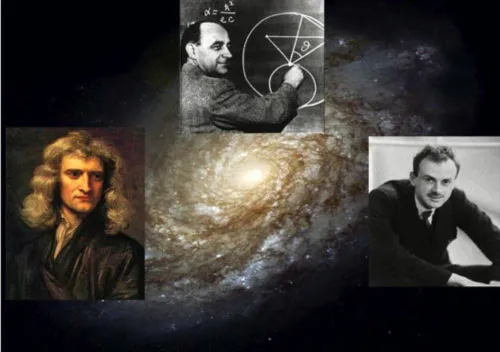
Alan Guth, who proposed cosmic inflation in the 1980s (as did Andrei Linde, A. Albrecht, and Paul Steinhardt), did so because such a process would solve a few problems in Big Bang theory: why the observable universe appears so uniform. One or two periods of inflation would imply an exponential expansion of space very shortly after the Big Bang. (See Inflation is a 'Mandinga' thing)
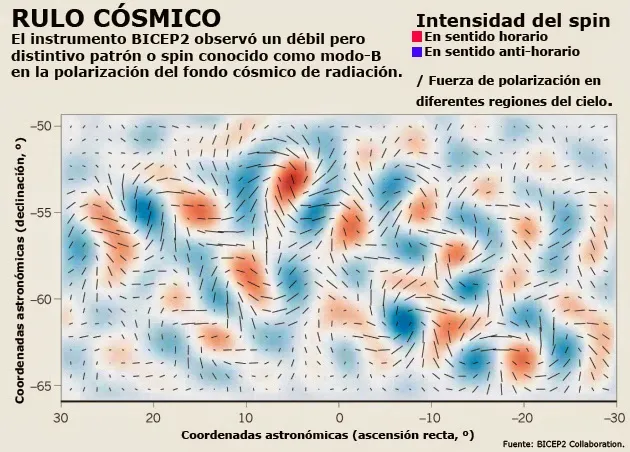
However, it was a hypothesis and had to be proven. If inflation really existed, then it could be detected by leaving a distinctive imprint: that brief but violent inflationary period would have generated gravitational waves that compress space in one direction while stretching it in the other (the wave effect). These waves would have left an imprint on the Cosmic Microwave Background (CMB) by polarizing the radiation in a particular way called B-Mode. (The cosmic curl).
Last year, B-mode polarization had been detected in the CMB. The signal was not interpreted as primordial gravitational waves, but was attributed to how galaxies curve the space through which the CMB travels. It was interpreted this way and not as primordial waves because such waves, if they exist, must be found at an angular scale smaller than one degree. The full Moon has an apparent size in the sky of half a degree.
That is what the team led by Jon Kovac achieved using BICEP2, meters away from the telescope that had detected the previous waves, in Antarctica, the SPT.
The finding has other implications. It not only supports the hypothesis of cosmic inflation, but also supports quantum gravity.
The data indicate that when inflation occurred (about 10-37 seconds after the Big Bang) and due to the temperature at that moment (corresponding to energies of 1016 gigaelectronvolts), three of the four fundamental forces -the weak force, the strong force, and the electromagnetic force- would be indistinguishable from each other in a model known as Grand Unified Theory.
Since inflation took place in the realm of quantum physics, detecting these waves from that time provides "the first experimental evidence of quantum gravity," according to Max Tegmark, a cosmologist at MIT.
The importance of the announcement
Albert Einstein predicted gravitational waves a century ago, but he calculated that they would be very weak, so weak that they would not be detectable.
These waves, if the finding is confirmed, would be an important support for modern cosmology: inflation.
But, what are these waves?
Gravity, according to Einstein, is how mass deforms the shape of space: near any massive object, space curves. This deformation can propagate through the universe, like seismic waves in the Earth's crust. But unlike these, gravitational waves can travel in empty space at the speed of light.
Can these waves be produced by something other than inflation?
This is a big question because in the universe causal relationships can be ambiguous.
Gravitational waves can be produced by any massive body, but in practice only those produced in cataclysmic events like the collision of black holes could be detected.
Is this discovery direct proof?
In science, direct proofs are difficult. Not all evidence is direct proof. We can infer the existence of electrons and positrons in a cloud chamber by the tracks these particles leave and infer their electric charge.
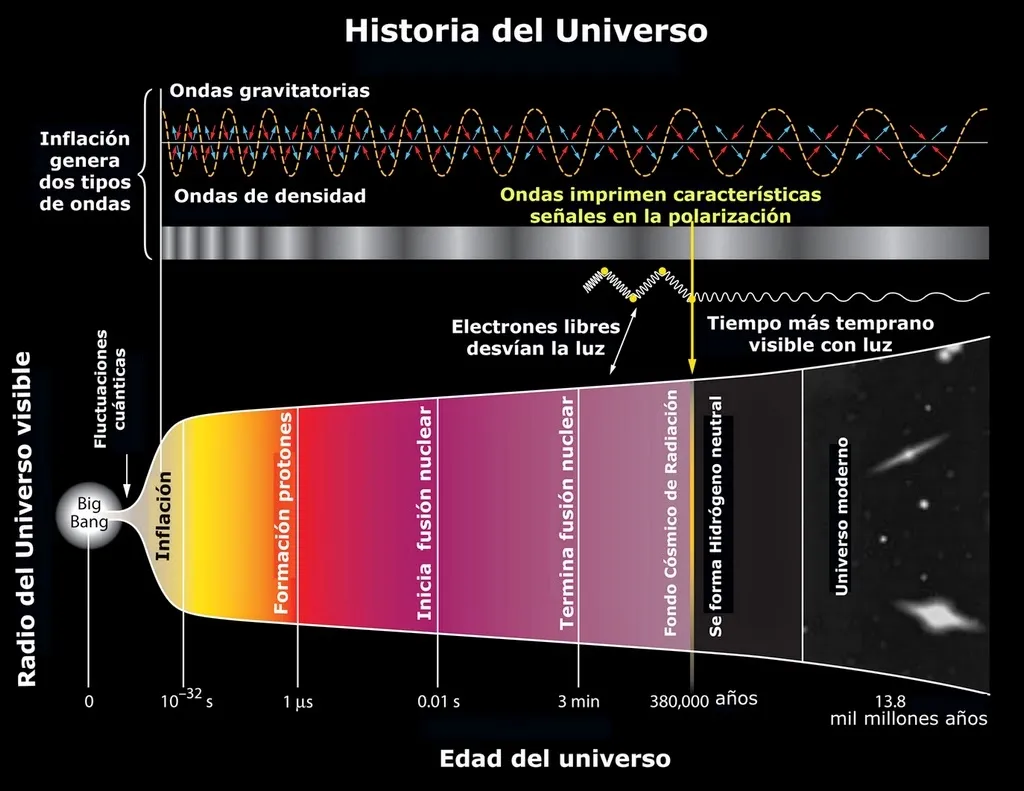
Gravitational waves originating during inflation still resonate in the universe, but they are very weak. Instead, these waves leave an imprint on the elementary particles that permeated the universe 380,000 years after the Big Bang, which we can detect in the Cosmic Microwave Background Radiation.
If this finding is confirmed, what other consequences would there be?
There are other models that will not coincide with this finding, such as the inflationary theories (brane cosmology) of Steinhardt–Turok called the Cyclic and Ekpyrotic models (see arXiv:astro-ph/0401579).
Many inflationary models would be ruled out if this discovery is confirmed, as has been publicly noted since the announcement.
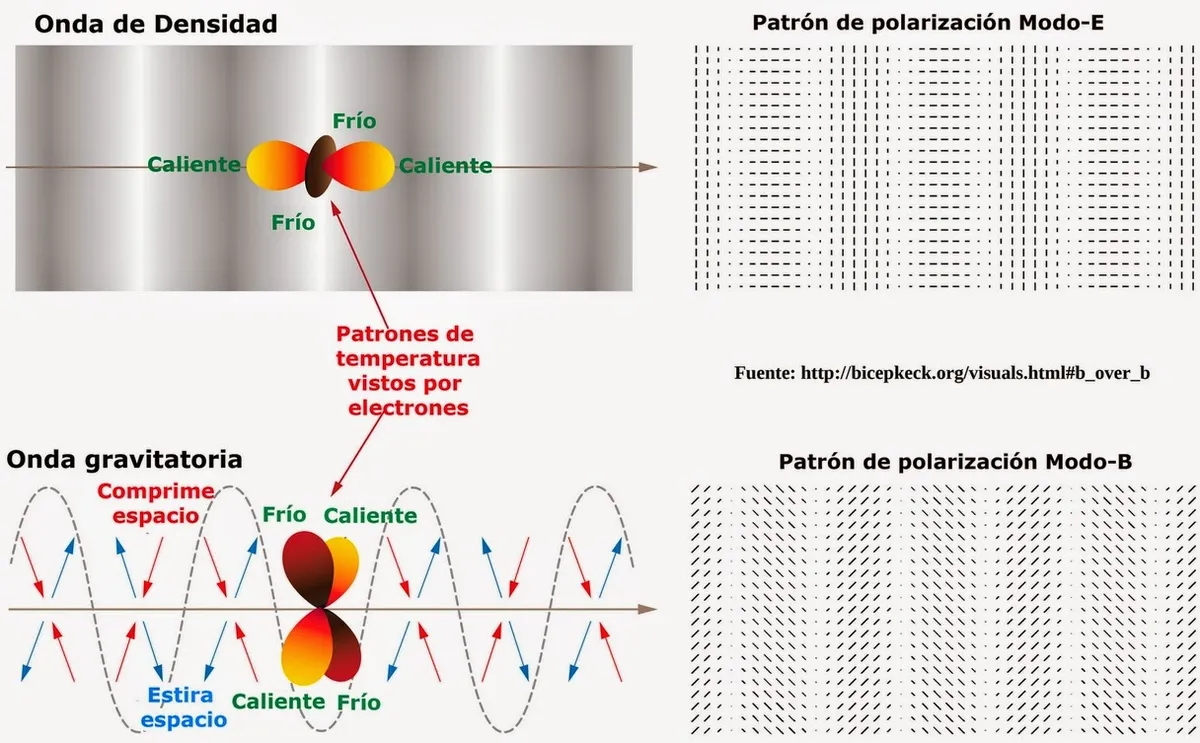
By measuring the polarization of the CMB at different points in the sky it is possible to determine a polarized direction and intensity (the polarized intensity of the CMB is less than 1/1,000,000 of the total brightness). This can be visualized as a map of small segments at each point in the sky, the patterns that were analyzed. B-mode polarization is that part of the pattern that is "curled". For the density fluctuations that generate most of the CMB polarization, this part of the primordial pattern is exactly zero. This is because density flows in the early universe passed into or out of denser regions and the polarization lines with those flows did not "curl", producing only E-mode patterns. Therefore, to have B-mode patterns in the early universe, gravitational waves are needed. Credit: BICEP2 Collaboration.
Inflation is a 'Mandinga' thing
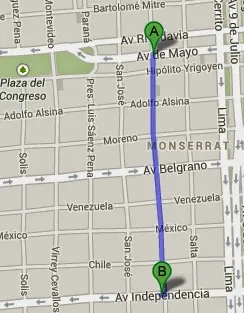
Let's imagine we are in the Monserrat neighborhood, in Capital Federal. We are walking down Avenida de Mayo towards the South. We see some bookstores and are amazed by the French-style architecture. If we continue walking south, we will cross Av. Independencia and will then be in the Constitución neighborhood. The landscape will change.
Now let's think we are on Av. de Mayo but space stretches. Between Av. de Mayo and Santiago del Estero to Independencia and Santiago del Estero there is 1 km. Suppose that only then does the landscape change. Imagine that this distance stretches and becomes 2000 km. This would mean that now we would walk through this stretched zone and would not notice a change in the landscape, since Av. Independencia and the Constitución neighborhood would be very far away.
In the early universe many changes occurred in very little time. If there were no inflationary process, we would have to notice those changes in a notable way. As if when observing the sky we saw very different physical processes in different "neighborhoods" or regions of space. But what is observed is very homogeneous. Inflation attempted to solve that, "flattening" the differences.
The CMB
On the UBA exactas site, specialist Susana Landau, a physics graduate from Exactas UBA and a doctor in Astronomy from the Universidad Nacional de La Plata and a CONICET researcher, explains the CMB:
"Before neutral hydrogen formed, electrons and photons interacted through collisions forming part of something that can be thought of as a fluid. In this fluid, the electrons provided the mass or inertia that pulled toward the center while the photons exerted a radiation pressure that pushed outward. In this way, electromagnetic radiation was trapped in that fluid. As the universe's fluid expanded it also cooled and, then, when the energy of the electrons dropped to levels favorable for union with protons, hydrogen atoms formed. At that moment, the photons were left without playmates, which is equivalent to saying that the electromagnetic radiation was no longer trapped and that they could travel freely through the universe. Even now those photons travel through the cosmos without interacting with anything and constitute the CMB: a cosmic fossil that holds a lot of information about the amount of total matter and energy, about how the most abundant element –neutral hydrogen– forms, about the early geometry through which they themselves traveled and, the fundamentally novel thing, about the first thousandth of a second after the Big Bang. I repeat, it is not a photo of that instant but a map of the polarization of the electromagnetic radiation that reaches us and which, in turn, is a representation of the primordial gravitational waves."
The polarization
The specialist explains: “The polarization of this radiation has different types of causes. The astonishing thing is that the angular scale and intensity of the polarization recently communicated is exactly what the so-called inflation theories predict, that is, those of an accelerated expansion only at the beginning of the universe. For this reason, this discovery is the first direct evidence of these inflationary models that seemed very crazy. The idea of inflation allowed us cosmologists to explain, in an elegant way, a bunch of problems like, among several others, the formation of galaxies and clusters of galaxies, but now that theory also tells us that you made, which also takes elements from both quantum mechanics and general relativity, is predicting these gravitational waves that we are seeing today”, explains Landau and adds: “Although the temperature of the CMB and its granularity or anisotropy had already been measured in great detail, that was not enough to validate the theory of inflation.”
Sources and related links
- CfA: First Direct Evidence of Cosmic Inflation
- Nature: Telescope captures view of gravitational waves, by Ron Cowen.
- UBA Exactas: Murmurs of the Universe, by Guillermo Matei.
- BICEP2 Results 2014
- Nature: Special Waves from the Big Bang
About the images
- The three images were taken from the BICEP2 collaboration site, translated by me.