It will be in the early morning and will be visible across the country. The Buenos Aires Planetarium invites you to observe the phenomenon.
As in all eclipses, on the night of Monday the 14th to Tuesday the 15th of April there will be a Full Moon.
It's worth stopping to think before continuing. When there is a full moon, what time does the Moon rise and set? One way to get an approximate answer is to think that the phases of the moon are due to the different illumination coming from the Sun. Therefore, since there is a relationship between the relative position of the Moon and the Sun, we can get an idea of the times, since we know that the Sun usually rises around 06:00 and usually sets around 18:00 (so it travels across the sky for about 12 hours, approximately).
Let's imagine the Full Moon is high in the sky. So where is the Sun? Since the face we see is fully illuminated, the Sun must be "on this side" of the Moon, unlike what happens at New Moon when the Sun is "on the other side" of the Moon.
Therefore, the Sun is on the other side of the Earth, that is, "down." If the Sun is well down, it is halfway between East and West. A quarter of the way is 6 hours. So, the Moon rose 6 hours ago and will set in 6 hours, since the Moon also travels across the sky in about 12 hours, approx.
So if the Moon is "in the North" and the Sun in the "South" there is a 180º difference that will be maintained that day, although throughout the lunar cycle that difference changes.
That's why, when the Moon rose, the Sun set. Ergo, the Moon rose around 18:00. When the Sun rises, the Moon will set. That will be around 6:00.
So if there is a full moon, we know in advance that the Moon will rise around 6 in the afternoon and set at 6 in the morning, approximately.
In fact, the Moon will rise that day at 18:10 and set at 7:28 (Argentina time).
How the eclipse will be and what will be seen
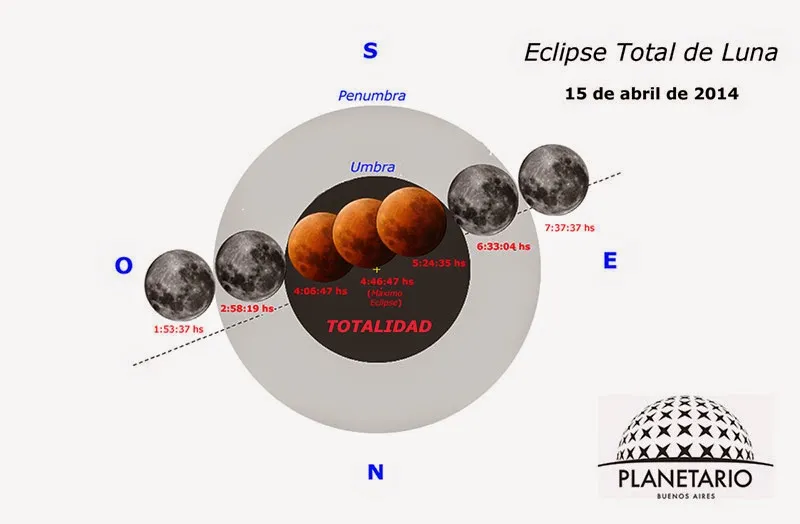
At 1:53 h, the Moon will enter the penumbra (the outer part of Earth's shadow). It will be, technically speaking, the beginning of the eclipse. The Moon will be about 60º above the horizon (90º would be right above our heads, the zenith). However, we will hardly notice anything until a while later. The real show will begin at 2:58 h, when the Moon enters the "umbra" (the central part of Earth's shadow cone). Selene will be at an altitude of 51º. Minute by minute, Earth's rounded shadow will cover the lunar disk, drawing an ever-larger dark "bite."
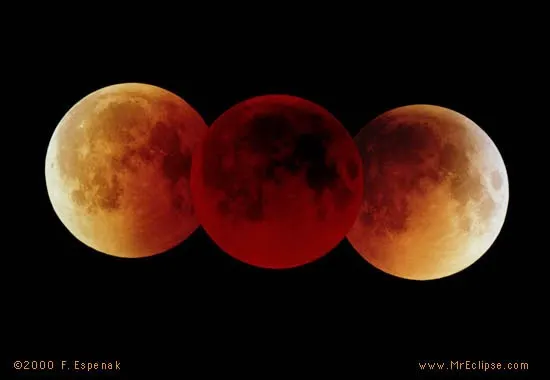
At 4:07 h, the Moon will be completely immersed in Earth's umbra: it will be the beginning of the eclipse's "totality." Its central and most spectacular phase. The satellite will be 38º from the horizon. During the following 78 minutes, our satellite will be faintly illuminated with a soft reddish-orange color (the result of the refraction of some sunlight, by Earth's own atmosphere, into the shadow cone).
End of the eclipse
The "totality" of the lunar eclipse will end at 5:24 h. From that moment on, direct, intense white sunlight will gradually regain the selenite disk. The Moon will leave the "umbra" at 6:33 h (already in full morning twilight). The Moon will be at an altitude of 10º and the Sun will rise at 7:17. That will be the end of the true eclipse (only a little over an hour of the final penumbral stage will remain, which is practically irrelevant).
Near the Moon, the brightest star of Virgo, Spica, can be observed. And Mars will be prowling the area.
Where it will be visible
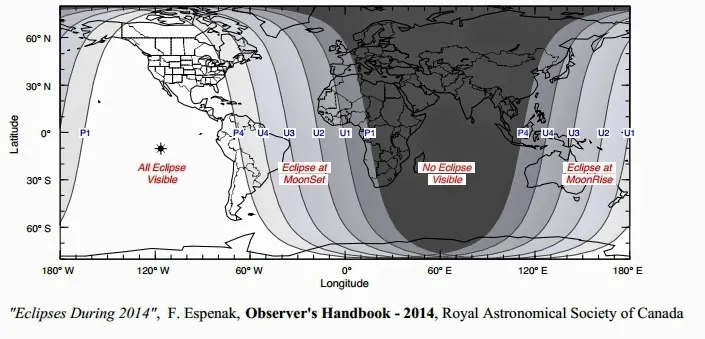
The entire event will be visible from North and South America. Observers in the Western Pacific will miss half the eclipse because it will occur before their sunrise. Likewise, most of Europe and Africa will experience moonset right at the beginning of the eclipse. No observers in Northeast Europe, East Africa, and Asia will see the eclipse. The following graphic shows the area where it will be fully visible (in white), the area where it will be visible during moonset (in shades of gray), and the regions where it will not be visible (in black).
The rematch
There will be another total lunar eclipse on October 8. But we won't see it completely. The entry into the penumbra will be at 8:15 UTC, that is, at 5:15 Argentina time. That day the Moon will rise at 18:23 and set at 6:20. At 5:15 the Moon is at an altitude of about 12º.
The entry into the umbra will be at 9:14 UTC, that is, at 6:14 local time.
But for the inhabitants of the North there will be a bit more observation time, since in San Salvador de Jujuy the Moon will set at 6:54.
The entry into totality will occur at 10:25 UTC, that is, at 7:25 Argentina time.
The true rematch, meaning we can see a complete event of this type from our country, will be next year, on September 28.
In the related links I indicate two sites to learn more about upcoming eclipses, but it should be considered that in the case of the graphics they were made in the Northern Hemisphere.
The Planetarium invites
The Buenos Aires Planetarium will organize a special event - public and free - to observe the eclipse with several telescopes, a giant screen, and music.
The meeting will be next Tuesday the 15th (night of Monday the 14th), starting at 3:00 h, at the entrance of the Buenos Aires Planetarium, Av. Sarmiento and Av. Figueroa Alcorta.
As happens with these events, it is subject to weather conditions. For now, the forecast for Tuesday is good.
Sources and related links
- Eclipse at the Planetarium
- NASA Eclipse
- MrEclipse
About the images
- Initial image: Photo from Mr. Eclipse.com. Credit: F. Espenak.
- Fig. 1: Planetario Galileo Galilei.
- Fig. 2: Graphic from NASA Eclipse. Credit: "Eclipses During 2014", F. Espenak, Observer's Handbook - 2014, Royal Astronomical Society of Canada.