What is astronomy? Is it, was it, and will it always be the same?
In a previous post in this series I said that astronomy is the way it is today because it is part of a system: capitalism.
The thesis that supports that idea can be stated as: The system (which has rewards and punishments) conditions our individual and group behavior. It does not predetermine it, but it strongly conditions it.
In response to this idea, I imagine two types of objections:
1-That astronomy existed before capitalism.
2-That if this model is not predeterministic, then, the outcome of a system is variable because we have freedom.
I refute those objections:
1-Artistic production also existed before capitalism. But you cannot explain art based solely on the paintings of Altamira. Certainly there are elements in common between the past and the present, which is why cave paintings, Baroque art, and pop art can all be considered "the same." However, along with those similarities there are differences given by different "current" factors from the previous ones.
How is astronomy done? Who does it? What is astronomy done for? How is astronomy communicated? are questions that mark differences between that activity developed by the Greeks or the Babylonians and the "same" current activity. And, in my view, such differences cannot be explained without understanding social systems.
2-The concept of freedom is complicated and, in many cases, illusory. Let's think about legal freedom and social freedom. In both cases, such freedoms have limitations. Legally we cannot kill other people, even though in fact we can buy a weapon and murder, but then we will be punished by the law. Socially the same happens with, for example, clothing. Nothing prevents (empirically) me from dressing as Batman to go to work, but that action will be "punished" socially.
We can also think about economic and political freedom. What degree of economic freedom do we have when economic power is in the hands of a few? and What level of political freedom do we possess when we delegate it to "representatives"?
It is objected that the State invests money in building a telescope that will be used to study black holes, on the grounds that such research has no "impact" on the quality of life. There is not only a concept of "need" that we should review to answer such formulations, but also a concept of wealth distribution, a concept of the State, a political ideology.
If we don't realize that, we cannot face such questions.
Resources and utilities
The same people who object to that State spending on apparently useless things, do not object to private companies investing huge resources in creating a factory. Suppose a company in Finland decides to spend a lot of money building a factory for cell phone batteries.
In the first case, the State's action is objected to because it uses money that belongs to everyone (for something supposedly useless).
In the second, the company's action is not objected to because, supposedly, it does NOT use money from everyone (for something supposedly useful).
Let's review this: Such a company, to produce lithium-ion batteries, uses a mineral that belongs to all human beings. The lithium that exists naturally in Bolivia or Argentina, the copper in Chile, the silver, gold and other minerals frequently used in electronic production, do not have labels with proper names of people, companies, or countries. It is in the world and the world belongs to everyone, regardless of political divisions.
So that formulation, which gave rise to this series, can only be analyzed as a symptom of the times we live in, a sign that the person formulating it thinks in a capitalist way.
Capitalist thinking, furthermore, has as a consequence giving almost absolute priority to instrumental needs, which is where ONE concept of "utility" arises.
But I don't want to stay there, since science (in this case astronomy) is also done within a capitalist framework, without objecting to it.
This may seem paradoxical: instrumental thinking threatens astronomy (and the other basic sciences, as well as the social sciences, art and philosophy). However, astronomy USES instrumental arguments.
How to understand that apparent contradiction?
First, astronomy (the sciences) is not anti-capitalist. I will be told that is a matter of economics and not of natural and exact sciences. A huge mistake because, as we will see in the next post, the mode of production of astronomy (and the sciences and art) is intimately related to capitalism. Cultural production is not separate from the production system. For two centuries, human production has adapted to the capitalist system.
Second, the sciences make use of the concept of utilitarian or instrumental need to justify themselves. It is the same type of argument by which it is objected to.
System and ideology
I will be told that it is not because of systems, but that people are naturally like that (the idea of selfish interest/gene, linked to competition). I am less and less sure what it means for our behavior to be "natural." Rather, I think as others have before, like Rousseau, that the human being is made. We are as we make ourselves. Religion, the educational system, the production system do not guarantee that we are a specific way, but they strongly condition us.
We are taught from childhood that competition is healthy and brings out the best in us. Do the best really triumph in the world we live in? What is being "better"? When we say Messi is the best player, what is the criterion? Soccer does not give points or prizes to the team that plays well, but to the one that wins (even if it's with the hand).
The artists who "triumph" are they the "best" or the most beautiful, the ones who sell the most?
And in science, who are the "best"? The Nobel Prize winners, those with a higher H-index, or those who do outreach?
The systems of soccer, media, music, science, who designs them and for what purpose?
Instead of assuming that what we do and the way we do it is the product of a struggle of supernatural forces (Good and Evil), I understand the social world through human will. I also understand that what we do has a reason, motive, or interest. I also call that ideology. However, for many, science or art or soccer have no ideology. On the contrary, I think that both science and art are human practices. We do them and for some reason. What is the goal of science or of art? I cannot give a romantic answer (which would assume only what I desire), but I try to evaluate what happens today in reality. On that "diagnosis" I can think about alternatives, but only after understanding how we function as a society.
The concept of system, applied to the social sciences, is somewhat controversial, partly because it is "easy". It is simple to understand (and over-understand) and quite linear. However, it is a valid term, at least as an approximation.
In the book "Science and Technology as Ideology", Jünger Habermas uses the concept of "system" from the discourses of Max Weber and Marcuse based on the fusion of technique and domination through rational action with respect to ends. The topic also appears in his work "Knowledge and Human Interests": he takes from Kant that knowledge is associated with some type of interest (pure or practical) and this is related to needs. Finally Habermas proposes a taxonomy of interests: the technical, the communicative, and the emancipatory.
Let's remember how this series began and we will see that in the question that originates it there is an idea of practical interest that, in my view, predominates in society and conditions it.
In his Critique of Instrumental Reason, Horkheimer assumes what the common person answers when asked what they understand by the concept of reason: "The average man will say that, evidently, reasonable things are useful things and that every reasonable man must be able to discern what is useful to him".[1]
What the author sees in this type of formulation is that a game of means and ends, considered rational in themselves, is taken for granted, and he perceives that such an answer is a symptom of the change in thinking in the Western world in recent centuries.
Another symptom of this system is found by the author in the story (I don't know if true) of a boy looking at the sky, who asks: "Dad, what article is the Moon advertising?".[2]
It seems that everything must have an instrumental or pragmatic purpose. Even the Moon must "serve" for something. And that objective is, ultimately, economic.
The German author takes the concept of selfish interest and competition under the idea of self-preservation. "Man tries to turn everything within his reach into a means for that end. Every word or sentence that has implications other than pragmatic ones is suspect".[3]
Instrumental science
In the United States (liberal capitalism) they use the concept of STEM, an acronym referring to knowledge in science, technology, engineering, mathematics. And there are state efforts for citizens to be educated in those areas. Is it because it is considered "necessary"? Yes, but it is a need that is ultimately linked to production and therefore, finally, to economic profit in an industrial society.
It is necessary, for the U.S., to have engineers and mathematicians to produce. Knowledge here is seen as an instrumental need (see below). In other countries that carry out a "progressive capitalism" the same thing happens.
Isn't the citizenry educated to possess "critical thinking"? It happens that an astronomer has the critical thinking required to rationally evaluate the apparent brightness of a star, but not in other ways. It is a technical critical thinking, not reflective. Having a higher education in (natural and exact) sciences does not guarantee anything regarding the formation of social critical thinking. It can happen and sometimes happily does. In Argentina, the case of Oscar Varsavsky is a good example.
The educational system is not designed to form free thinkers regarding consumer society and the social system. The astronomer is not educated about that, at least not at the University. Dedicating oneself to that, again, "doesn't pay". In fact, it is considered "not necessary".
Astronomy and need
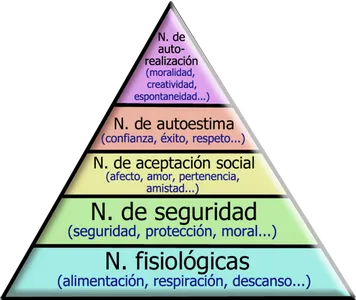
One might ask if astronomy is a need. The psychologist Abraham Maslow thought of a "pyramid" of needs, usually illustrated with a triangle like this.
This taxonomy assumes a rigid logical linearity: first I must satisfy physiological needs and only then those of security, since it is a "hierarchical system". On the contrary, it seems to me that those (and other needs) can be satisfied simultaneously and in a different order.
Maslow's taxonomy can be thought of in an individual sense, but also collectively, as a society.
The order of needs will depend on each spatio-temporal, historical-social configuration, of each community-individual.
Nor can we think that needs are achieved absolutely at some point. The need to eat, for example, is never definitively achieved.
It seems to me that the taxonomy can be thought of in this way:
1-Need is everything that is indispensable, unlike desire which is an aspiration for what is not needed.
2-Satisfiers. Every need uses one or several satisfiers. The need for food is satisfied by the intake of meat, vegetables, etc. Each of those elements are satisfiers. I don't need to eat meat or caviar. I need to eat.
3-There are first-order needs that require immediate satisfaction for subsistence (Maslow's physiological ones).
4-Intermediate/instrumental needs: Some needs turn out to be satisfiers of another need. Studying can be an activity thought of in that sense. If the need is economic security, to achieve it I can use the satisfier "job", but to be able to use such a satisfier I must obtain knowledge. In this way, obtaining knowledge is a satisfier of the need "job", which is actually another satisfier of the need "economic security".
5-The human being requires satisfying several needs (not infinite) and many at the same time because needs are intertwined. This is considerably important in the notion of social satisfaction, linked to the concept of "dignified life" which is not achieved only with "basic needs".
In a capitalist system, which favors instrumental needs, the goal is individual, not social.
6-There are finalistic needs: they are needs that have always existed, but are not essential in the short term, but in the long term. The need for expression is an example. The Altamira cave paintings perhaps respond to such a need. But certainly, even though that need has been "always there," I can hardly fulfill it if a tiger is about to attack me. Although these needs can be postponed, they are permanently within us, but only in some circumstances can we develop them.
In my view, astronomy is an instrumental need and a finalistic need. It is instrumental as those who justify astronomy through the so-called "technology transfer" point out. By designing and building better telescopes, knowledge may arise, for example in the field of optics, which can later be used in other industries and have, indirectly, an "impact" on the quality of life. However...
Astronomy as an instrumental need
Although I understand that astronomy is justified in this way, one must tell it like it is, a parrhesiast would say.
The current Argentine Government created the Ministry of Science in 2007, which gave science a "social impulse," with the goal of solving real and local problems, that is, having an "impact" on the quality of life.
One of the most developed or promoted areas since then is nanotechnology, which is justified, in most public speeches, by its instrumental character. Roberto Reale, Undersecretary for State Modernization, wrote in El Cronista regarding nanotechnology:
"In our daily lives, its applications are increasingly present through multiple disciplines."
But, correctly, he then clarifies: "What remains to be established is whether this great potential, which is nanotechnology, will be harnessed to improve human quality of life or for its destruction, since its uses for good and evil are unlimited." [4]
It is for this reason that I do not consider the instrumental argument as valid to justify astronomy (and the same in other areas, like art).
In fact, the justification for music or astronomy is that they respond to finalistic needs: the need for expression and the need to know, respectively. However, this justification cannot be disconnected from social reality. In every society there will be some system. Let's think of a system different from the capitalist one. In a socialist system the finalistic argument will have greater weight, but astronomy cannot be justified except based on its relationship with society. In a community with large pockets of poverty it would be irrational (for the sake of the common good) to use resources to study black holes, instead of alleviating hunger. Hence, astronomy is not justified "in itself." The meaning of astronomy arises from its historical-social configuration. Let us remember, however, that in our societies not only astronomy is done, but a wide range of things whose "usefulness" is questionable, both in the private and state spheres.
Society and system
Who is to blame for society being the way it is? Who "designs" social systems?
It would be lengthy to answer such a question, which, moreover, would be poorly formulated. What we call society is a set of people who interact and these relationships are the product of a historical process. So who MAKES history?
Another question: If thinking that both astronomy and the rest of the sciences, as well as art and philosophy, sports and other activities are, currently, capitalist, isn't that a merely "economistic" stance?
I refer, for both questions, to a letter from Engels to José Bloch.
Astronomy and system
Is astronomy exempt from this system? Some will tell me that the sciences have constituted "autarkic" systems. Yes, in part. And that has also resulted, in many cases, in isolation. And that is so for the reasons described above.
I will be told that astronomy (I refer to research) does not seek economic/material profit, but pure knowledge. Are you sure?
In the next part I will dedicate myself to showing (which is not the same as proving) why it is reasonable to say that current astronomy is the product of a system.
What I am trying to do is reach a diagnosis. The valuation of such a diagnosis is another matter. Some will think that things are fine as they are, others will think that something is wrong, and there will be those who think that the only alternative is to change everything. My position will become clear in the last part of this series. Meanwhile, I believe it is possible, aside from value judgments, to reach a realistic diagnosis and not a romantic one. Observing the sky and deep space objects is beautiful. Professional, modern astronomy is something else.
----------
Note on needs: An indispensable work on the subject is "The Necessity of Art," by Ernst Fischer. Perhaps I will address the issue here in some post, but for now my idea is to compile all the posts on the topic -once I finish- into a single work that will be corrected and expanded with citations and bibliography.
Sources and related links
- [1] Horkheimer, Max. Critique of Instrumental Reason. Buenos Aires. Editorial Sur, 1973, Spanish version by H.A.MURENA and D.J. VOGELMANN, page 15.
- [2] See an article on the subject of advertising commodification that takes up the same example in María Teresa Pellicer Jordá, La publicidad infantil. ¿Qué vende la Luna?, Razón y Palabra Nº 76, year 16, May 2011- July 2011
http://www.razonypalabra.org.mx/N/N76/index76_final.html (last accessed 22-2-2014) - [3] Horkheimer, Max. op.cit., page 111.
- [4] Things change because of nanotechnology, by Roberto Reale Undersecretary for State Modernization.
El Cronista Comercial, 03-01-2014, opinion, page 14.
http://m.cronista.com/opinion/-Las-cosas-cambian-por-la-nanotecnologia-20140103-0011.html (last accessed 22-2-2014)
About the images
- Initial composition made with a background image of my own and an image of The Thinker, by Rodin, retouched by Walké (Photo by user:Hansjorn) [GFDL or CC-BY-SA-3.0], via Wikimedia Commons
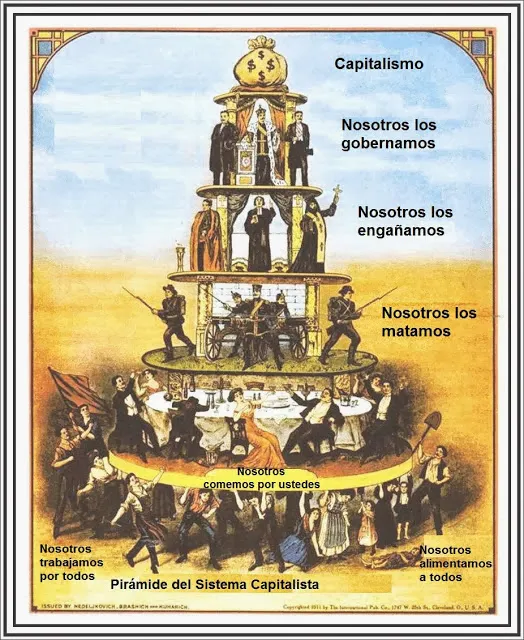
- Pyramid of the Capitalist System: at the top, money (1911 poster by Industrial Workers of the World), in Spanish. Taken from http://davinnie05.blogspot.com.ar/2013/06/piramide-del-sistema-capitalista.html (last accessed 22-2-2014)
- Interpretation of Maslow's pyramid, by Dalton2, Dalton1 (Own work) [CC-BY-SA-1.0], via Wikimedia Commons.