According to Bernard Jones, astronomy does not only "serve" to know more, but has tangible "benefits" for society. In a conference during the International Year of Astronomy, in 2009, he presented his point of view.
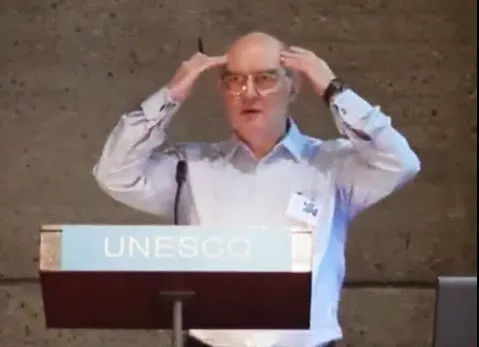
In a previous note I made an introduction to the topic by indicating a series of items that the issue seems to have according to certain shared discourses.
This thematic outline is not complete nor does it reflect my opinion on the matter, but arises from points of view of other people along with inferences I allowed myself to make.
Among those points are "technology transfer" and education.
During the International Year of Astronomy 2009, the IAU symposium titled "The Rôle of Astronomy in Society and Culture" was held at Unesco, Paris.
In this space we will give room to some of the conferences held there, as they addressed the topic of what astronomy "is for".
Bernard Jones's conference, held on 22-1-2009, was titled "How, precisely, can astronomy be of benefit to anyone?" that is, "How can astronomy be of benefit to everyone, really?".
The content of the conferences can be traced using two sources that host the content through two different media. On one hand, they were published in written form in Proceedings of the International Astronomical Union, Volume 5, Symposium S260, available for free download.
But the lectures were also recorded audiovisually and appear in video on the Canal C2 website.
What follows is a synthesis of Bernard Jones's arguments and not a translation of his paper or the lecture.
Bernard Jones and his astronomical practice
The lecturer introduces himself by indicating that it has been 40 years since he obtained his doctorate in astronomy at Cambridge under the supervision of Dennis Sciama and Martin Rees (two eminences in cosmology). He worked full-time for 25 years at various universities around the world and in 1983 Jones and his wife, Janet, formed a technology company in Copenhagen and two years later he left academia to dedicate himself to that venture. The company's goal was to exploit the knowledge gained from astronomy for the benefit of the commercial domain. They focused on image and video processing. According to him, astronomers are very good at dealing with complex images and data. That will be his main argument, later applied to the "outside of academia."
His company is called Astraguard and specializes in the acquisition, compression, processing, analysis and storage of video with a wavelet far superior to the standardized MPEG-4.
However, he indicates, he continued doing cosmology, interested in understanding the large-scale cosmic structure.
The importance of the question
Starting from the title of his lecture, which is a question, he points out that it is important in the context of the high budget in sciences where the justification of funds in terms of objectives is central to supporting one project over another.
There is also a purely intellectual answer based on the fact that basic research is important because otherwise, as a society, there would be no progress.
But, he continues, it is difficult to argue that fast asteroids, although they may be very interesting, are manifestly important to everyone, except for a small community. The public, which pays taxes, feels that in these days of financial crisis (remember that the lecture is from 2009) there must be a direct return on investment.
According to Jones, many of his academic colleagues would argue against this by saying that the return is a deepening of the understanding of nature, from which we all benefit. And he adds, that may be so, but the public needs to see that benefit, it must be tangible.
And then he justifies his lecture: he will argue that those benefits exist and that astronomy is in a stronger position than other branches of science in returning those benefits to the society that pays for them. It is important, he notes, to recognize that this public benefit is not books with many pretty pictures taken with the Hubble Space Telescope.
The question of how astronomy can be of benefit to everyone could have been answered a millennium ago as 'To make better predictions for more accurate horoscopes.' 500 years ago and up to the last century the answer could have been formulated as 'To search for clocks and global position.' Today, the clearest answer might be: 'To inspire the general public.' That is undeniably important, Jones opines, but surely there must be more than that, right? Yes there is, according to the astronomer, and his purpose is to point out what that other thing is, in a realistic way.
http://youtu.be/v7T3ypoW7U4
The varied knowledge of astronomers
Astronomy contains a remarkably diverse number of disciplines in which most professionals specialize and stick to an area of interest for most of their careers. These fields of specialization tend to become increasingly technical and specific.
Jones says that astronomers are good at:
Creating instruments, acquiring data, managing databases, modeling, simulating, interpreting data.
In his own field (cosmology) data visualization is becoming a key research tool.
From explaining the importance of data visualization and simulation he will then arrive at an argument to answer the question.
Before, however, it refers to an issue of the magazine Physics Today about a report titled "The business of Academic Physics" (#1) in which a number of conclusions are reached that can be summarized as that physics students obtain a solid education for a diverse range of careers, but that the students are unaware of this.
It also indicates the academic overvaluation of the doctorate, an extremely counter-productive narrow vision that leaves most new physicists at a disadvantage.
He comments on this that there is little interest in astronomy and physics in preparing graduates for the "outside world".
Skills
Employers in finance, administration, and technology look for individuals with "standard skills". Someone without those skills is at a disadvantage when applying for a job. Some aspects of what is taught to students are synthesized in a table (like the one I show here, taken from the paper).
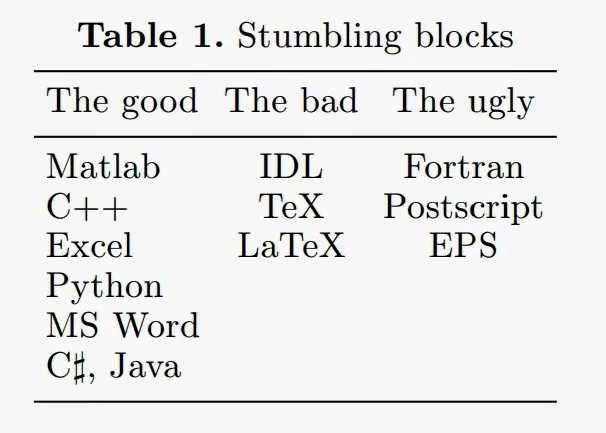
As will be seen, computer languages are classified by referring to the film "The Good, the Bad and the Ugly".
Currently, Jones says, programming in astronomy is biased towards Fortran and perhaps C. Relatively few employers use supercomputers, except for financial modeling or the petrochemical industry. And he adds that the argument that "learning C++ to an adequate level of efficiency is easy" is false. There are also issues of multiprocessing, networking, processing of multi-core architectures, etc. And, he says, job candidates are rigorously tested on these subjects. The need for Fortran skills is comparatively low.
Visualization: Technology transfer
Then Jones will talk about a "benefit" of astronomy in terms of data visualization. He describes the developments by Rien van de Weygaert's group in Groningen of algorithms and methods such as the so-called DTFE (Delaunay Tessellation Field Estimator) and MMF (Multiscale Morphology Filter). See for example arXiv:0912.3448 [astro-ph.IM].
It is similar to what other teams have been doing. I reported on that in an article published here in 2001 with the suggestive title "Así en la Tierra como en el cielo".
Detectors: CCTV and more
Jones says that astronomers intensively use equipment very sensitive to photon detection, based on CCDs, whose sensitivity is given by the amount of lux and the spectrum they cover (in wavelengths).
Here comes the EMCCD used in astronomy that allows capturing images at night when there is very little light (for example 10-5 lux or less).
More information on this (not provided by Jones in his lecture) in the related links.
Finance: Merton-Black-Scholes
Then Jones looks for the "benefit" of astronomy for "the outside world" in finance, appealing to the apparent similarity between the Merton-Black-Scholes model and cosmology.
Jones says that when buying and selling in the futures market there are two "barriers" in time, similar to what is found in cosmology.
For this, the Merton-Black-Scholes formula or model from 1973 is applied in finance. And he explains how it is, which I will avoid here, but the paper can be consulted.
And then he explains the barrier in cosmology linked with mass and density through time.
But the point is simple, according to Jones: the astrophysicist is prepared to tackle the mathematics of finance.
"The more something changes, the more it resembles the same thing"
Finally the astronomer refers to the phrase by the French novelist Jean-Baptiste Alphonse Karr to point out that this problem of the utility of astronomy has not changed (especially for academics) since the time of Socrates. That is why he quotes book VII of Plato's Republic.
Socrates thinks with Glaucon about what knowledge the ruler must have. But his justification for astronomy is not given by adding comfort to vulgar life, but in raising the mind to the contemplation of things that are perceived only by pure intellect.
However, Jones does not want to emphasize that point. On the contrary, he considers that astronomers should not be trained to produce more astronomers and that most ignore the vast possibilities those students later have in the "outside world".
The synthesis can be this:
1-Astronomers acquire a great amount of knowledge that can be put into practice in "the outside world", that is, outside the academic sphere, in a variety of "positions", tasks or jobs.
2-Education in professional astronomy would not, according to Jones, be in line with that, but rather with training more astronomers exclusively for the academic sphere.
3-Technology in astronomy can be transferred to other areas of knowledge that do have an impact on social life.
What is my opinion on the matter?
I will continue to leave my opinion for the end, after exploring other approaches. But I can leave some questions:
1-What does Jones mean when he talks about the "outside world", exactly?
In principle he is referring to "outside academia". This already points to a fact, also indicated in the paper in another way: the astronomical community acquires knowledge and shares it among themselves, among a small number. But Jones does not point to just any "outside world", but almost exclusively to the private sphere, more specifically the business one.
It is not the only "outside world", outside of academia, that one can think of.
2-The above has reasons. In part they will be the way astronomy is done in other parts of the world: who trains, where one works. And it is there that the dichotomy arises: State vs. Market.
In due time I will address that topic, in particular because what do we call the State?
What would become of astronomy if it were carried out exclusively by the Market?
3-Jones thinks of a way to answer the question that has an impact on the method and content of teaching. As can be seen, the question is far from naive or trivial.
4-I do not agree with Jones's ideas, as he frames the issue, but I must say that not many astronomers have had the courage to ask themselves the question and answer it publicly.
5-If we believe that astronomy is important, then for us more than for anyone else, it should be key to give ourselves some solid answer to the question. But it happens that the answer is necessarily in line with other topics that are not astronomy. Astronomy is a social activity. Is it?
6-Last: One way to think about the problem is to ask ourselves: what things do we NOT want astronomy to be?
Sources and related links
- How, precisely, can astronomy be of benefit to anyone?, M. Bernard JONES, International Astronomical Union Symposium : The Rôle of Astronomy in Society and Culture, UNESCO, Paris. Video of the conference on Canal C2.
- Bernard J. T. Jones (2009). How, precisely, can astronomy be of benefit to anyone?. Proceedings of the International Astronomical Union, 5, pp 381-392. DOI :10.1017/S1743921311002560.
- High-performance imaging solutions
- (1): John S. Rigden and James H. Stith (2003). The business of academic physics. Physics Today, Volume 56, Issue 11. DOI: 10.1063/1.1634533
About the images
- Initial image: Screenshot of video on Canal C2.
- Table 1 from Bernard J. T. Jones (2009)