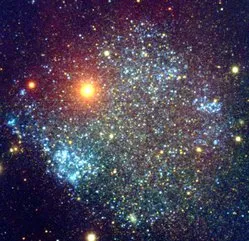
A recently discovered dwarf galaxy neighboring the Milky Way offered a surprise to astronomers: it appears to emit gamma rays that could be a signal of dark matter.
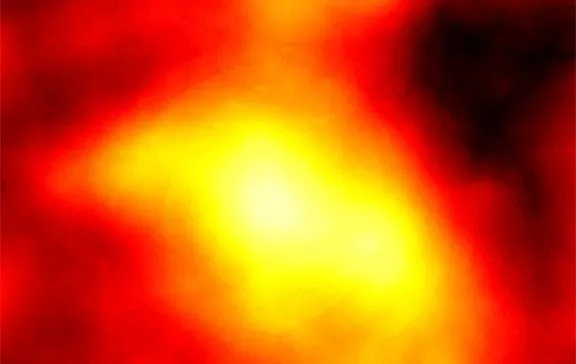
"Something in the direction of this dwarf galaxy is emitting gamma rays," indicated Alex Geringer-Sameth, a researcher at Carnegie Mellon and lead author of a yet-to-be-published paper. "There is no conventional reason for the galaxy to be generating gamma rays, so it is potentially a signal of dark matter."
The dwarf, called Reticulum 2, was discovered in recent weeks (arXiv:1503.02079) in data from the Dark Energy Survey, an experiment that maps the southern sky to understand the accelerated expansion of the universe. At a distance of nearly 98,000 light-years (30 kpc) from Earth, Reticulum 2 (Ret2) is one of the closest dwarfs detected to date. The closest dwarf is Segue 1 at 23 kpc and then Sagittarius SagDEG at 24 kpc. Ret2 is almost three times more luminous than Seg1, which suggests that its dark matter halo is more massive, making it an attractive place to search for dark matter annihilation.
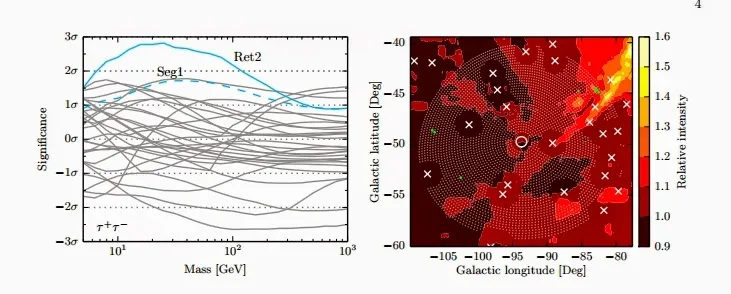
Using public data from NASA's Fermi telescope, Geringer-Sameth and team showed that there are gamma rays coming from the direction of the galaxy in excess of what would be expected from a normal background.
"In the search for dark matter, gamma rays from a dwarf galaxy have long been considered a strong signal. It seems we have detected them for the first time," commented Savvas Koushiappas, co-author of the paper.
"The gravitational detection of dark matter tells you very little about the behavior of that matter," explains Matthew Walker, a professor at Carnegie Mellon and another author of the work. And he added: "But now we would have a non-gravitational detection showing dark matter behaving like a particle, which would be a holy grail."
One theory suggests that dark matter is composed of WIMPs (Weakly Interacting Massive Particles), that is, massive particles that interact weakly. When a pair of these particles meet, they annihilate, generating gamma rays. If this were true, then there should be many gamma rays emanating from places thought to have many WIMPs, such as the centers of galaxies. The problem is that such emissions are also generated by other sources like black holes and pulsars, which makes it difficult to disentangle a dark matter signal from background noise.
That is why dwarf galaxies are important in the hunt for dark matter. Dwarfs are thought to lack gamma-ray producing sources, so a flux of that type is a strong signal of dark matter.
In recent years, Geringer-Sameth, Koushiappas, and Walker developed an analysis technique (arXiv:1410.2242) that searches for weak signals in gamma-ray data that could be due to dark matter annihilation. With the discovery of Ret2, Geringer-Sameth's attention focused on that part of the sky in search of all the gamma rays in that direction and in adjacent areas.
"There seems to be an excess of gamma rays above what is expected from normal processes coming from that direction," reported the astronomer.
The work was pre-published on Arxiv and submitted to Physical Review Letters.
Sources and related links
- Evidence for Gamma-ray Emission from the Newly Discovered Dwarf Galaxy
Reticulum 2
Alex Geringer-Sameth et al (2015)
arXiv:1503.02320 [astro-ph.HE] - Brown University: Detection of gamma rays from a newly discovered dwarf galaxy may point to dark matter
About the images
- Initial image and Fig.1: NASA/DOE/Fermi-LAT Collaboration/Geringer-Sameth & Walker/Carnegie Mellon University/Koushiappas/Brown University