In September, "Music under the stars" arrives at the Buenos Aires Planetarium. And at the Friends Association, a conference on stellar evolution.
This month the Galileo Galilei Planetarium begins a musical cycle: different musical genres performed live by great artists under the starry sky of the Planetarium
Science, art and technology join hands in every project developed by the Planetarium. In September, one of these three pillars, art, takes on renewed prominence; the concert cycle "Music under the stars" will be presented in the Planetarium Hall
Starting September 12, for 4 consecutive Fridays at 20 h, the public will be able to enjoy different musical genres: tango, choral singing, classical and a tribute to the Beatles performed live by renowned artists accompanied by full dome projections, that is, images created to be displayed on the full dome with an immersive system.
In short: music, art in one of its most moving expressions, under the imposing starry sky of the Planetarium.
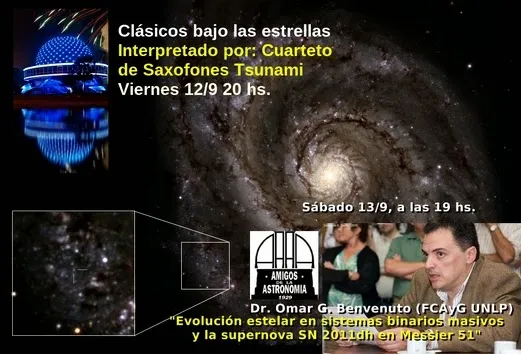
Friday 12/9 Classics under the stars.
Performed by: Tsunami Saxophone Quartet
Friday 19/9 Tango under the stars
Performed by: Chico Novarro accompanied by the bandoneon and musical direction by Carla Algeri
Friday 26/9 Tribute to the Beatles
Performed by: 4Beatleband.
Friday 10/3 Lights and shadows
Performed by: Marisa Mónica García (Recitations) ; Vocal Cantares del Parque (Choral group) Javier Pautasso (Musical direction)
(Free admission until capacity of the Planetarium's Show Hall is exhausted)
Friends Association
Conference: "Stellar evolution in massive binary systems and the supernova SN 2011dh in Messier 51", by Dr. Omar G. Benvenuto (Faculty of Astronomical and Geophysical Sciences, National University of La Plata). It will take place on Saturday, September 13, 2014, at 19 h. at the social headquarters at Av. Patricias Argentinas 550 - C.A.B.A. Admission is free.
Summary: In this talk I present the theory of stellar evolution in massive binary systems. In the case that the stars are close enough, during their evolution they can reach the maximum volume they can occupy, without losing mass. This volume corresponds to the famous "Roche Lobe". In the case that the more massive star of the pair (which is the one that evolves faster) fills this lobe, from that moment the pair exchanges mass: The more massive star gives mass to its companion and both reach evolutionary states very different from those accessible to isolated stars.
The supernova SN2011dh occurred in galaxy M51 and has been the brightest discovered that year. In pre-explosion images from the Hubble Space Telescope (HST), the supernova was identified with a yellow supergiant star. This star can reach the pre-supernova structure, if it was in a binary system. If that was really the case, as the supernova faded, the yellow star should not be found. Such a prediction was confirmed with HST observations made early this year. The binary evolution models we have built predict that for the supernova to have that structure it had to be accompanied by a blue star that is the one that received mass. This star was detected around mid-August of this year in other HST observations. Without a doubt SN2011dh exploded in a binary system!
Dr. Benvenuto has just published a paper on the same background topic, with a different object: iPTF13bvn: The First Evidence of a Binary Progenitor for a Type Ib Supernova
Melina C. Bersten et al. 2014 The Astronomical Journal 148 68.
DOI:10.1088/0004-6256/148/4/68
TEACHER COURSE AT THE PLANETARIUM
Astronomy as a link between human beings and the Universe
Start: Thursday, September 18, 2014.
Teacher: Dr. Juan Carlos Forte (CONICET; G. Galilei Planetarium; National Academy of Sciences of Buenos Aires).
Place: "Galileo Galilei" Planetarium Hall.
Target audience: Free course aimed at science teachers and teacher training students
Duration: 30 h. distributed in ten modules
Frequency: One weekly meeting, Thursdays from 18:00 to 21 h.
Certificate: The course grants points assigned by the Ministry of Education of CABA
SEE CONTENTS
Sources and related links
- Argentine Association of Friends of Astronomy
- Planetarium: Music under the stars
About the images
- Photo of Dr. Omar Benvenuto in FCAGLP Bulletin. Credit: Guillermo Sierra.
- Photo of SN 2011dh: 'Before' and 'after' images of SN 2011dh in the Whirpool Galaxy (M 51) imaged with ALFOSC through B, V and R filters.
Credit: Mattias Ergon/Nordic Optical Telescope.