Anywhere in the world, our days begin with light. Light is everywhere. And darkness?
Anywhere in the world, our days begin with light. Light is everywhere. Light is life. Light connects us to each other, near or far. It entertains and inspires, both young and old. Light allows us to see things we never imagined. Light will be the engine of the economies of the future. With light we can diagnose and treat diseases. It helps us protect and make our communities safe. Light will be essential in the discovery and attainment of solutions to society's most urgent problems. When the lights go out, at the end of the day, our future will still be possible, thanks to light.
This is the message of the institutional video, in Spanish, for the International Year of Light 2015 (IYL2015).
On December 20, 2013, the United Nations General Assembly proclaimed 2015 as the International Year of Light-based Technologies.
The IAU (International Astronomical Union) recognizes the importance of light for astronomy and supports technologies to achieve greater energy efficiency, in particular, to limit energy waste and the reduction of light pollution, which is key to preserving dark skies. Therefore, IAU supports the event known by its English acronym IYL2015.
In this sense, IAU will organize events under the slogan Cosmic Light during the coming year.
APPARENT LIGHT, REAL LIGHT
We have associated light with knowledge and the lack of light with ignorance.
Those who begin in astronomy quickly discover that the light of the stars is apparent.
Let's take Alpha Centauri as an example. To the naked eye, it appears to be a star, but it is a multiple system. With the naked eye, our eyes and our brain perceive and interpret that such a star, the brightest in Centaurus, is a little brighter than Beta Centauri.
The apparent magnitude of Alpha Centauri is -0.01. The star is known as Rigil Kentaurus. Beta Centauri, or Hadar, has an apparent magnitude of 0.61. Therefore, the first appears more luminous to us than the other (that's why they are named that way, Alpha and Beta).
But the truth is something else. Alpha Centauri lies just over 4 light-years away, while Beta (which is a binary system) is 500 light-years away.
The two main stars of Alpha Centauri have an absolute magnitude between 4 and 5, while Proxima Centauri has an M of 15 (average).
In contrast, the absolute magnitude of Hadar A/B is -5 (approx).
Another notable event for the coming year will be the study of Pluto by the New Horizons mission, around July.
If, these days in Buenos Aires, we wanted to see Pluto, it would be an impossible task: not only does it reflect little light from the Sun (Magnitude 14) but it is currently very close to the Sun in the sky. Nearby lie Venus and Mercury. Before 21 h, if we look towards the southwest, we can see the Evening Star and the first planet from the Sun, in Sagittarius. Higher up, in Aquarius, we will find the Moon and very close to it Neptune. Further north, Uranus in Pisces. Around 23 h, we will see Jupiter rise in the East-Northeast near Regulus in Leo. Oh, Mars, in Capricorn.
In the case of both Venus and Jupiter, we could easily mistake their light for stars because of how bright they are to the sight. But it would be an apparent truth.
The constellation liberty
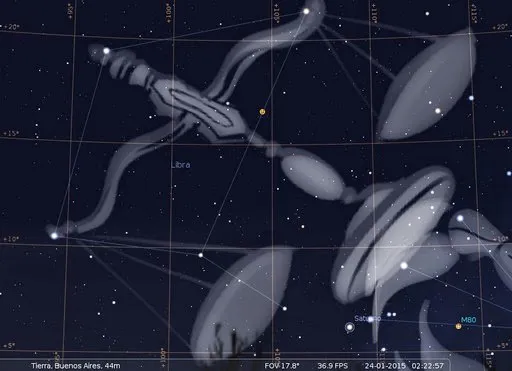
What about Saturn? The planet with the most prominent rings is moving through Libra. It's not a good opportunity to observe it from Buenos Aires. It rises around 4 am, very close to sunrise.
But we know that stars and planets "advance" 4 minutes per day, that is, 2 hours per month. Therefore, by the end of January, it will rise around 2.
Libra is the scales, a symbol of justice. I would like to pause here to talk about equality and equity.
Actually, what I wanted to reflect on is freedom. I find it impossible to think of freedom disconnected from equality.
In the Diccionario Filosófico by Pelayo García Sierra, revised by Gustavo Bueno, it states: The various worldly, academic concepts of the term freedom constitute a very dark constellation, a nebula.
I want to propose thinking about freedom in relation to constellations. By the way, why isn't there a constellation with this name?
Freedom has been thought of in many ways. There is an epic of freedom, independence, and sovereignty. It is the cry of William Wallace in Mel Gibson's film. And the handkerchief falling in slow motion. Because the freedom of a people is well worth the life of a person.
I propose thinking of freedom as constellations, allegorically, for the following reason: in constellations we mentally connect the stars to each other with lines. We "bind" one star with another.
We could think of ourselves, human beings, also as "tied" to each other, but also to Nature. I am not saying, in this allegory, that everything is "tied" to everything, but that the world is interwoven.
There is no human being "in itself". There could not be human beings apart from everything else. We exist in relation to air, gravity, trees, animals, other living beings.
And it is this way of relating that denotes that "binding". We cannot not relate to each other and to Nature. In this sense, there is no freedom in an absolute way. That is, it is not possible to cut those chains, but at most to modify them. We cannot not depend, to some degree, on everything else.
Thus, human beings should not want to "cut the chains" as the Argentine anthem says.
Equality and freedom cannot be thought of as dissociated. Freedom, therefore, is not "something in itself". And given the allegory, we are all "tied". What changes is the way we tie ourselves to each other. We can call those various ways of relating "power".
Some have these chains longer than others. They have greater relative freedom. It is still a conditional freedom, but broader.
By the way, when someone extends their chain, they shorten another's chain.
That is why there is only freedom when there is equality, although subjectively speaking, whoever possesses a long chain will feel freer than another. The divergence lies in thinking about individual freedom versus collective freedom.
What kind of freedom has the Cuban people had until now? What kind of freedom will they have in the near future?
Is freedom perhaps related to the number of options?
Is someone who can choose between a fan, a ventilator, and air conditioning more free?
That would be an apparent truth, like the first perception we have of Rigil Kent.
In the history of humanity, except for specific and short-lived processes (but valuable ones), we are not going to find a world of equals. We have developed great arguments throughout history to justify the state of things.
Wishes for 2015
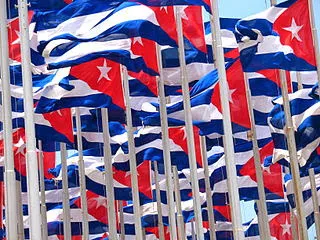
My wish for the coming year, in which we Argentines will once again have to "choose," is that we can shed some light on the way we live, not just individually, but collectively. I extend this wish to all citizens of the world and especially to the wonderful Cuban people.
According to Wikipedia, Narciso López in the late 19th century, looking out the window, saw the colors of the morning dawn in the sky. In the distance he could see "a triangle of red clouds announcing the dawn, and in the triangle shone the morning star, Venus, while two white clouds parted from the triangle to divide the resplendent sky into three blue stripes"(1). This is how he was inspired to create the flag of Cuba.
My wish is that, as a people, we can someday be free. But we will only achieve this when there is equality. Let's clarify: equality is not that we are all identical, clones. We are not atoms, protons, neutrons. Certainly, we are not neutral. We shouldn't be.
In photography, the concept of "neutral light" is used, which is basically natural light (color temperature at 3500ºK). This neutral light is the "balance" between warm light and cool light. In photography, warm light is red, and cool light is blue. In astronomy, it's the opposite.
A photo with neutral light is one that has light sources "in the middle."
That is NOT equality. It is a balance that, in many cases, justifies inequality, as these balances contain both the warm and the cool. In a society, an attempt is made to find a balance that justifies the wealth of a few. My wish is not for a balanced world, but for a just world, and therefore an egalitarian one.
To conclude: a self-criticism.
I have resumed here the allegory of light-knowledge/darkness-ignorance. Astronomy teaches us something rather opposite.
That's why we want dark skies, to be able to see the stars. Perhaps astronomy and the Year of Light can also allow us to reflect on that dialectic.
And justice for Ayotzinapa!
Sources and related links
- International Year of Light 2015
About the images
- Cosmic Light IYL2015 logo
- In Flag of Cuba, Wikipedia. By Elemaki (Own work) [GFDL or CC BY-SA 3.0], via Wikimedia Commons