Is it possible for a natural satellite to possess a "moon"? If so, would it be a submoon?
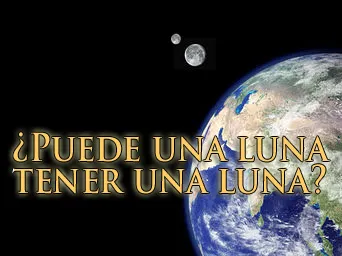
Starting from a NASA project to give the moon a moon [1], it's worth thinking about in what sense that is possible. As I commented in a previous post, when we want to explore the possible or the impossible, especially regarding natural objects, we can think of reality divided into three planes: the logical, the empirical, and the technical. If something is logically impossible, it will also be so on the other two planes. If something is possible from logic, it may not be empirically or technically.
I propose that we first think about the topic from the empirical point of view, somewhat abstractly.
This point of view is from human scientific knowledge of what we call "Laws of nature."
In very general terms, without yet defining what we call planets and moons, we can think that it is possible for one object to orbit another and for the latter to be orbited by a third.
The Sun orbits the center of the Milky Way. Earth orbits the star. The Moon orbits our world.
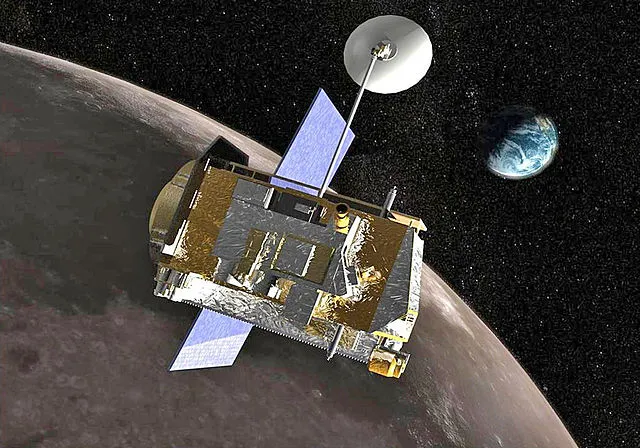
Can something orbit the moon? The LRO mission, which is ultimately an artificial satellite, has orbited the Moon. Just because of that it is possible to say that the Moon has had a satellite, in this case artificial.
From the physical-astronomical point of view we could resort to the concept of Hill Sphere or Roche Sphere (not to be confused with the Roche lobe) which assumes the sphere of gravitational influence of a celestial body due to the gravity of another more massive body it orbits.
Thus, each celestial body possesses a Hill sphere of different diameter or reach.
Our Moon has its Hill sphere, with a radius of about 60,000 km. It is there that the Lunar Reconnaissance Orbiter satellite was placed. Could a natural satellite exist there?
Before addressing the linguistic-logical point of view, in relation to the definitions of planets and moons, it is worth adding other notions.
When an object orbits another, it is useful to think about the concept of barycenter or center of mass. It usually coincides with the concept of center of gravity.
The Moon and Earth orbit around a center of mass located inside Earth. But beware: the Sun and Jupiter orbit around a center of mass that is NOT inside the Sun.
Thus, we could say that Earth does NOT orbit the Sun, but a common center of mass, which is incredibly closer to the Sun than to Earth.
The Solar System is a war of gravitational tugs. The Sun, which possesses more than 99% of the system's mass, will always win such a war.
Now, Mercury and Venus have no natural satellites. If they did, such satellites would be stalked both by the gravity of those planets and by the gravity of the Sun. Let's remember that gravity is a force inversely proportional to the square of the distance. If these inner planets had a moon and it were very close to such planets, they could end up colliding with the planets. And if they were farther from the planets, they would be captured by the Sun.
So we could for now reach these conclusions:
We can think of the universe as organized in structures from smaller to larger (or the reverse) of gravitationally bound objects. This assumes a certain "equilibrium" between masses and distances.
But let's add that the concept of Hill sphere takes into account gravitational force and not others such as tidal force or radiative pressure.
We have said that the Moon can therefore have a satellite, artificial. And natural? How could a moon form on a moon?
It is still debated how our Moon would have formed. Suppose an asteroid deviated from its orbit around the Sun and collided with the Moon and that such an asteroid is inferior in mass to Selene and became trapped in lunar gravity, in orbit around the Moon. We could then add the concept of escape velocity, that is, the minimum speed at which a body can escape the gravitational attraction of another. Earth has a Ve of 11.2 km/s.
Let's now add rings. Jupiter, Saturn, Uranus, and Neptune have rings. Such rings are concentrations of dust, particles around a planet. It has been thought that these rings can be generated by tidal forces that shatter a body around a larger one. Another possibility is a collision between a natural satellite and an asteroid.
Here we can include two more concepts: shepherd satellites and the Roche limit. The former are small moons of the giant planets whose gravitational influence confines material in some planetary rings into very narrow regions, like Metis and Adrastea in Jupiter's system that "shepherd" one of the inner rings of the gas giant.
The Roche limit is called the minimum distance that an object, which maintains its structure solely by its own gravity and orbits a massive body, can withstand without beginning to disintegrate due to the tidal forces generated by the main object.
Based on all the above, we can conclude that it is possible, but very unlikely, for submoons to exist for prolonged times (astronomically speaking), that is, moons that possess moons. These submoons, if they existed, would be subject to gravitational or tidal forces that would fatally bring them closer to the moons they orbit or to the planets of such moons.
Definitions
Now let's go to the definitions. According to the IAU, a Moon is a solid object in orbit around a planet, dwarf planet, minor planet, or trans-Neptunian object which is called a "satellite." A natural satellite is sometimes called a "moon" in popular usage. However, Earth's satellite is called "Moon" in both popular and scientific usage.[2]
In some papers the concept of Moonlets [3] is used, defined as a very small natural satellite, as in the case of a belt of objects in a planetary ring, like in Saturn's A ring or F ring. The noun has also been used to name moons of asteroids, as in the case of 87 Sylvia.
So we could already reach a conclusion: perhaps, if it is empirically possible for submoon to exist, we need to rethink the definition of Moon or create a new term. Have submoon been detected yet? We will leave that point for the end, but before that, let's think that depending on how we make such definitions we could say that submoon already exist in the solar system.
Saturn's second largest moon, Rhea, would have its own rings composed of small moons (whether we call them submoon or moonlets). The discovery of such rings was announced in 2008, but later with new research their existence was ruled out.[4]
Debates
Two cases that could be considered are Belinda and 1986U10 (Perdita), moons of Uranus, as debated in the Migui Forum. [5]
In the Cosmoquest forum, a debate was held in 2013 started by a user Matthias.[6] The user points out that the current IAU definition of moons implies that any natural object, regardless of its size, in orbit around a planet, would be a moon. Since that doesn't sound entirely logical, he proposes a new, more restricted definition for all celestial objects that (1) are in orbit around a planet and (2) have sufficient mass and gravity to have a rounded shape due to hydrostatic equilibrium. Objects that meet (1) but not (2) would be "minor satellites".
Currently, the concept of Minor bodies is applied to celestial bodies that orbit the Sun, but are not planets, dwarf planets, or satellites.
I recommend reading the entire discussion. The user Mapguy responded by showing Wikipedia graphs and evaluating the result of applying this new definition.
In the Jovian System, Ganymede, Callisto, Io, and Europa possess more than 99% of the mass while the other 63 moons possess 0.003% in total.
If such a new definition were applied, Jupiter would have 4 moons, 63 minor satellites, and an uncountable number of moonlets in its ring system.
The simple fact that we are using the word "moonlets" shows the need to include a word in our vocabulary because the existing definitions are not enough.
A proposal for redefinitions and taxonomy
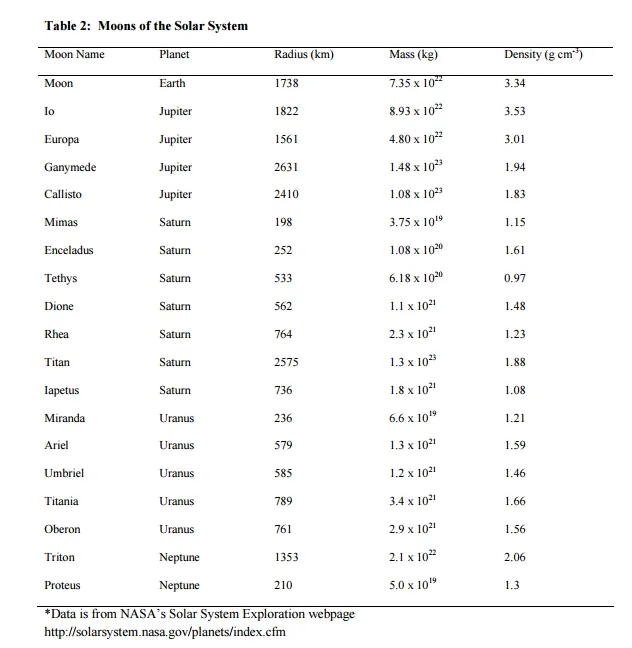
David Russell (Owego Free Academy) has proposed a taxonomy [7] for both objects in the solar system and objects in other systems. In his taxonomy, what we currently call moons or satellites interchangeably, would be moons whose definition would be: A planet in orbit around a larger one with the barycenter located within the radius of the larger planet. Thus, the Solar System would have 19 moons.
Satellite: would be an object of mass less than a planet (<3.75 x 10¹⁹ kg) in orbit around a Principal planet, belt planet, Moon, or Rogue planet.
The technical plane
From a technical point of view, we could say that this concept of submoon or moons of moons or perhaps moonlets or whatever we want to call it, is difficult to find outside the solar system. The techniques used to find exoplanets have improved in recent decades, but generally giant planets orbiting other stars are discovered. In recent years, planets of size similar to Earth or somewhat larger have been found. For the moment, it seems difficult that "submoon" will be found outside the solar system.
Also for the moment, we could settle for an existing definition and more than one possible classification: large, medium, and small moons; moons formed by such and such process; shepherd satellites, asteroid satellites. They are ways of classifying that maintain the same current definition.
At this point, we could say that it makes no sense to start extensive and vehement debates about a new definition of "moon" that includes new terms as long as they are not effectively necessary. Surely that could happen if several objects were discovered that don't quite fit the current definition. Moonlets is an example of that. I have used the term in English because there doesn't seem to be a consensus in Spanish, but -extramuros- it could be "lunitas" or "satélites menores".
Sabrina Stierwalt is a professional astronomer. She has pointed out, by virtue of the Hill sphere, that it is indeed possible for a moon to have a moon (or submoon or sub-satellite) but that the problem is that it won't last long due to tidal force. [8]
We always see the same face of the Moon: its rotation period is equal to its orbital period, which is a result of tidal forces. Thus, an object within the Hill sphere of our moon will also have its own orbital decay due to such forces, gradually bringing the sub-lunar object closer to the satellite until it collides or breaks apart.
I don't think professionals find it necessary to redefine the concept of moon and include new ones like minor satellite or submoon until they start finding objects in other systems that don't fit well into the current concept.
Does it make sense to name something that doesn't exist?
Well, we use words like Unicorn. However, in this case, are we talking about something non-existent or something not well defined? Be that as it may, to define is to think about reality. And since reality is in permanent change and transformation, definitions change. At least in science. Astrologers, on the other hand, don't seem to care that natural satellites exist, except the moon, for some strange, mysterious, and mythical reason.
But be careful: having critical thinking is not only thinking and rethinking concepts like those of moon or submoon, but also others, much more transcendent for our real life, like the term "poverty". Do we have critical thinking? Or is it perhaps a sub-critical thinking, a minor critical thinking? Or is it that we are left at the moon of the moon of Valencia?
Sources and related links
- Realclearscience.com, (2015). Can Moons Have Moons? | RealClearScience. [online] Available at: http://www.realclearscience.com/blog/2014/12/can_moons_have_moons.html [Accessed 30 May 2015].
- [1] Artime, M. (2015). La NASA planea darle una luna a la luna. [online] Yahoo Noticias. Available at: https://es-us.noticias.yahoo.com/blogs/ciencia-curiosa/la-nasa-planea-darle-una-luna-a-la-luna-024651282.html [Accessed 30 May 2015].
- [2] Planetarynames.wr.usgs.gov, (2015). Planetary Names: Frequently Asked Questions. [online] Available at: http://planetarynames.wr.usgs.gov/Page/FAQ [Accessed 30 May 2015].
- [3] Wikipedia, (2015). Moonlet. [online] Available at: http://en.wikipedia.org/wiki/Moonlet [Accessed 30 May 2015].
- [4] News.sciencemag.org, (2015). The Moon Rings That Never Were. [online] Available at: http://news.sciencemag.org/2010/06/moon-rings-never-were [Accessed 30 May 2015].
- [5] Foro.migui.com, (2011). Una luna puede tener lunas?. [online] Available at: http://foro.migui.com/vb/showthread.php/11346-Una-luna-puede-tener-lunas [Accessed 30 May 2015].
- [6] Cosmoquest.org, (2006). The "What is a moon?" definition thread. [online] Available at: http://cosmoquest.org/forum/showthread.php?42786-The-quot-What-is-a-moon-quot-definition-thread&highlight= [Accessed 30 May 2015].
- Cosmoquest.org, (2013). Restricting the definition of what is a "moon". [online] Available at: http://cosmoquest.org/forum/showthread.php?144821-Restricting-the-definition-of-what-is-a-quot-moon-quot [Accessed 30 May 2015].
- [7] Russell, D. (2013). Solar and Extrasolar Planet Taxonomy. [online] Arxiv.org. Available at: http://arxiv.org/abs/1308.0616 [Accessed 30 May 2015].
- [8] Stierwalt, S. (2015). Can moons have moons? (Intermediate) - Curious About Astronomy? Ask an Astronomer. [online] Curious.astro.cornell.edu. Available at: http://curious.astro.cornell.edu/our-solar-system/44-our-solar-system/the-moon/general-questions/104-can-moons-have-moons-intermediate [Accessed 30 May 2015].
- John P. Millis, P. (2015). What Exactly Is a Moon?. [online] About.com Education. Available at: http://space.about.com/od/solarsystem/a/What-Is-A-Moon.htm [Accessed 30 May 2015].
- Satellite of satellites on Wikipedia: http://es.wikipedia.org/wiki/Sat%C3%A9lite_natural#Sat.C3.A9lites_de_sat.C3.A9lites
[Accessed 30 May 2015].
About the images
- By NASA ESA (http://www.nasa.gov/) via Wikimedia Commons http://commons.wikimedia.org/wiki/File%3ANasa_earth.jpg