On Friday, December 5, NASA announced that the Orion spacecraft completed its first trip to space, a milestone according to the U.S. agency "on its journey to Mars", first steps of a new "conquest".
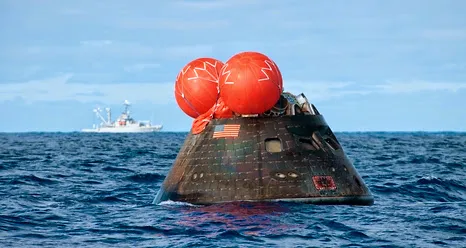
The capsule was launched from Launch Complex 37 at Cape Canaveral on a Delta IV rocket. The vehicle returned 4.5 hours later by falling into the Pacific.
During the uncrewed flight, the capsule traveled twice through the Van Allen Belt experiencing large periods of radiation and reached an altitude of 5,800 km above Earth.
The statement indicates that "Orion will open the space between Earth and Mars for exploration by astronauts".
Beyond the technical data that could be added to the news, some reflections are in order.
First, Mars has been explored for decades, through probes and robots. The journey to the red planet is much longer than to the Moon and involves a number of risks to human life, unnecessary, given that it is possible to collect data by other means.
Why would it be necessary, in the future, to send astronauts? There are certain tasks that robots cannot perform. Thinking in the medium to long term, the "conquest" of Mars does not seem possible with robots alone. It would involve establishing human bases, carrying out mining activities and, almost science fiction, terraforming that planet.
Does all this make sense? With our feet on the ground, we can explore the issue: the meanings that some give to planetary exploitation will not be the same that others of us may give it. A critical look cannot be abstract, but concrete. It is not the "thirst for knowledge" that is questionable, but who, how, and for what purpose that knowledge is obtained.
They will try to convince us that the object of scientific activity is "knowledge for knowledge's sake". This "science in itself" we must characterize just as we have thought of "art for art's sake".
It is an abstract thought, that is, extracted from concrete, intertwined, social, historical reality. Therefore, it is functional to the interests of the moment, which are not those of ordinary citizens, those of the workers.
Mars will be "conquered" as the Earth has been conquered. A minority, which appropriated material resources (natural and human), will also be the one that, not content with terrestrial exploitation, seeks to expand capitalism into the "beyond".
They will try to convince us that this milestone is a human achievement, that it implies an improvement for the whole; that it is the fruit of competition and the merit of effort.
There is no doubt: scientists and engineers work hard, but they will not be the owners of the wealth they themselves generate. The mineral wealth of Mars will be produced by "space workers", an incipient extra-planetary proletariat that will not see the benefits of such effort.
On January 14, 2004, George W. Bush announced the Crew Exploration Vehicle (CEV) as part of his "Vision for Space Exploration," in reaction to the Space Shuttle Columbia accident in which the seven crew members died. The program was continued by the U.S., despite the change of government. This "state policy" is nothing more than a policy of the bourgeoisie.
For the late Hugo Chávez, capitalism would have ended life on Mars: "(...) but maybe capitalism got there, imperialism got there and finished off that planet" (CNN). Said like that, it's an eccentricity. But it's an extrapolation: "Watch out! Be careful! Look, here on planet Earth where there were great forests hundreds of years ago or less, what there is now are deserts".
On January 18, 2004, José Pablo Feinmann wrote in Página/12: "The same with children, with the 11 million who die per year amid the waste of the society of the spectacle, of militarism and of extraplanetary adventures".
According to Ovid, Orion was born from the urine of the gods and was a great hunter of animals, defeated by a simple scorpion. He lies as a figure in the mythological skies aided by the hunting dogs and a hare. But in those skies, the scorpion is very far from the hero.
The planet anciently associated with the god of war will, in not many years, be the setting not for fiction stories, but for a harsh and bloody reality; the same (with a different backdrop) as the one unfolding down here. For the bourgeoisie, "as on Earth, so in heaven": what is being carried out is nothing other than a class struggle.
Does this mean we should not go to Mars, then? Should we not do science? There are many scientific reasons, like those presented by Francisco Anguita (Professor of Planetary Geology. Complutense University of Madrid) in Why should we go to Mars?. (PDF)
The problem lies in thinking of science (in this case space exploration) as "something in itself," disconnected from other social practices. That abstract thought must be transformed into concrete. Reality is not abstract. Science does not develop in isolation from everything else.
Modern discourses tend to split reality, to hide the struggle for real power, and to tell us stories. Thus, astronauts are heroes for kids and adults. Juan Gelman wrote (see Los buñuelos de la tía Francisca):
I envy like crazy the astronauts/
they have more money than the central bank/
they are fed every day/
it's a special meal to withstand the void/
besides they appear on tv/
a beautiful blonde woman spends her time waiting for them/
they are discreet like aunt francisca/
who never had a yes or a no with the uncle/
In the Financial Times, an article was written about capitalism beyond Earth and it states: "Above all, Bigelow is concerned that if Western capitalism does not annex celestial bodies in the name of private companies, some other nation will go about building its own empire." (1)
The article refers to Robert Bigelow -of Bigelow Aerospace- who in due course wrote an open letter to the current NASA administrator, Charles Bolden.
"The system can only perpetuate itself if, imaginatively, there are always new places to go to extract, and hence in a certain sense the attempt to flee to the cosmos seems natural to it", writes Jorge Riechmann(2).
Riechmann's discourse opposes that of those who uphold the "anthropofugal" guideline like Adrian Berry: "Contrary to the belief of the Club of Rome, there are no 'limits to growth'. (...)Even if the resources of the earth are ultimately proven to be finite, those of the Solar System and of the Great Galaxy that surrounds it are, for all practical purposes, infinite."(3)
According to the author of The Next Ten Thousand Years, within four or five centuries man will be able to devise explosives capable of shattering Jupiter in a matter of hours (El País).
It is worth asking again: for what, for whom?.
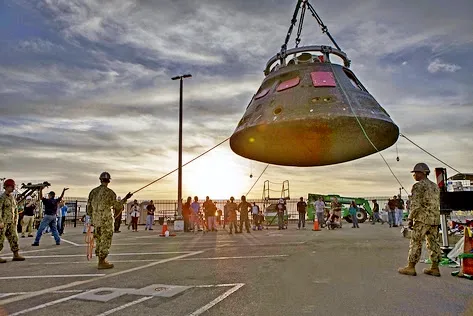
Therefore, we cannot think of the Orion capsule in the abstract, but in relation to concrete social practices. The capsule is not "free", but "tied" to social production.
To conclude, it is necessary to ask: who does Mars belong to? To whom does it belong? Or, paraphrasing the poet Nicolás Guillén, Can you sell me Mars, can you sell me Mars, can you?
Can you? - Nicolás Guillén (in Spanish and Portuguese, lyrics and audio)
Sources and related links
- NASA: Orion Performance Showcases Exploration Abilities
- YouTube: Paul Krugman proposes a space war to save the economy
- YouTube video: Primitive accumulation
- (1) FT: The dark side of space: how capitalism poses a threat beyond Earth, By Izabella Kaminska en http://on.ft.com/1m4tBF4
- (2) Jorge Riechmann, Gente que no quiere viajar a Marte: ensayos sobre ecología, ética y autolimitación; Los Libros de la Catarata, 2004 (p.111)
- (3) A.Berry, Los próximos diez mil años, Alianza, Madrid, 1977 (p.65)
- Monthly review, 2010, Volume 62, Issue 06 (November): The Humanization of the Cosmos—To What End?, by Peter Dickens
About the images
- NASA/Cory Huston
- Orion Recovery. Credit: U.S. Navy