The MUSE instrument, installed on ESO's Very Large Telescope, has provided astronomers with the best three-dimensional view of the deep universe achieved to date.
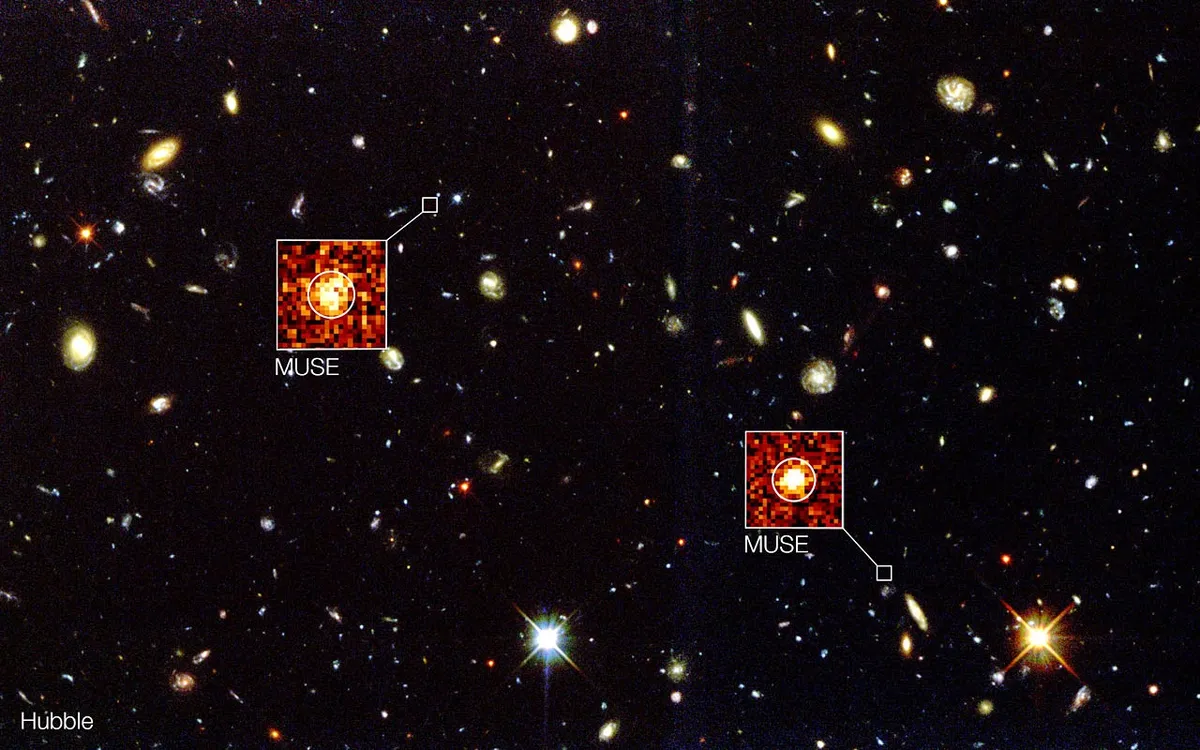
After meticulously observing the southern region of the Hubble Deep Field for just 27 hours, the new observations reveal the distances, motions, and other properties of many more galaxies than had been seen until now in this patch of sky. It also goes beyond Hubble and reveals the presence of objects that had not been seen before.
By taking very long exposure images of various regions of the sky, astronomers have created many deep fields that have revealed abundant information about the early universe. The most famous was the Hubble Deep Field (HDF), carried out over several days by the NASA/ESA Hubble Space Telescope in late 1995. This iconic and spectacular image quickly transformed our understanding of the contents of the young universe. Two years later, a similar image of the southern sky followed, the Hubble Deep Field South.
But these images did not answer all the questions. To find out more about the galaxies observed in the deep field images, astronomers had to look carefully at each one with other instruments, a slow and difficult job. But now, for the first time, the new MUSE instrument can do both jobs at the same time (and much faster).
One of the first observations with MUSE, after its commissioning on the VLT in 2014, was a difficult and prolonged look at the Hubble Deep Field South (HDF-S). The results exceeded expectations.
"After just a few hours of observations at the telescope, we took a look at the data and saw many galaxies — it was very encouraging. And when we returned to Europe we began to study the data in more detail. It was like fishing in deep waters, and each new catch generated a lot of excitement and discussions about the species we were finding", explains Roland Bacon (Centre de Recherche Astrophysique de Lyon, France), principal investigator of the MUSE instrument and head of the team responsible for its commissioning.
For each part of MUSE's view of the HDF-S there is not just a pixel in an image, but also a spectrum that reveals the intensity of the different colors that make up the light at that point — about 90,000 spectra in total. Each spectrum covers a range of wavelengths from the blue part of the spectrum to the near-infrared (375-930 nanometers). These can reveal the distance, composition, and internal motions of hundreds of distant galaxies — as well as capture a small number of very faint stars in the Milky Way.
Although the total exposure time was much shorter than for the Hubble images, the MUSE data from the HDF-S revealed the presence, in this small patch of sky, of more than twenty very faint objects that Hubble had not detected.
"The greatest excitement came when we found very distant galaxies that were not visible even in the deepest Hubble image. After so many years of hard work on the instrument, for me it was a very intense experience to see how our dreams became reality", adds Roland Bacon.
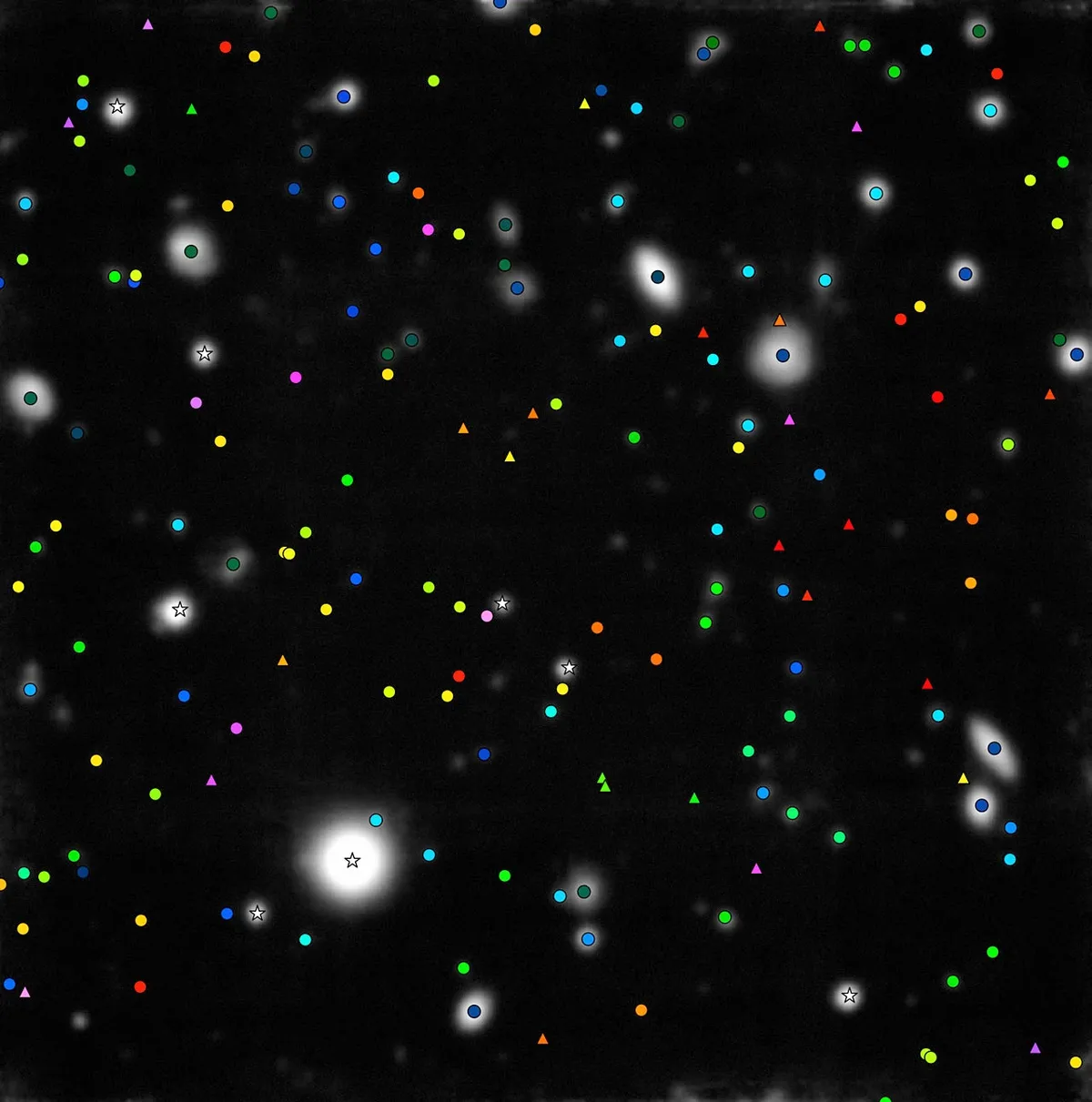
By carefully observing all the spectra from the MUSE observations in the HDF-S, the team measured the distances to 189 galaxies. They ranged from some relatively nearby, to some that were seen when the universe was less than a billion years old. This is more than ten times the number of distance measurements that existed before for this area of the sky.
For the closer galaxies, MUSE can do much more and can detect the different properties of different parts of the same galaxy. This reveals to us how the galaxy rotates and how other properties vary from one place to another. This is very important information for understanding how galaxies evolve through cosmic time.
"Now that we have demonstrated the unique capabilities of MUSE to explore the deep universe, we are going to look at other deep fields, such as the Hubble Ultra Deep Field. We will be able to study thousands of galaxies and discover new extremely faint and distant galaxies. These small infant galaxies, seen as they were more than ten billion years ago, gradually grew to become galaxies like the Milky Way we see today", concludes Roland Bacon.
Sources and related links
- "The MUSE 3D view of the Hubble Deep Field South", by R. Bacon et al., which appears in the journal Astronomy & Astrophysics on February 26, 2015. arXiv:1411.7667 [astro-ph.GA]
- ESO: The deep universe in 3D
About the images
- Image 1- Credit: ESO/MUSE Consortium/R. Bacon
- Image 2- Credit: ESO/MUSE consortium/R. Bacon