They measure explosions in the galactic center. Presentations at the 225th meeting of the AAS.
As every January, American astronomers meet. On this occasion, while Earth was approaching its closest approach to the Sun, the 225th meeting of the American Astronomical Society (AAS) began on January 4.
Some of the research released yesterday deals with the center of the Milky Way.
Fermi Bubbles
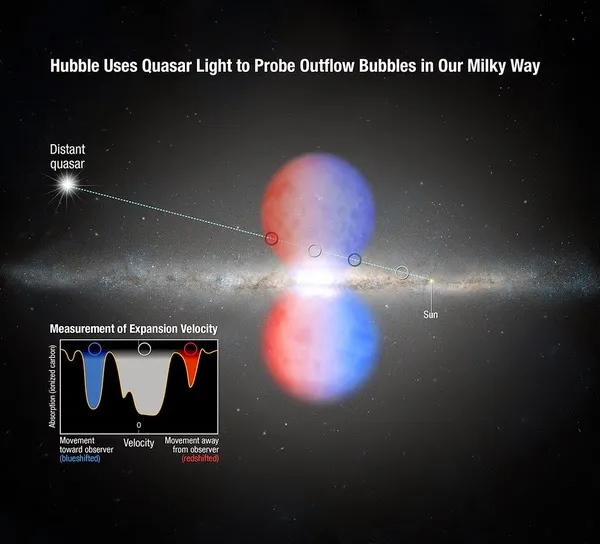
By the time our ancestors began to walk upright, the heart of our Milky Way had a gigantic eruption, driving gases and other materials outward at 2 million miles per hour (3.2 million kilometers per hour).
Now, about 2 million years later, astronomers are witnessing the consequences of the explosion: billowing clouds of gas rising 30,000 light-years above and below the plane of our galaxy.
The enormous structure was discovered five years ago as a glow of gamma rays in the sky in the direction of the galactic center. The balloon-shaped phenomenon has been observed in X-rays, as well as in radio waves. But astronomers needed a telescope like Hubble to measure for the first time the speed and composition of the mysterious "lobes" (known as "Fermi Bubbles"). Now they seek to calculate the mass of ejected material, which could lead them to determine the cause of the event.
Researchers have proposed two possible origins for these bipolar lobes: a storm of star birth in the center of the galaxy, or an eruption from the supermassive black hole. It is not the first time astronomers detect and study winds of gas composed of streams of charged particles coming out of the nuclei of other galaxies, but in this case, they have a close-up view of a similar event in our galaxy.
"When you look at the centers of other galaxies, the outflows of matter appear much smaller because the galaxies are very far away," said Andrew Fox of the Space Telescope Science Institute in Baltimore, principal investigator of the study.
The results of Fox and his colleagues will be published in The Astrophysical Journal Letters and will be presented at the meeting of the AAS (American Astronomical Society) that is meeting this week in Seattle.
Outburst, outburst, tell me something about Sgr A*
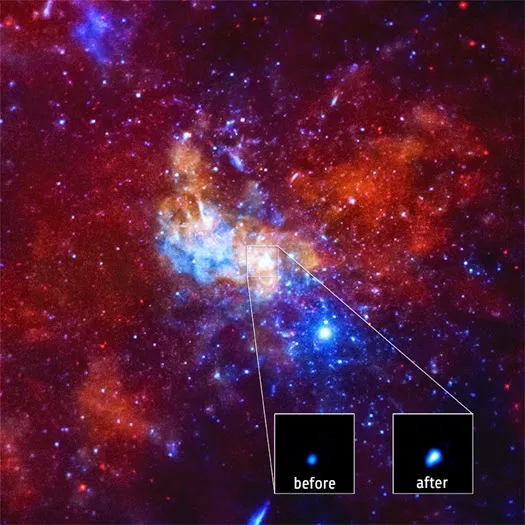
On September 14, 2013 astronomers captured the largest "flare" of X-rays ever detected from the supermassive black hole at the center of the Milky Way, known as Sagittarius A* (Sgr A*). The event, captured by the Chandra telescope, was 400 times brighter than the usual outbursts from the same object.
The discovery was unexpected (serendipity) as researchers were observing how Sgr A* would react to a nearby cloud of gas known as G2.
"Unfortunately, the G2 gas did not produce the 'stellar fireworks' we expected when it approached Sgr A*," commented Daryl Haggard of Amherst College. "However, Nature often surprises us and we saw something else that was really interesting."
The mega-outburst is almost three times larger than the brightest one previously recorded from the same object in 2012. But then, Chandra detected another huge outburst 200 times brighter than usual, on October 20, 2014.
Astronomers estimate that G2 was closest to the black hole in the boreal spring of 2014. The outburst observed in September 2013 was at a distance almost 100 times closer to the black hole, making the event unlikely to be related to G2.
There are two possible explanations, according to the researchers. An asteroid that came very close to the supermassive black hole and was destroyed by its gravity. The debris heated up and produced X-rays before disappearing over the event horizon.
A second hypothesis is that the magnetic field lines in the gas flowing toward Sgr A* became "tangled." Such a reconfiguration could produce bright X-ray flares. This type of magnetic flare is seen on the Sun and Sgr A* has similar patterns of intensity. Recall that Sgr A* contains about 4.5 million times more mass than our star.
"Stars" of sports are not better when they break records. They are only more notable. Stars, black holes and other astronomical objects are not more important when their brightness is greater, only that the research gains greater media relevance. In the cosmos, everything is "astronomical."
Sources and related links
- Fox, Andrew J. et al; Probing the Fermi Bubbles in Ultraviolet Absorption: A Spectroscopic Signature of the Milky Way's Biconical Nuclear Outflow; arXiv:1412.1480 [astro-ph.GA]
- Hubble Discovers that Milky Way Core Drives Wind at 2 Million Miles Per Hour: HubbleSite
- Haggard, Daryl et al; An Update on Chandra/VLA Galactic Center Campaigns Targeting Sgr A* and G2; 2015AAS...22510209H
- NASA's Chandra Detects Record-Breaking Outburst from Milky Way's Black Hole: Chandra Observatory
About the images
- Image 1. Credits: NASA, ESA, and A. Feild (STScI)
- Image 2 (initial). Credits: NASA/CXC/Amherst College/D.Haggard et al