A team led by a Conicet researcher discovered two pulsating helium white dwarfs.
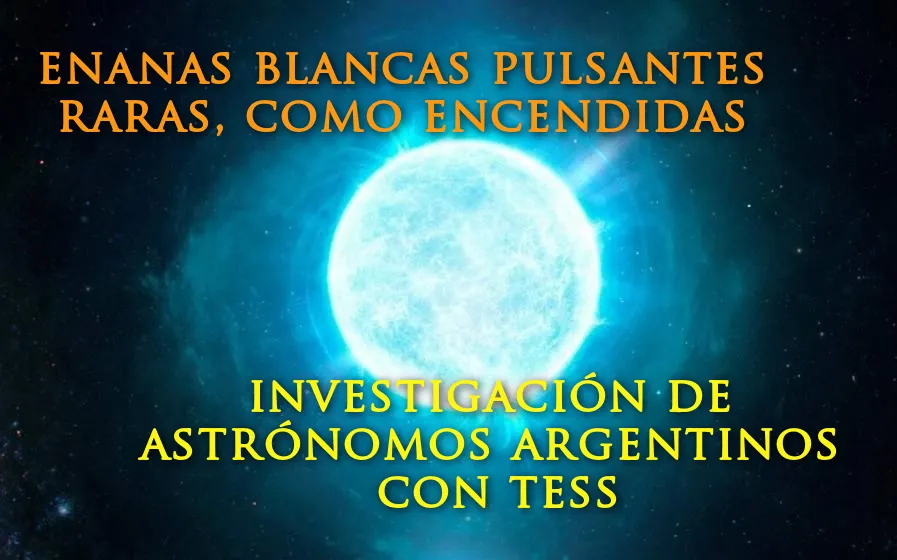
An international team of scientists, led by a researcher from Conicet-La Plata, discovered two new dying stars, which pulsate or flicker, called "white dwarfs" and added information about three other already known ones, the scientific organization reported.
Doctor in Astronomy Alejandro Córsico, from the Instituto de Astrofísica de La Plata (IALP)-Conicet-UNLP), headed the group of experts from Germany, Brazil, Chile, the United States, Italy and Poland that made the discovery and which also includes the Argentine researcher from Conicet-La Plata Leandro Althaus.
According to the organization, the international team managed to provide important clues about the structure of a type of star known as white dwarfs, that is, compact dying stars that contain approximately the same matter as the Sun in a size barely larger than that of our planet and that have exhausted their nuclear fuel and are going through the last stage of their evolution.
Using data from NASA's TESS (Transiting Exoplanet Survey Satellite) satellite and ground-based observations, the experts discovered two pulsating white dwarfs, meaning they have oscillations in their brightness; and added valuable information about the behavior of three others whose pulsations were already known.
The results were published by the prestigious scientific journal Astronomy & Astrophysics.
A white dwarf is the final chapter in the evolution of stars of approximately less than 9 times the mass of the Sun.
"Some stars pulsate radially, that is, they expand and contract as a whole in a periodic manner", explained the researchers from La Plata and added that "however, white dwarfs undergo more complex pulsations called non-radial pulsations. In them, one part of the interior material expands, while another contracts".
And they expanded: "If one could see the surface of a pulsating white dwarf, we would notice that it oscillates, with some regions going up and other contiguous ones going down slightly, as happens with a drum skin when it resonates".
These pulsations, with intervals ranging from 100 to 7,000 seconds, cause the "white dwarfs" to periodically change their total brightness.
Asteroseismology
"The precise measurement of the oscillation periods or rhythms has opened a new path to study the mysterious interior of white dwarfs and other pulsating stars", the researchers reported in a statement.
The pulsating white dwarfs studied are characterized by having a thin helium atmosphere.
"Those of this type are very scarce. With the ones we present in this work, only 49 are known, much fewer than those with hydrogen-rich atmospheres, of which there is information on about 500. This makes this discovery extremely important, because advancing in their knowledge will allow for better estimates of their physical characteristics and understanding what their origin is", they considered.
There is a whole classification of pulsating white dwarfs. Those with helium absorption lines are known as DBV. The most populous are the ZZ Ceti or DAV, with hydrogen atmospheres. DBVs could be descendants of PG 1159 stars, stars in transition between planetary nebula and white dwarf.
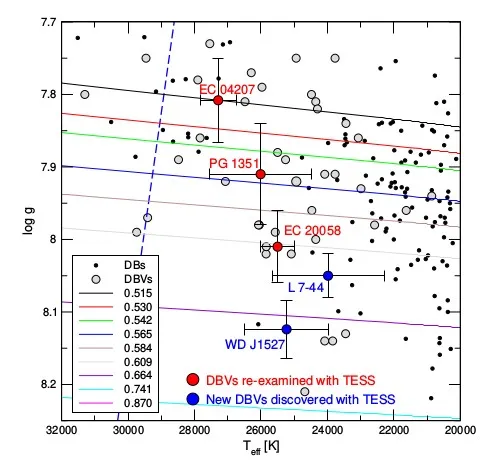
In this work, observations with TESS of already known stars were presented: PG 1351+489, EC 20058−5234, and EC 04207−4748. Additionally, the variability of two DBV white dwarfs is reported for the first time: WDJ 152738.4−450207.4 and WD 1708−871 (L 7−44).
They performed a detailed asteroseismology analysis. The present study is the fifth in a series of works dedicated to investigating hydrogen-deficient pulsating white dwarfs.
White dwarfs are compact, post-stellar objects. They are no longer part of the main sequence and are left cornered at the bottom left of an HR diagram, for being very hot and not very bright. They gradually fade away.
But white dwarfs have been discovered that refuse to stop being stars, clinging to layers of hydrogen, helium, carbon or oxygen.
They are rare, as if lit up. Like lovers dancing to the rhythm of a tango by Cadícamo, they seem to sing:
♪Today you will enter my past
And today we will take new paths,
How great our love has been
And yet, oh!, look what remains♪.
With so many pulsations, the ones who get dizzy are the astronomers. But thanks to scientific research, they exchange the elixir of Bacchus for knowledge, for the delight of the curious observers of the night.☉
Sources and related links
- Pulsating H-deficient WDs and pre-WDs observed with TESS: V. Discovery of two new DBV pulsators, WD J152738.4-450207.4 and WD 1708-871, and asteroseismology of the already known DBV stars PG 1351+489, EC 20058-5234, and EC 04207-4748
https://arxiv.org/abs/2210.05486 - Pulsating hydrogen-deficient white dwarfs and pre-white dwarfs observed with TESS
A&A Volume 655, November 2021
https://doi.org/10.1051/0004-6361/202141253
Pulsating hydrogen-deficient white dwarfs and pre-white dwarfs observed with TESS:
I. Asteroseismology of the GW Vir stars RX J2117+3412, HS 2324+3944, NGC 6905, NGC 1501, NGC 2371, and K 1-16 https://arxiv.org/abs/2011.03629
A team led by a Conicet researcher discovered two dying stars https://www.telam.com.ar/notas/202210/608995-conicet-nuevas-estrellas-moribundas.html
White dwarfs: international discovery with a La Plata stamp https://www.eldia.com/nota/2022-10-27-2-45-38-enanas-blancas-hallazgo-internacional-con-sello-platense-informacion-general
About the images
Illustration: Giuseppe Parisi https://giuparisi.com/a-white-dwarf-living-on-the-edge
Fig. 1: Córsico et al (2022)