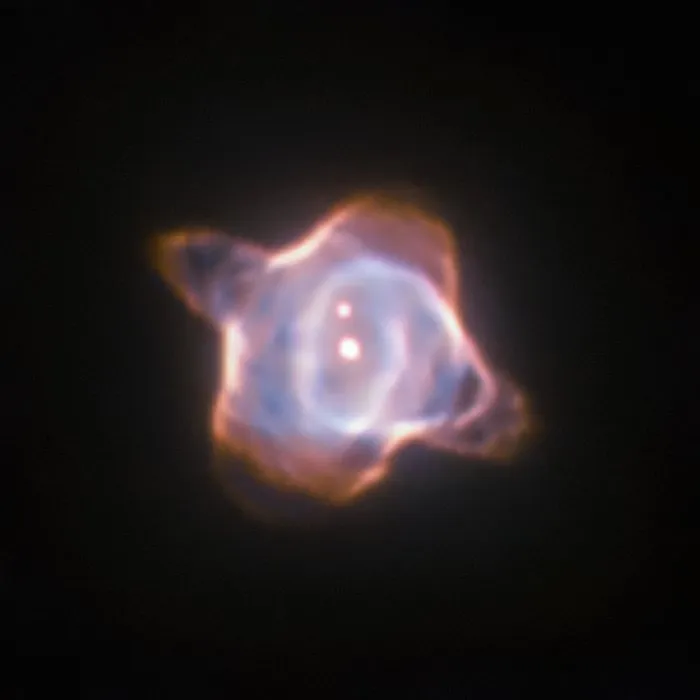
Researchers have discovered the richest pulsating ultramassive white dwarf to date: a crystallized stellar remnant vibrating with 19 distinct modes. This discovery paves the way for future studies on the structure and internal composition of the white dwarf.
When a star with less than 8 solar masses ends its equilibrium cycle, it leaves behind a dense, compact remnant core: a white dwarf. It is the fate of our Sun. With temperatures above 10^5 K, white dwarfs cool slowly. When they reach a temperature limit, they enter an instability phase that causes pulsations.
Observing those white dwarf pulsations allows researchers to learn about the star's interior, which is key to better understanding the origins of the most massive white dwarfs. To date, a handful of these ultramassive white dwarfs are known. Of these pulsating ones, only one (BPM 37093)—with eight detected pulsation modes—has provided astronomers with data to understand its interior. Francisco De Gerónimo (Instituto Astrofísico de La Plata-CONICET) and colleagues set out to increase that statistic with a search for similar stars.
This type of white dwarf is spectrally classified as DAV. A star of this class is ZZ Ceti, in Cetus. Hence, similar objects are classified as "ZZ Ceti stars".
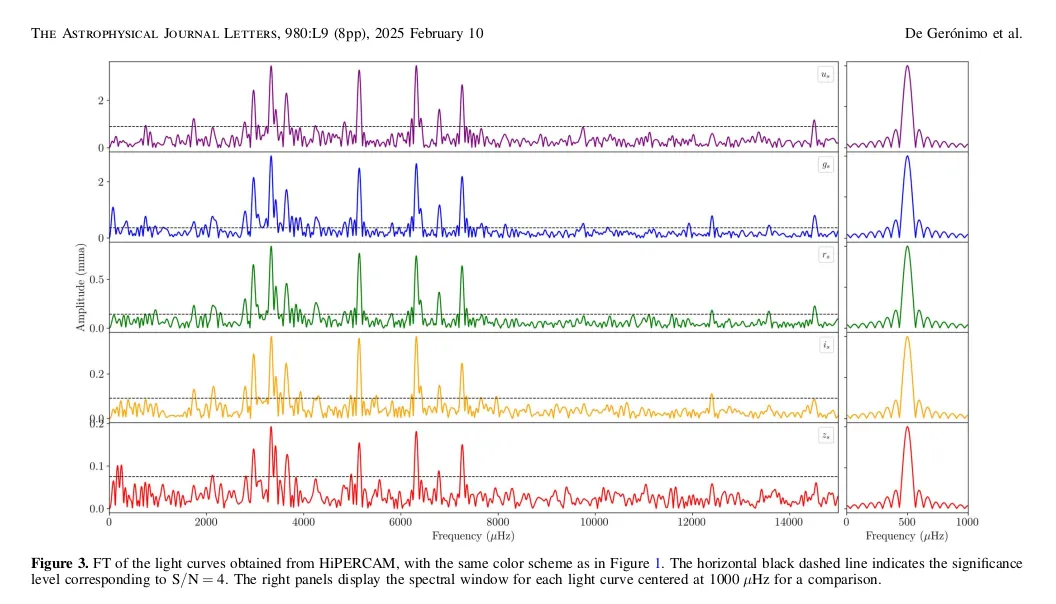
The astronomers in this work began the search with a list of over 12,000 white dwarfs within a radius of 326 light-years from the Sun, using a catalog provided by a previous work, F. M. Jiménez-Esteban et al. (2023). The article focuses on the case of WD J0135+5722, which they observed with the Grantecan (GTC) and the Apache Point Observatory. By applying the Fourier transform to the observations—obtained with the HiPERCAM instrument—the team extracted the periods and amplitudes of the compact object's pulsations. They detected 19 pulsation modes, with periods between 137 and 1345 seconds. This is, by far, the largest number detected in ultramassive white dwarfs to date. The finding opens the way to a more detailed study of the interior of these fascinating objects.
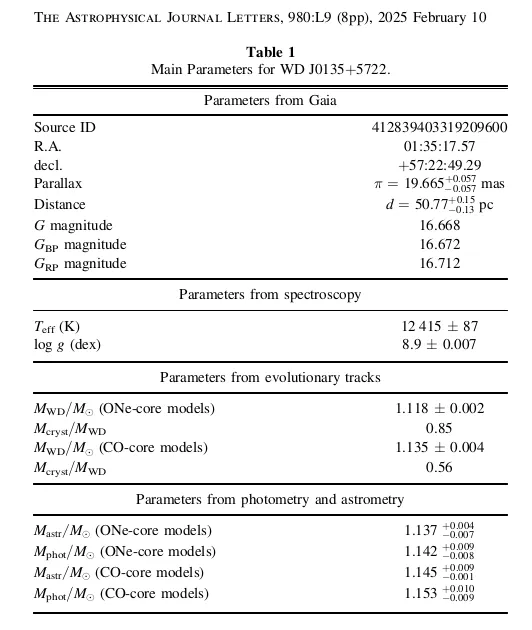
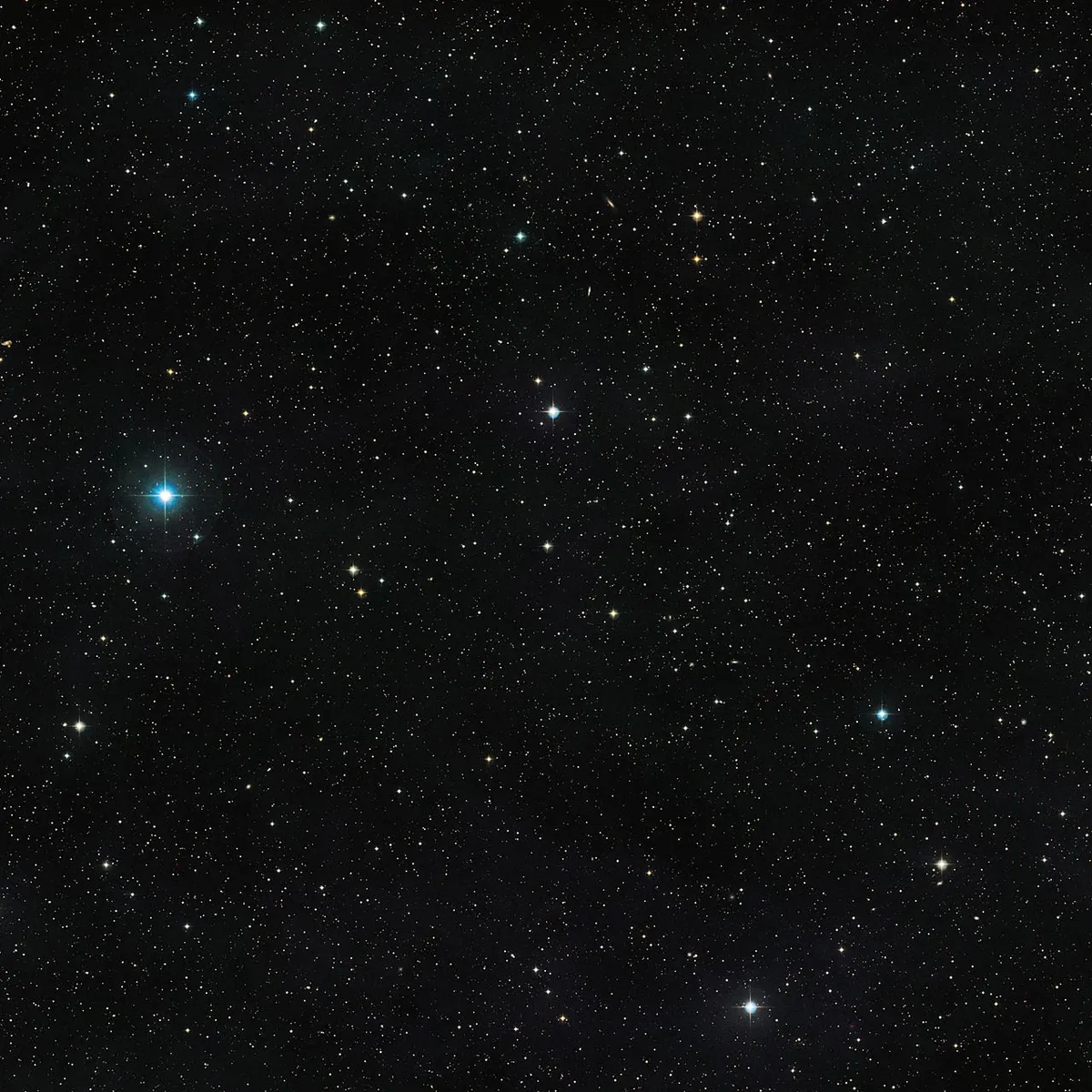
Located about 165.5 light-years away, WD J0135+5722 is a white dwarf with a mass of approximately 1.12-1.15 solar masses and an effective temperature of 12,415 K. The mass varies in the calculations depending on the composition: 1.12-1.14 M if the core is oxygen and neon, or more than 1.14 if it has a carbon and oxygen core.
A couple of years ago, some of the same researchers had discovered "the most massive pulsating white dwarf," WD J004917.14-25255681. Scientific knowledge is like that: it's always possible to surpass oneself. Not only Messi breaks records. ☉

Sources and related links
- Discovery of the Richest Pulsating Ultramassive White Dwarf
Francisco C. De Gerónimo et al 2025 ApJL 980 L9
DOI 10.3847/2041-8213/adad73
https://iopscience.iop.org/article/10.3847/2041-8213/adad73 - Record-Breaking Pulsating White Dwarf Discovered
https://aasnova.org/2025/02/28/record-breaking-pulsating-white-dwarf-discovered/ - 2023: The discovery of the most massive pulsating white dwarf star
https://ialp.fcaglp.unlp.edu.ar/el-descubrimiento-de-la-estrella-enana-blanca-pulsante-con-mas-masa/
About the images
Credits: CONICET Fotografía/R. Baridón.