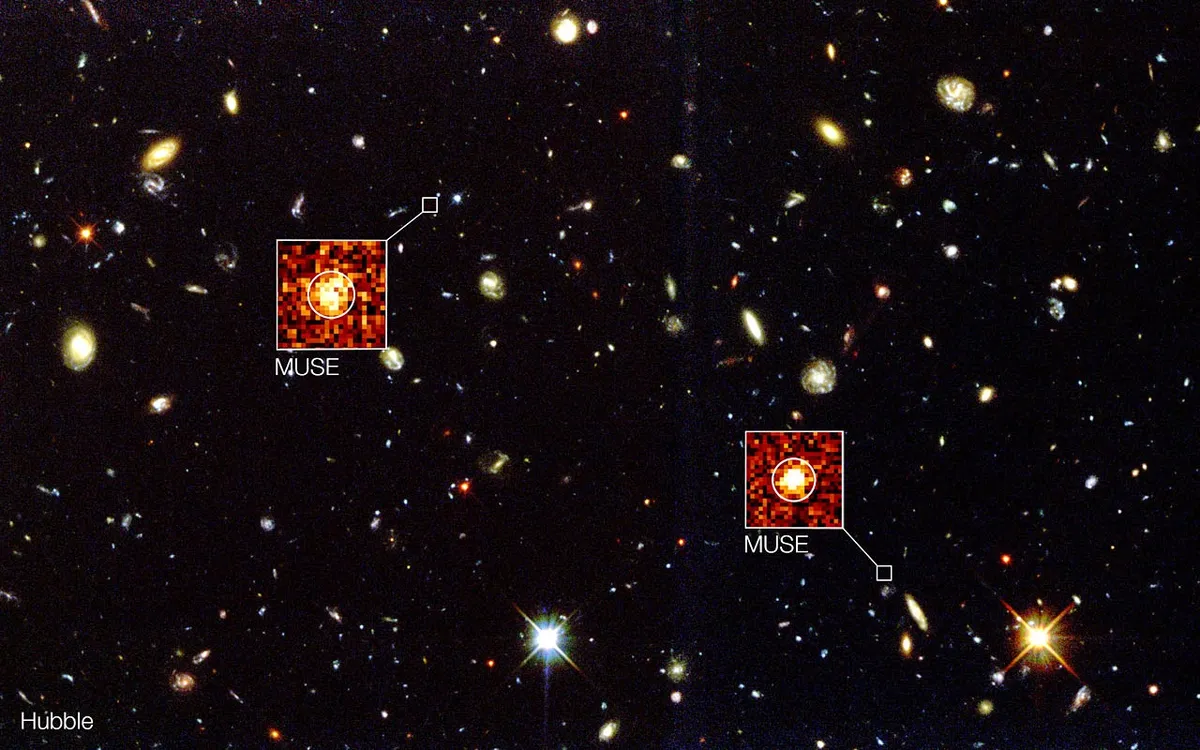
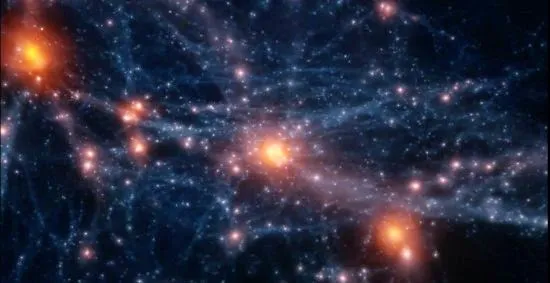
Astronomers study an unexpectedly evolved and dusty galaxy.
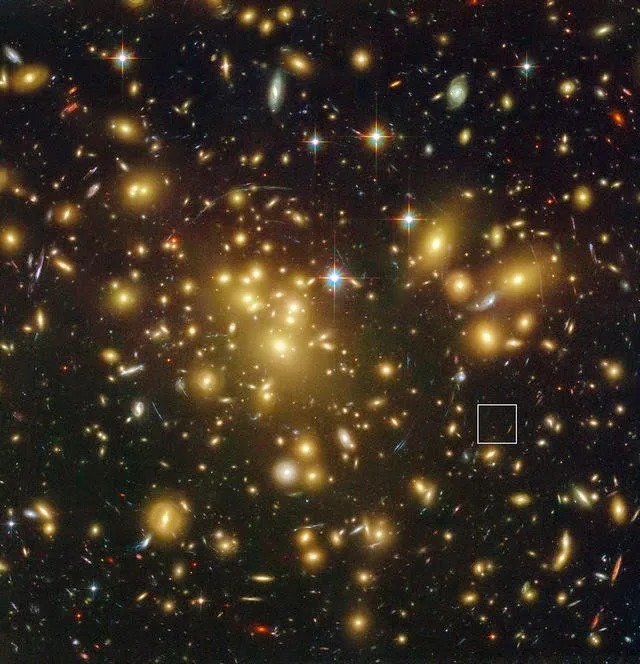
One of the most distant galaxies observed [#1] provides astronomers with the first detection of dust in a remote star-forming system of this type, promising evidence to explain the rapid evolution of galaxies after the Big Bang. To collect the faint glow of cold dust in galaxy A1689-zD1, the new observations have used the ALMA array; to measure its distance they have used ESO's Very Large Telescope.
A team of astronomers, led by Darach Watson of the University of Copenhagen, has used the X-shooter instrument, installed on the VLT, together with ALMA, to observe one of the most remote and youngest galaxies ever found. They were surprised to discover a much more evolved system than expected, as it had a dust fraction similar to a galaxy like the Milky Way. This dust is vital for the formation of planets, complex molecules, and normal stars.
The object is called A1689-zD1. We can see it thanks to a gravitational lens (due to the interposition of the galaxy cluster Abell 1689) that amplifies its brightness more than nine times. Without this gravitational phenomenon, the glow of this distant galaxy would have been too faint to detect. This galaxy was discovered previously in Hubble images and it was suspected to be very far away, but at that time its distance could not be measured precisely.
We are seeing A1689-zD1 when the universe was only about 700 million years old (five percent of its current age). Technically, its cosmological redshift or z parameter is 7.5. It is a relatively modest system, much less massive and luminous than many other objects that have been studied before in this stage of the early universe and, therefore, a more typical example of a galaxy at that time.
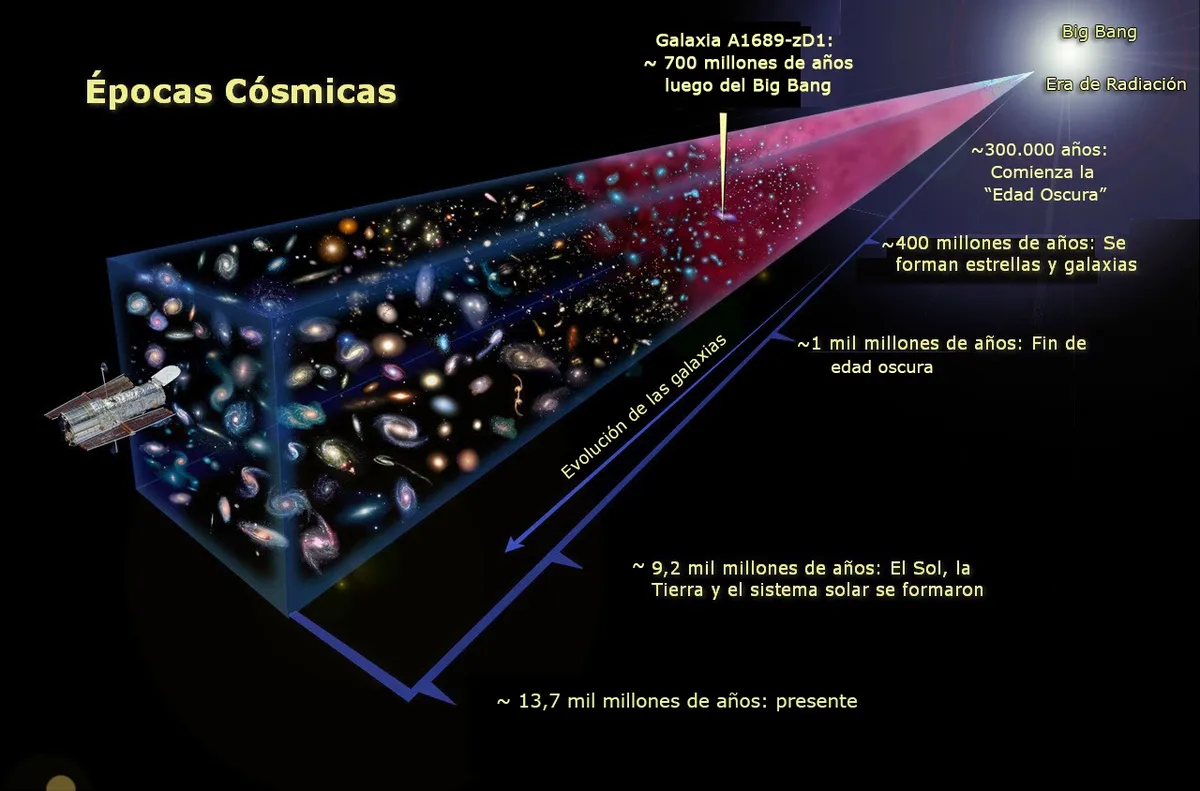
A1689-zD1 is being observed as it was during the period of reionization, when the first stars brought with them a cosmic dawn, illuminating for the first time a vast and transparent universe and ending the prolonged stagnation of the dark ages. Observers expected to see a system with the appearance of having recently formed, but the galaxy surprised them with its rich chemical complexity and its abundance of interstellar dust.
Previously, there would have been a recombination phase (400,000 years after the Big Bang, z=1100) in which, due to cooling from the expansion of the universe, the recombination rate of hydrogen was greater than the ionization rate, allowing protons to recombine with electrons to form neutral atoms.
Reionization occurred between 150-1000 million years after the big bang when the first generations of stars emitted radiation.
This galaxy was in its cosmic infancy, but turned out to be precocious. At this age, it was supposed to have few heavy chemical elements. In astronomy, any element heavier than hydrogen or helium is defined as a metal. These are produced inside stars and are dispersed and carried away once the stars explode or otherwise reach the end of their lives. This process must repeat over many stellar generations to produce a great abundance of heavier elements like carbon, oxygen, and nitrogen.
Surprisingly, galaxy A1689-zD1 appeared to be emitting a large amount of far-infrared radiation [#2], indicating that it had already produced many of its stars and significant amounts of metals, revealing that it not only contained dust but had a dust-to-gas ratio similar to that of much more mature galaxies.
As Darach Watson explains, "Although the exact origin of galactic dust remains a mystery, our results indicate that its production is very rapid, within a margin of only 500 million years from the beginning of star formation in the universe. In cosmological terms, this is a very short time, given that most stars live for billions of years."
The results suggest that A1689-zD1 has been forming stars uniformly at a moderate rate since 560 million years after the Big Bang, or else it went through its starburst phase very quickly before entering a stage of decline in star formation.
Before this result, astronomers feared it would be impossible to detect this type of distant galaxy using these techniques, but A1689-zD1 has been detected using only brief observations carried out by ALMA.
Kirsten Knudsen (Chalmers University of Technology, Sweden), co-author of the paper, added, "this incredibly dusty galaxy seems to have been in a hurry to make its first generations of stars. In the future, ALMA will be able to help us find more galaxies like this and thus learn why they are so eager to grow".
The most distant objects
[1] The list of the most distant objects known to humans changes over time. Detection methods are usually spectroscopic or photometric. The former is considered much better. According to that method, the most distant known object is GRB 090423, whose discovery Watson boasts about on his website (carried out as a collaborator of a group of astronomers).
However, it is a Gamma Ray Burst (GRB) and not an "object," although such a burst must come from an astronomical object, whatever type it may be.
On the other hand, if we think of specific objects, the most distant galaxy would be UDFj-39546284, under debate; followed by the dwarf z8_GND_5296. The most distant supernova would be SN 1000+0216.
As Tejada Gómez wrote with music by Ariel Ramírez in homage to Guillermo Hudson in "Allá lejos y hace tiempo":
♪Far, very far from the sun
Memory returns from there
I feel shining in my eyes
The blue solitude of my native land.♪
An astronomically beautiful zamba. A lovely interpretation is by Rosa Incaica Trío.
Sources and related links
- “A dusty, normal galaxy in the epoch of reionization”, by D. Watson et al., Nature March 2, 2015.
- ESO: An aged galaxy in a young universe
- [2] By the time it reaches Earth, and due to the expansion of the universe, this radiation has been "stretched," shifting toward the millimeter wavelength range, so it is possible to detect it with ALMA.
About the images
- Fig.1: Credit: NASA; ESA; L. Bradley (Johns Hopkins University); R. Bouwens (University of California, Santa Cruz); H. Ford (Johns Hopkins University); and G. Illingworth (University of California, Santa Cruz)
- Graphic by NASA, ESA, and A. Feild (STScI): Cosmic Epochs.