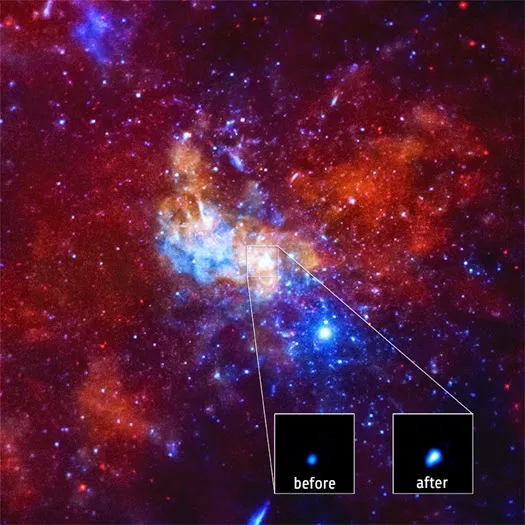
Two recent studies detail discoveries of an impossible supermassive black hole and an intermediate-mass black hole. The black hole "family" is still a mystery.
The intermediate-mass black hole
"In paleontology, the discovery of certain fossils can help scientists fill the evolutionary gaps between different dinosaurs," said the Spanish researcher Mar Mezcua from the Harvard-Smithsonian Center for Astrophysics, who led a recent study and added: "We do the same in astronomy, but we usually have to 'dig' our discoveries in galaxies that lie millions of light-years away."
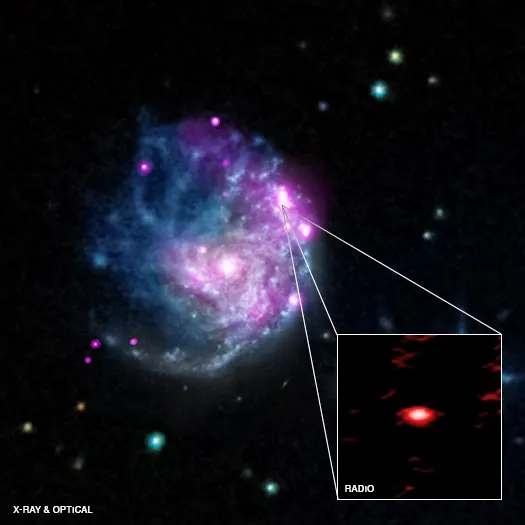
The intriguing object, called NGC-2276-3c, is located in a spiral arm of the galaxy NGC 2276 which is 100 million light-years from Earth. The object appears to be an intermediate-mass black hole (IMBH).
For many years, scientists have found evidence of small black holes containing between five and thirty times the mass of our sun. There is also abundant information on supermassive black holes that reside in the centers of galaxies and can possess millions of solar masses.
As their name indicates, IMBHs represent a class between the two well-established groups, with masses in the range of a few hundred to a few thousand solar masses.
"Astronomers have been searching hard for these medium-sized black holes," commented co-author Tim Roberts from Durham University. "There have been hints of their existence, but IMBHs have acted like a long-lost relative that isn't interested in being found," he added.
To learn more about the particular object, researchers observed it with X-rays using the Chandra Observatory and in radio waves using the VLBI. They estimated its mass at 50,000 times that of the Sun.
A remarkable property of the object is that it has produced a powerful radio jet that extends for 2,000 light-years. The region along the matter jet appears to have few young stars, which would be an indication that IMBHs strongly influence their environment.
The black hole NGC-2276-3c is one of eight ultraluminous X-ray sources (ULXs) in the galaxy in question studied by Anna Wolter of INAF in Italy. Hundreds of ULXs have been detected in the last 30 years; however, the nature of these sources is still a matter of debate.
Observations with Chandra show that an apparent ULX observed with ESA's XMM-Newton instrument is actually five ULXs, including NGC-2276-3c. Wolter's research concludes that between five and fifteen solar masses form in NGC 2276. This star formation rate could have been triggered by a collision with a dwarf galaxy, supporting the merger origin of IMBHs.
The results of both investigations will be published in separate papers in MNRAS.
THE IMPOSSIBLE BLACK HOLE
Scientists have discovered the brightest quasar in the early universe, powered by the most massive black hole known to date, as recently published in Nature.
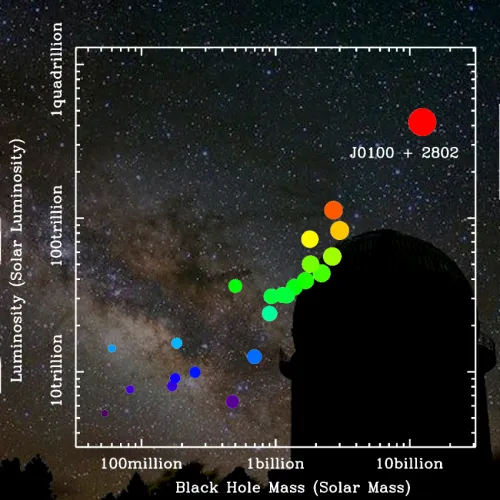
The quasar -named SDSS J0100+2802- would have a central black hole of 12 billion solar masses and a luminosity of 420 trillion suns. It is located 12.8 billion light-years from Earth.
The discovery is a difficult piece in the puzzle of theories about black holes in the early universe, according to Xiaohui Fan, an astronomer at Peking University and the University of Arizona. "How could such a luminous quasar and such a massive black hole form so early in the history of the universe, in an era very soon after the first stars and galaxies emerged?" pondered Fan. And he added: "And what is the relationship between this enormous black hole and its environment, including its host galaxy? This ultraluminous quasar with its supermassive black hole provides a unique laboratory for studying mass aggregation and galaxy formation around very massive black holes in the early universe."
The quasar dates from a time near the end of the epoch of reionization or cosmic dawn, when the light from the first stellar generations ended the "dark ages" and transformed the universe into what we see today.
The recently discovered quasar is seven times brighter than most known quasars with a black hole of 12 billion solar masses. "In comparison, our Milky Way has a black hole with a mass of only 4 million solar masses; the black hole powering this new quasar is 3,000 times more massive," reported the astronomer.
"This quasar was first discovered with our 2.4-meter Lijiang Telescope in Yunnan, China, making it the only one discovered by a telescope of that size at such a distance and we are proud of it," commented Feige Wang, a doctoral student at Peking University and co-author of the study.
After the initial discovery, two telescopes in Arizona continued the work. Astronomers determined the distance and mass with the 8.4-meter LBT and the 6.5-meter MMT. Additional observations were made with the 6.5-meter Magellan at Las Campanas and the 8.2-meter Gemini North on Mauna Kea.
Sources and related links
- The powerful jet of an off-nuclear intermediate-mass black hole in the spiral galaxy NGC 2276; Mezcua, M et al, 2015, MNRAS (accepted); arXiv:1501.04897
- NGC 2276: a remarkable galaxy with a large number of ULXs; Wolter, A. et al, 2015, MNRAS (accepted); arXiv:1501.01994
- NASA's Chandra Finds Intriguing Member of Black Hole Family Tree
- An ultraluminous quasar with a twelve-billion-solar-mass black hole at redshift 6.30; Xue-Bing Wu et al (2015) Nature 518, 512–515 DOI: 10.1038/nature14241
- Phys.org: Monster black hole discovered at cosmic dawn
- University of Arizona: UANews
About the images
- Initial figure. Credit: X-ray: NASA/CXC/SAO/M.Mezcua et al & NASA/CXC/INAF/A.Wolter et al; Optical: NASA/STScI and DSS; Inset: Radio: EVN/VLBI
- Fig.2: Credit: Zhaoyu Li/Shanghai Observatory