NASA's New Horizons probe is about to reach its closest approach to Pluto after 9 years of travel. The Planetarium of Buenos Aires invites you to watch the moment live.

The Galileo Galilei Planetarium of the City of Buenos Aires invites you to participate in the event "Encounter with Pluto," on Tuesday, July 14 from 19:30.
The United States space agency, NASA, launched the New Horizons spacecraft towards Pluto and the Kuiper Belt in 2006.
After nine years of travel, next Tuesday, July 14, the spacecraft will be about 4,800,000,000 kilometers from Earth and just over 12,000 kilometers from Pluto, reaching its closest approach to that dwarf planet.
At the Planetarium we will be celebrating this "historic moment," connected live with NASA, through NASA Museum Alliance and the Embassy of the United States in Buenos Aires, Argentina.
We will enjoy live images and accounts of this human feat in the field of Astronautics and Astronomy.
Admission to the showroom is by strict order of arrival (capacity 250 seats). It is a free activity.
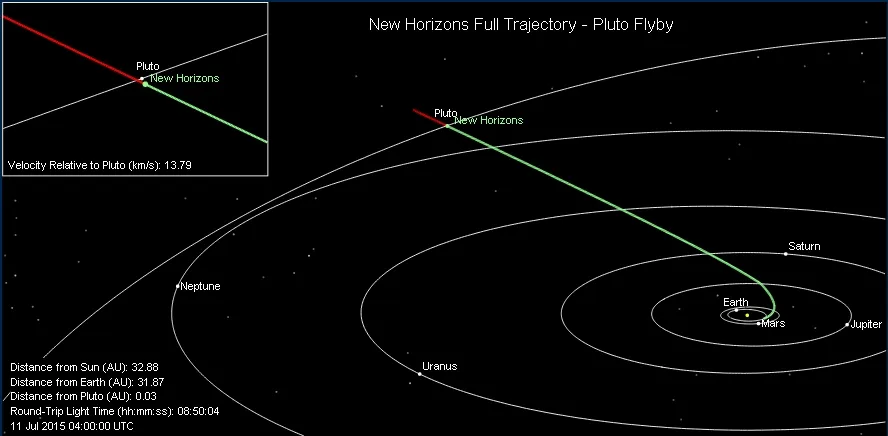
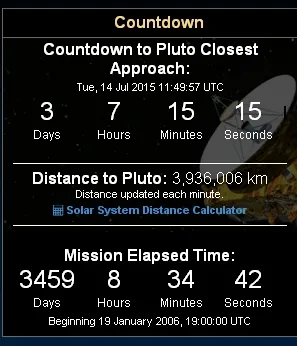
The spacecraft experienced an anomaly on the afternoon of July 4 that caused a loss of contact with Earth, but it was overcome and communication with the probe was reestablished.
The operations center at Johns Hopkins University lost contact with the unmanned spacecraft 10 days before its closest approach to Pluto and regained communications a couple of hours later. During that time, the spacecraft's autopilot switched from the main computer to the backup, in "safe mode," and communication was restarted.
The investigation into the anomaly concluded that there was no hardware or software error, but a flaw in a command sequence during a preparation operation for the flyby. No similar operations are planned for the remainder of the mission.
LORRI: Houston, we have geology: the whale and the heart
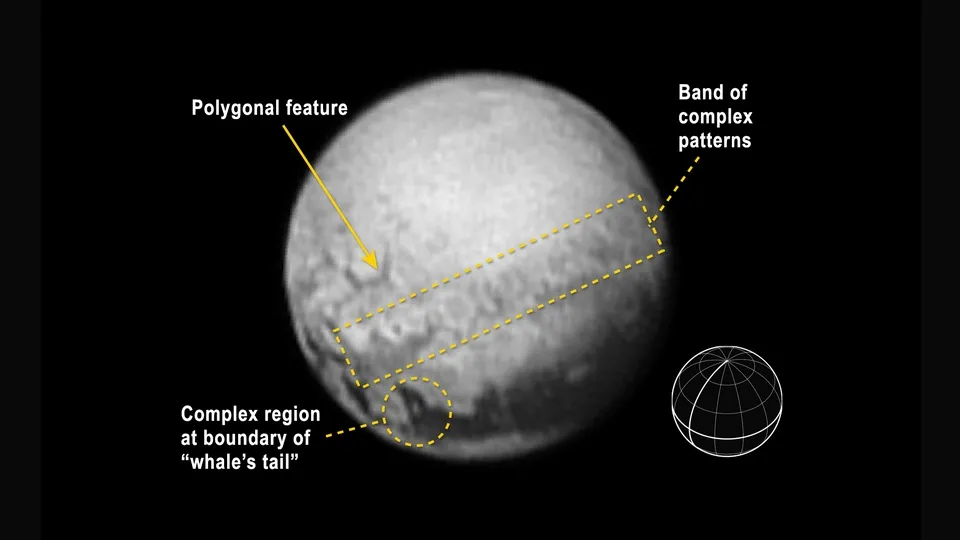
It started as a point of light and evolved into a strange shape: the latest portrait of Pluto reveals an intriguing world with surface features that include an immense dark band that looks like a "whale."
From LORRI (Long Range Reconnaissance Imager) New Horizons is sending images that are already beginning to reveal the geology of the dwarf planet.
This image was taken on July 9 from 5.4 million kilometers from the planet. The face of Pluto we see is always facing its moon Charon and includes the shape now called the "whale's tail" at the bottom.
In another image taken on July 7, the surface features of the distant world of the solar system resemble the shape of a heart.
The image was taken from 8 million km from the planet and was the first to be received after the July 4 anomaly that put the spacecraft in safe mode. This view is almost centered on the area that will be seen up close on the 14th of this month at closest approach. This side of Pluto is dominated by three broad regions of varying brightness, among which stand out a long dark shape at the equator, informally called the "whale," and a long heart shape measuring about 2,000 km, on the right.

Sources and related links
- Galileo Galilei Planetarium: Encounter with Pluto
- New Horizons Plans July 7 Return to Normal Science Operations
- NASA: New Horizons
- NASA Johns Hopkins New Horizons
About the images
- Credit: NASA/Johns Hopkins University Applied Physics Laboratory/Southwest Research Institute
- Credit: NASA/Johns Hopkins University Applied Physics Laboratory/Southwest Research Institute