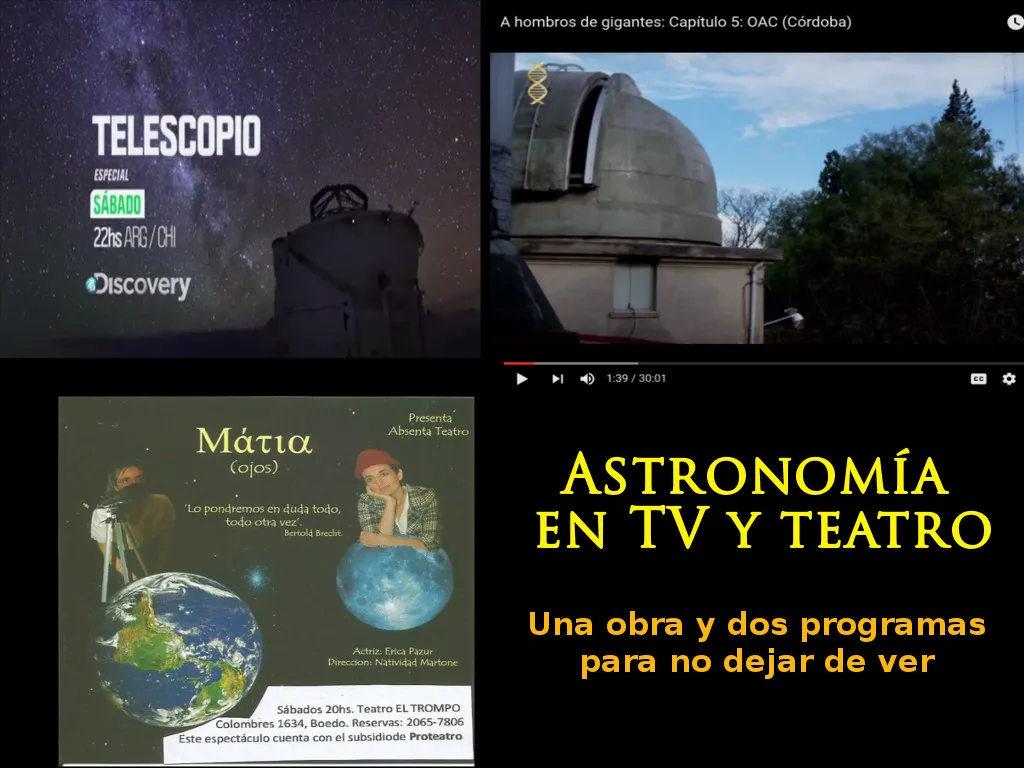
Review of the play μάτια (Mátia), directed by Natividad Martone, starring Erica Pazur. Theater and astronomy for reflection and smiles.
Everything takes place in Lucy's office, an astrophysicist who lives in her own academic-professional bubble with the (plausible and exaggerated) ingredients that real astronomical work indeed has: she is searching for a new theory, apparently about the expansion of the universe. Something doesn't match the supernova observations up to 1998. She writes barely perceptible formulas on a blackboard. The spectator knowledgeable in the subject will see some graphs with theoretical meaning, like the Omega parameter (about the critical density of matter in the universe).
Lucy talks a lot on the phone: with her mom, who asks her about the moon in Gemini and whom Lucy reminds that she is an astrophysicist, that she does research, not astrology, and to whom she also says she has no time for men, because she has to work. And later, she will have even less time for her mom: she was granted observing time on the Atacama telescope!
Lucy also talks with Walther, her boss, who persistently hangs up on her. These other characters only appear through these phone conversations: this is how we learn about the (absent) presence of Juan, her married-lover-professional colleague. And about Marcos, her assistant. Lucy really likes music. At the start of the play we hear a metronome (an instrument for measuring time, the beat) and then a violin, which she plays sitting in front of her computer. On the wall are two portraits: Vivaldi and Einstein, whom Lucy will call by their first names (Antonio and Alberto).
It's that Lucy, besides talking on the phone, talks out loud. She talks to her violin, whom she nicknames John (a reference that can be established not only with the Beatle, but with her lover, Juan).

When Lucy leaves the office, always in a hurry, with time "running out", she usually does so while talking on her cell phone. When she leaves the office-set, the spectators hear what Lucy is talking about, off-stage. The office lights go out, to come back on when Charlotte bursts onto the scene, a character embodied by the same actress -Erica Pazur- now personifying the scientist's personal assistant. In clear contrast to Lucy, Charlotte is clumsy in her pompous movements and a bit crude, for example in her use of language. Charlotte is a counterpoint, she is the character that gives the play mobility, who puts Lucy in check by erasing the equations from the blackboard. The hypothesis! The tragedy of losing the hypothesis because her assistant erased it, quickly mutates, as the astrophysicist realizes her theory had an error. This will repeat in the play: Charlotte's "blunders" are, in reality, her "salvation".
The apparent is different from the real. Her love, Juan, wasn't what he seemed either. And Marcos?
Those are the axes of the play, traversed by the music of the Four Seasons, and two songs by the Fabulous Four from Liverpool: Here Comes the Sun and Across the Universe.[1]
The "presence" of Vivaldi and his seasons also deserves a semiotic reading: there is not only a relationship with the astronomical, but a season only acquires meaning through the others. In the same way, what exists acquires meaning when it is missing, presence through absence. The void is as material as an incandescent ball of plasma.
Both because of the exaggerated and acrobatic movements, and because of the fact of appealing directly to the spectator, especially in the character of Charlotte, it is evident that the one-woman show is based on clown technique. The "clown", with his comic-dramatic discourse, allows saying what would otherwise be difficult to express. It is characterized not only by acrobatic skills, but by breaking the "fourth wall", by interacting with the audience through actions and glances. [2] [3]
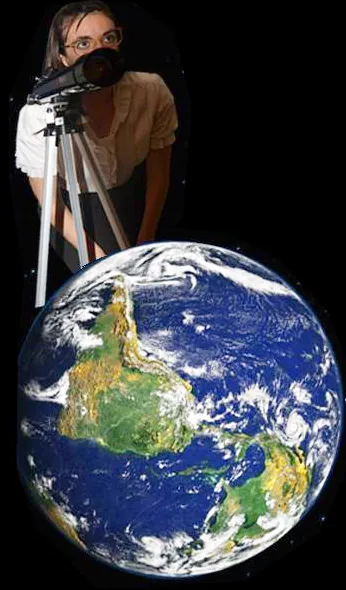
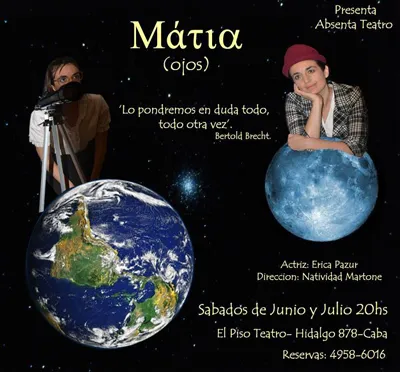
At some point, the play has a "message", a possible meaning à la Saint-Exupéry about what is essential being invisible to the eye. On the play's card, a phrase by Bertold Brecht is included: "We will question everything, everything again". The reference is to the play about Galileo. In its chapter 9, the German author has the great Italian astronomer say that [4] in a speech that appeals to methodological doubt.
The play is called Matia which in Greek means "eyes". The word is used explicitly only once, at the end of the play. The spectator will be the one who must give meaning to the word.
In some way, the theatrical play questions the meaning of academic, rigorous life, in which one lives to work (and not the other way around), in which what is at stake are personal egos, the search for prestige (the institutional prize), even if to achieve that the rules are bent a little (as Juan will do, as others do in real life, appropriating what belongs to others). That methodological doubt, the Cartesian doubt so characteristic of critical-scientific thought, transcends the merely professional sphere to move into people's lives, into the way of living (and working). It is, at this point, a critique of the lifestyle, or, in any case, it is a meaning that can be given to it.
Another idea that seems to arise from the play is that those contradictions of modern life can be overcome with humor and love.
In conversation with the actress who embodies the two characters, it is evident that there is something of that. The play is the fruit of her interest in astronomy, but it is also the result of great work and a search that took years, through different directors. Finally, Erica Pazur found in Natividad Martone -the director- the necessary creative duo to give theatrical form to the idea. And it is not a work that has ended, as the play is in constant change and transformation, like life.
It is interesting to note that no astronomical knowledge is needed to understand what happens to Lucy and Charlotte. The symbolic play not only prompts reflection, but brings out illuminating laughter and one can guess the smiles shared in the audience.
The playful, perhaps childish, perhaps naive, challenges us to live in another way, in that search for happiness that we don't quite know what it is, but that we intuit and that unfolds, expands, like the universe, bringing the planets into the hands of the spectators.
Finally the lights go out and the metronome resumes its beat. Applause erupts and something will remain shining within us. A play to see.
---------
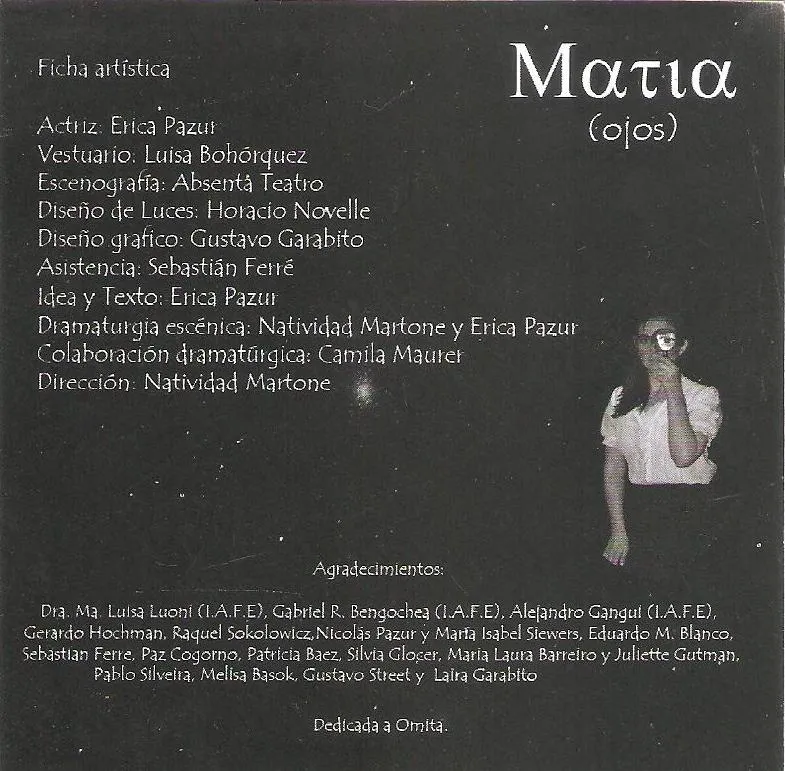
Play details
Actress: Erica Pazur
Costumes: Luisa Bohórquez
Set Design: Absentá Teatro
Lighting Design: Horacio Novelle
Graphic Design: Gustavo Garabito
Assistant: Sebastián Ferré
Idea and text: Erica Pazur
Stage Dramaturgy: Natividad Martone and Erica Pazur
Dramaturgical Collaboration: Camina Maurer
Direction: Natividad Martone
Saturdays in June and July, 20 h
El Piso Teatro, Hidalgo 878, CABA
Reservations: 4958-6016
The footprints of three Argentine professional astronomers
If the play possesses a certain realism associated with professional activity in astronomy and its current theoretical context, it is no accident. Erica Pazur had the collaboration of three professionals from the IAFE, who are thanked on the back of the card: Dr. María Luisa Luoni, Gabriel Bengochea, and Alejandro Gangui.
Sources and related links
- [1a] YouTube video Beatles, Across the universe, subtitled in Spanish: https://www.youtube.com/watch?v=D28imrpdwdk
[1b] NASA: Transmiten a Los Beatles al espacio - [2] I want to talk about that: the clown technique
- [3] Wikipedia: the fourth wall
- [4]: Bertold Bercht, Galileo Galilei, on elortiba.org (search for part 9, at the end, just before 10)
Galileo Galilei, Bertold Brecht, Ediciones Losange, Buenos Aires, 1956, pp. 48-49.
On Scribd.