In a recent survey of more than 1100 astronomers, almost half said they had received little or no training in software, although 90% wrote some program. Jon Cartwritght in Physics World reports the latest trends in programming languages and their professional use.
What follows is a free translation of the article in English published in Physics World, December 2015, by Jon Cartwritght, freelance journalist.
Ivelina Momcheva realized she was wasting a lot of her time programming. Whether to analyze data or to produce graphs for papers, she sits down to write on her keyboard at Yale University line by line. Although it is a very important part of her work, she never received a formal education in software development.
"Since I started my undergraduate degree, I have mostly been self-taught," she explained. "I took some recommended books, some online classes and looked at codes written by my colleagues", she added.
Her colleague, Erik Tollerud has a somewhat different story. Son of a computer science professor, he took a course before university. With that background, he was better prepared than Momcheva, although perhaps not by much, for a life in modern astronomy. Are these two examples that can be extrapolated? In December of last year the pair attended the .Astronomy 6 (dot astronomy) conference in Chicago, where they found many of their colleagues debating how they use software and about the current level of teaching. As there was no consensus, they decided to investigate with an informal survey.
The results, based on responses from more than 1100 astronomers of all levels, reveals how poorly prepared professionals are in this subject. The vast majority (90%) said they write at least a part of the software they use, but less than 10% said they had received "important" (substantial) training.
About half said they had received little training, while 43% indicated they had had none.
"One of the points we wanted to make with the paper is that there is very little teaching for something that represents an important part of our jobs, and that is a problem", explained the astronomer.
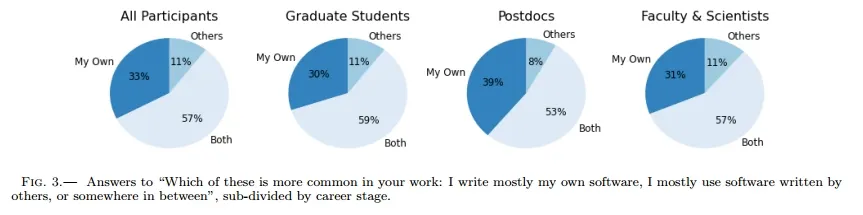
Responses to the question: Which of these options is most common in your work?
-Mostly use my own software
-Mostly use software written by others
-Something in between the two previous ones
Responses were divided by career levels
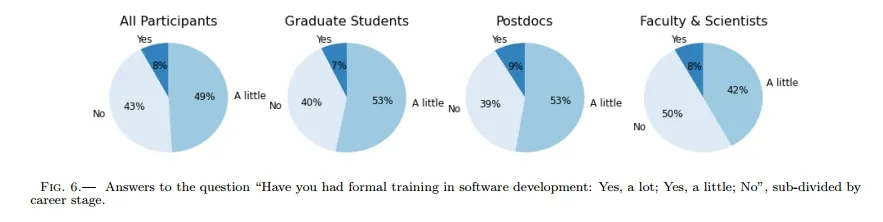
Responses to the question: Have you had formal training in software development: Yes, a lot; Yes, a little; No. Subdivided by career degree.
Languages
One could argue that the lack of teaching is not a problem. Scientists have always been quick to use computers for the benefit of their work, and there is a long history indicating they learn on the fly, without the support of formal classes. Isn't that the best way to learn, just as people learn foreign languages in their native country? Tollerud does not recognize the comparison.
"Despite the word 'language', the analogy is not so good with language, but it is with mathematics". Unlike what sometimes happens with languages, one does not learn calculus and linear algebra "on the fly".
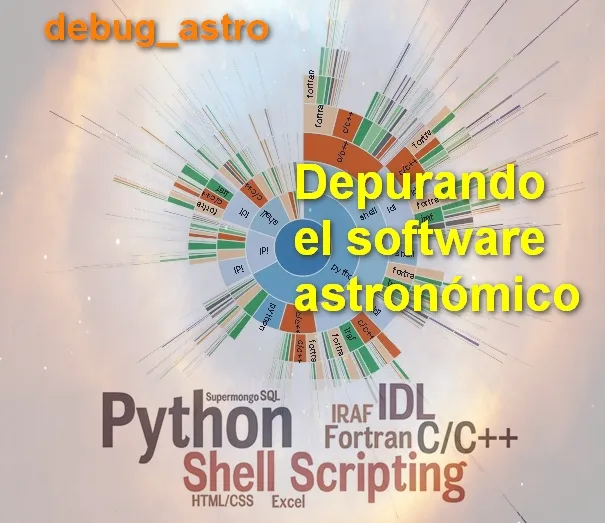
According to this work, two thirds of astronomers use Python, while 44% use IDL, 37% use C or C++ and 28% Fortran. "Historically, a lot of scientific code was written in Fortran. And although it is now generally recognized as a more difficult language to work with, it is still used because of decades of development put there. They don't want to change to something new", explained Tollerud.
But the academic admits that languages like Fortran, which are more similar to current machine code, -low-level languages- can produce faster programs.
Jonathan McDowell, an astrophysicist at the Harvard-Smithsonian Center in Cambridge, agrees. "Software engineers sometimes try and push us towards the latest languages that in 10 years will be forgotten". McDowell is a software developer for the Chandra Observatory and adds: "Fortran may be an old language in the rest of the world, but for us it is alive and for a lot of reasons".
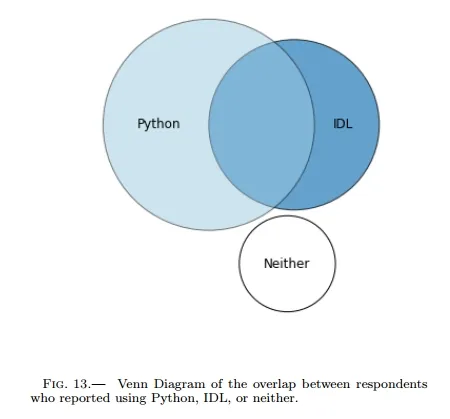
The Venn diagram shows that 86% (984 responses) of the surveyed use both Python and IDL. Of them, 764 use Python and 497 IDL. Both are chosen by 277, 25% of the total. This indicates an overlap: 36% of Python users also use IDL and 55% of IDL users also use Python. Finally, 158 participants (14% of the sample) do not choose any of those languages.
To facilitate the understanding of the multidimensional dataset on how various tools are used, the authors provide an interactive visualization, accessible from the link indicated below.
Required teaching
McDowell agrees with the authors of the paper about the inadequate education in software. "A quick look at many astrophysicists' codes shows how deep the need for certain formal training is. Astronomical code is sloppy, tangled and frequently stuck in the styles of the 1960s". He thinks courses should focus on "simple things": loops, subroutines, established styles. "Most astronomers only need the basics, because they are not going to try to do anything super fancy".
The credits
The article mentions workshops called "SciCoder" and organizations like Software Carpentry that run workshops for scientists of all disciplines. But much of such effort is based on taking programming more seriously as part of modern science, not only making better programs, but giving appropriate credit to computational production. "There is less recognition of software as something that is critical for doing science, than in instrumentation", commented Tollerud. And he added: "Even though, in modern astronomy, it is".
Comic on XKCD.com used in the paper
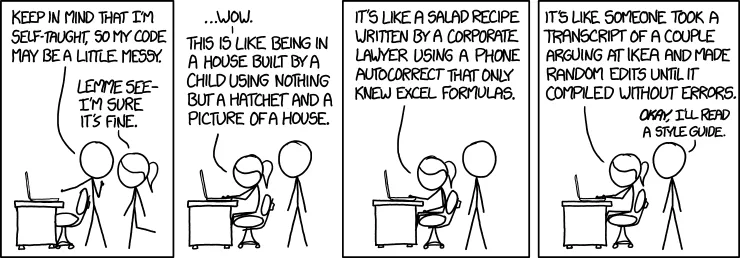
He: -Keep in mind that I'm self-taught, so my code might be a bit messy.
She: -Let me see, I'm sure it's fine.
She: ...Wow. This is like being in a house built by a child using an axe and a drawing of a house.
She: -It's like a salad recipe written by a corporate lawyer using a phone with autocorrect that only knows Excel formulas.
She: -It's like someone took a transcript of a couple arguing at Ikea and edited it randomly until it compiled without errors.
He: -Well, I'll read a style guide.
Sources and related links
- The article appears in Physics World Focus on Astronomy & Space
http://live.iop-pp01.agh.sleek.net/physicsworld/reader/#!edition/editions_Astro-2015 - Software Use in Astronomy: an Informal Survey
Ivelina Momcheva, Erik Tollerud
arXiv:1507.03989 [astro-ph.IM]
http://arxiv.org/abs/1507.03989 - Available on Authorea: https://www.authorea.com/users/10533/articles/18046
Interactive visualization: http://eteq.github.io/software_survey_analysis/software_tools_heirarchy_d3vis.html
About the images
Figures from the aforementioned paper and XKCD.com comic: https://xkcd.com/1513/
Opening image: Combination of images:
-Word cloud of languages, from the Physics World article
-Helix Nebula: HubbleSite
-Visualization image from Momcheva-Tollerud.