An international team of astronomers (including Chileans and Spaniards) says it has found the faintest object ever seen in the early universe.
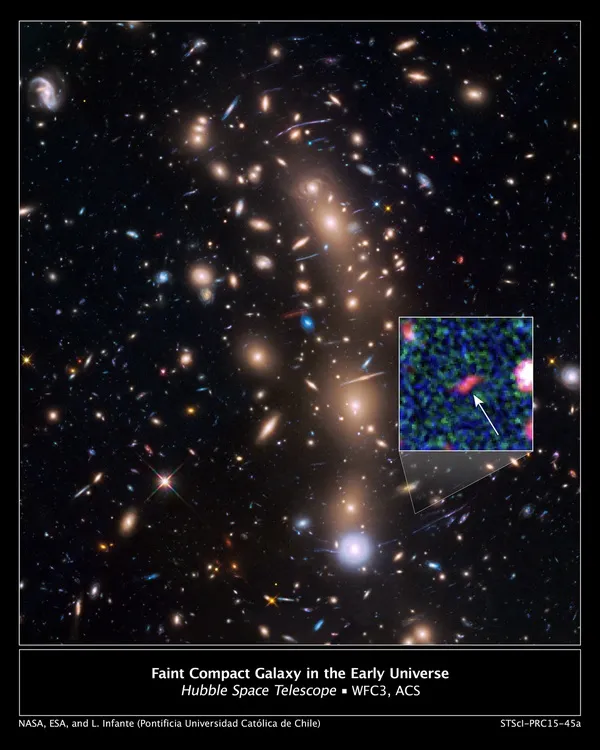
According to the NASA press release, the team nicknamed the object Tayna, which means "firstborn" in Aymara.
According to the release, telescopes like Hubble and Spitzer had already detected other galaxies that broke distance records, but in this case it would be a smaller type of galaxy, very faint, more representative of objects in the early universe.
"Thanks to this detection, the team has been able to study for the first time the properties of extremely faint objects formed shortly after the big bang", said Leopoldo Infante, an astronomer at the Universidad Católica de Chile. The remote object is part of a discovery of 22 young galaxies near the observable horizon of the universe. The results were published in The Astrophysical Journal.
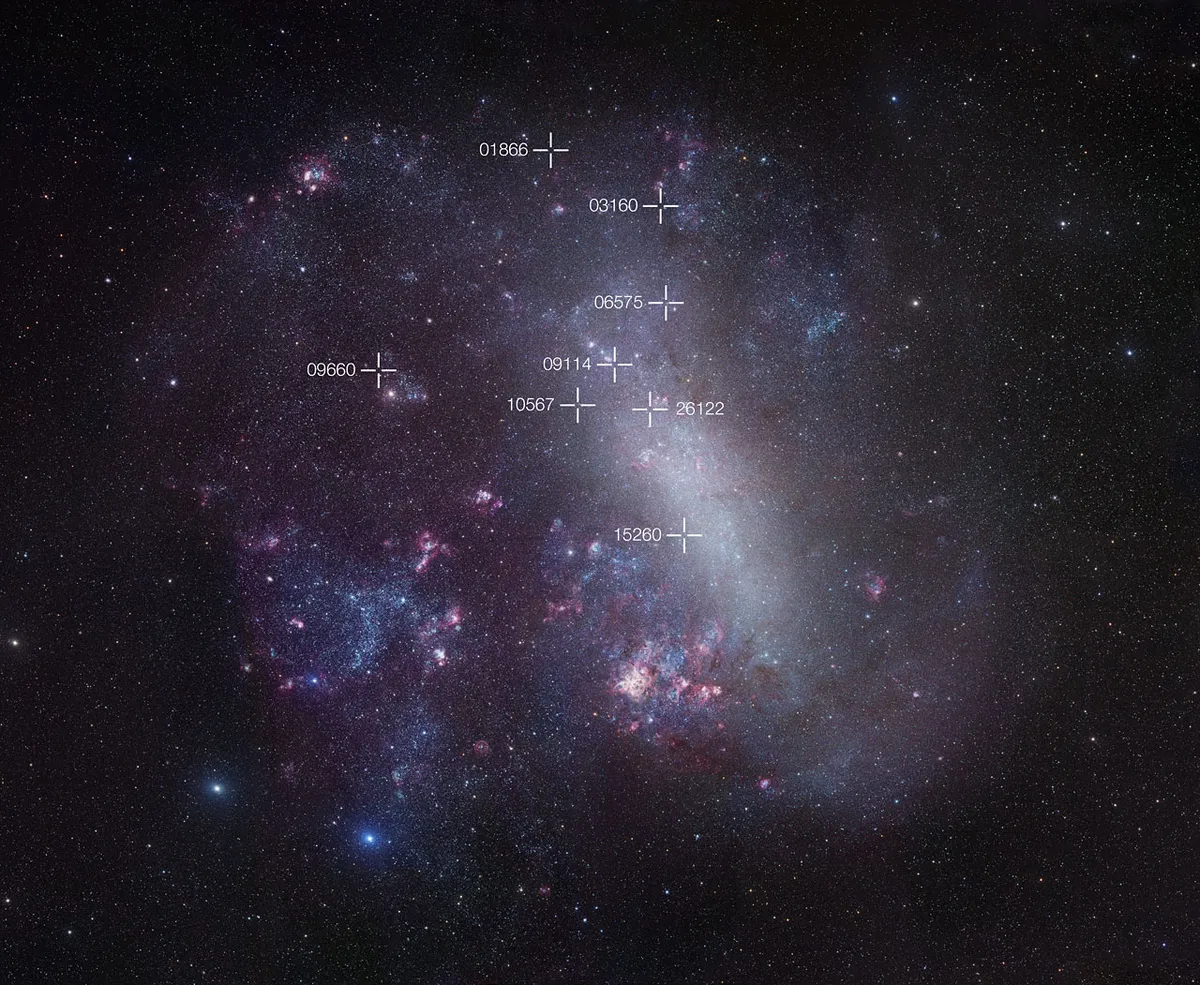
The object is comparable in size to the Large Magellanic Cloud (LMC), a small satellite galaxy of the Milky Way. It is creating stars at a rate ten times higher than the LMC. This faint object could be detected using the gravitational lensing technique. As part of the Frontier Fields program, Hubble observed a massive galaxy cluster, MACS0416.1-2403, located about 4 billion light-years away, with a mass of trillions of suns. This giant cluster acts as a powerful lens by bending and amplifying the light of more distant objects located "behind" it.
The distance was estimated by constructing a color profile from combined Hubble and Spitzer observations. The expansion of the universe causes light from distant galaxies to stretch, that is, there is a redshift of the spectrum. Since most of the galaxy's new stars are intrinsically blue-white, their light shifted to infrared wavelengths, measurable with Hubble and Spitzer.
The paper indicates that photometric redshifts were calculated using an updated version of the "Bayesian Photometric Redshifts" code (BPZ 2.0).
Professional astronomers, when studying very distant objects, do not refer to their distance, but to their cosmological redshift using the letter z. In this case, the objects studied would be at z>= 8.
This calculation requires setting some parameters beforehand. The online calculator by Ned Wright can be used for this purpose.
Records, both for distant objects and for more or less bright, more or less massive objects, are frequently broken in astronomy. As if that weren't enough, there are different methods for studying distant objects that generate various interpretations and controversies about the level of precision of the data and conclusions.
For example, this same year the discovery -spectroscopically confirmed- of an object with z=8.68 was reported.
In the last five years, a reference for more distant objects has been UDFy-38135539, an object from the Hubble Ultra Deep Field (UDF) with z=8.6.
Therefore, when we read statements like "astronomers found the faintest object ever seen in the early universe" we should take them with a grain of salt. Or, to put it another way: the search for the primordial ("firstborn") objects of the universe did not end with Tayna, but is still in its infancy.
Sources and related links
- NASA Space Telescopes See Magnified Image of the Faintest Galaxy from the Early Universe
http://www.nasa.gov/feature/goddard/nasa-space-telescopes-see-magnified-image-of-the-faintest-galaxy-from-the-early-universe - YOUNG GALAXY CANDIDATES IN THE HUBBLE FRONTIER FIELDS. II. MACS J0416–2403
Leopoldo Infante et al (2015)
The Astrophysical Journal, Volume 815, Number 1
DOI: http://dx.doi.org/10.1088/0004-637X/815/1/18 - arXiv:1510.07084 [astro-ph.GA]
About the images
NASA, ESA, and L. Infante (Pontificia Universidad Católica de Chile)