What is the canícula? What different uses can we give to this word? Starting from this concept, is it possible to think of new concepts?
When I was a teenager-young person, that is, before the internet, we could borrow a book from a library or a readers' club. If after a certain time we didn't return the book, they would call us on the phone or send us a letter. I was embarrassed for that to happen and the few times I took a book home I returned it so quickly that I didn't really read it, I just "skimmed" it.
The internet and electronic media haven't changed things much. We read on the internet like I read those books: we "skim".
A few years ago, on a blog (I think on Guillermo Abramson's blog), I read about the word "canícula" like someone treasuring a useless piece of information [1]. I say it was a useless piece of information, not as a criticism of that blog, but because ultimately I never used the word since then.
More or less around that time, a person lent me a book that, for the reason stated before, I returned at lightning speed, without having read it "for real". You will soon see the curious relationship between that book and the word in question.
Since December I embarked on rereading that same book and stumbled upon the unexpected. It's "El hombre que amaba a los perros", by Leonardo Padura. At the end of the book the word canícula is used, which, as we will see below, is related to the word "dog" and not because of the title of that historical novel.
The word canícula refers to the period of greatest heat in a region. It is therefore a relative term, strongly based on the northern hemisphere. The word has its etymological origin in the word "can", which means "dog".
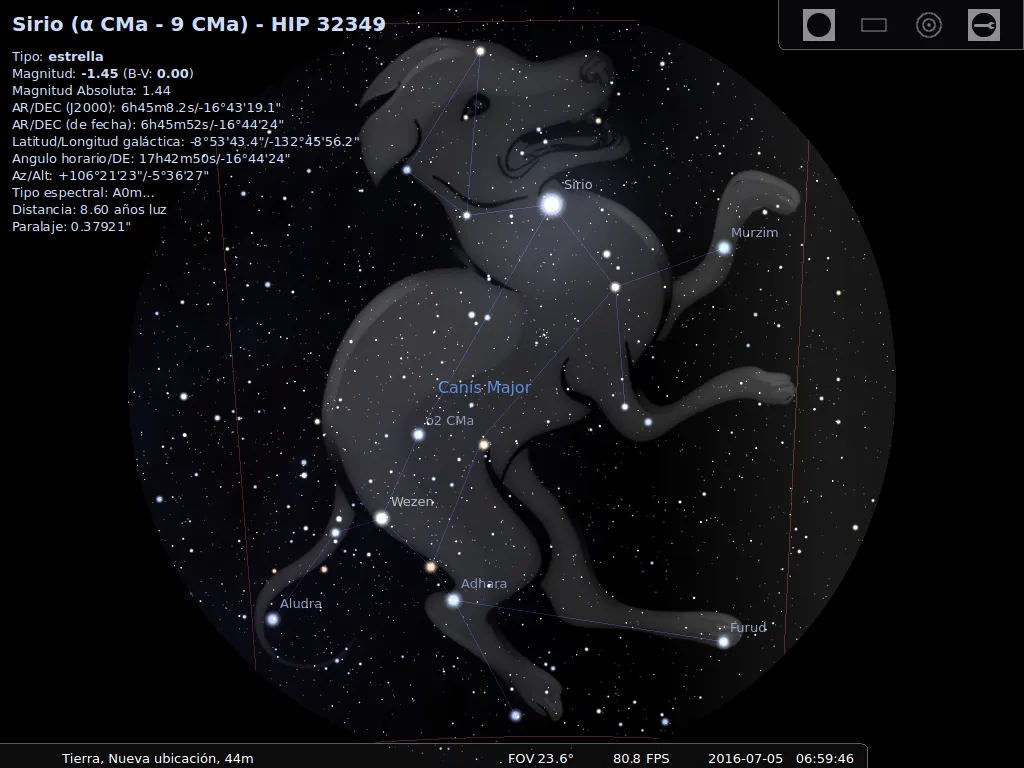
Such origin is pseudo-astronomical (or ancient astronomical): in the constellation of Canis Major, the brightest star (and in the whole sky, except the Sun) is Sirius. In antiquity, the "heliacal rising" of the star coincided with "the period of greatest heat" in the northern hemisphere [2].
The concept of "rising" in astronomy refers to the "rising" of a celestial body above the horizon. The concept of "heliacal rising" arises from there, but is more specific [3].
This concept is also relative, as can be seen in an applet or script developed by the University of Nebraska-Lincoln and whose screenshots we can see below:
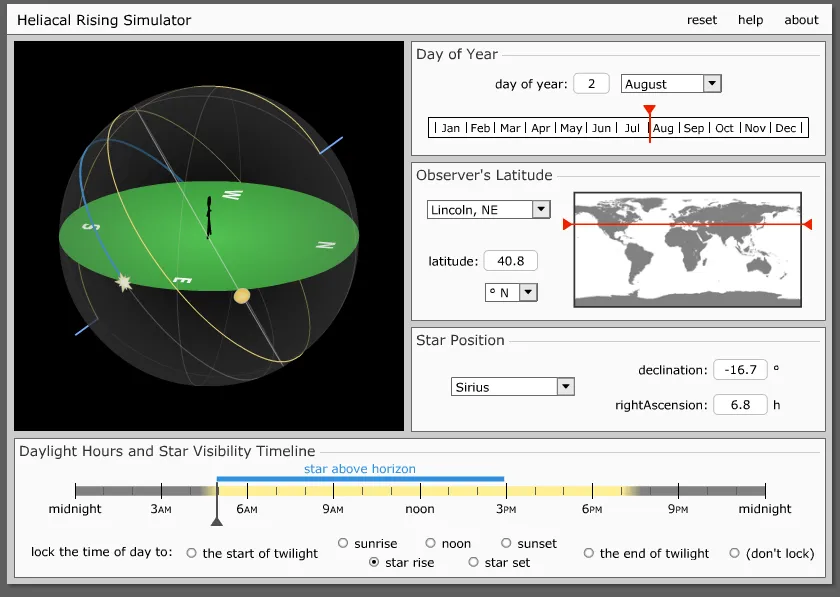
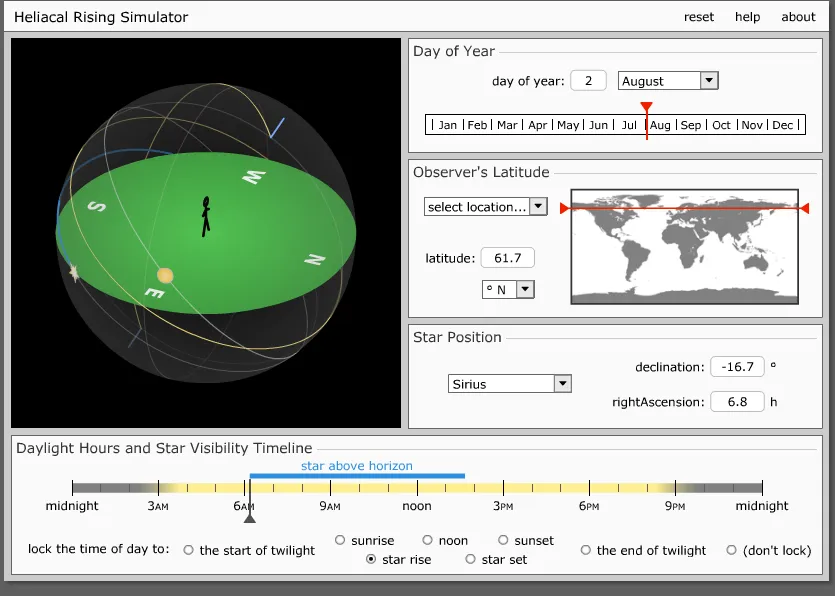
In the first image we see the rising of Sirius taking a mid-northern latitude. In the next image, for the same date, the rising of the star will be different since the latitude is different, even though it is still in the same hemisphere [4].
Let's also say that the "period of maximum heat" can be related to the summer season, but the beginning of summer is not the same as the peak of summer. The "period of maximum heat", on the other hand, could well be considered as the peak of summer, perhaps its apex or midpoint. If the austral summer begins in December, the point of maximum heat (the canícula) would be in January-February. If the boreal summer begins in June, the canícula would be in July-August.
Some millennia ago, the canicular period in the north coincided with the heliacal rising of Sirius, approximately on June 22.
Therefore, the canícula or canicular period is a concept valid for the northern hemisphere, in its etymological origin. This is why it is difficult to find a use of the term in southern latitudes, except through reading novels whose plot takes place in the north, like in "El hombre que amaba a los perros". Padura says in his novel:
"The Moscow hotel was a symbol of a still-living past, like the two men who, thanks to their high badges, entered the air-conditioned bar that freed them from the Moscow canícula." [5]
As can be seen, the term "canícula" could be replaced by "oppressive heat" and, therefore, it is already a use of the word that is alien to its pseudo-astronomical origin, with no relation to the time of year or the position of Sirius.
This is very valuable in languages: giving new meanings to words, transgressing their initial boundaries, expanding their senses: canícula could refer to a period of "greatest friction" in a meeting (for example when soccer players get into disputes that turn into blows, as we unfortunately see recurrently in these latitudes and also in others, the canícula of the match). Paradoxically, we also call those situations "álgidas".
Sometimes we speak of a "little summer" in reference to several hot days that can occur in other seasons that are not summer, like winter. That is, a "canicular period" at any time of the year.
Thus, the word that until now has been used almost exclusively in the north, could expand its use. For example, in Buenos Aires, around these dates, we are going through a terrible canícula. And not just because of the temperature, but because of the rise in electricity rates!
WE MUST GET THROUGH THE WINTER
"We must get through the winter" is a regrettable phrase that has its history in events of Argentine politics from some decades ago (Alsogaray, Frondizi Government, speech from 1959). But if the canícula refers to periods of heat and therefore to summer (although I have shown that not exclusively), then what do we call the periods of less heat (or more cold)?
One possibility would be to consider such periods as "anti-caniculares", as if they were their exact opposite. We will see later why that wouldn't be entirely the case.
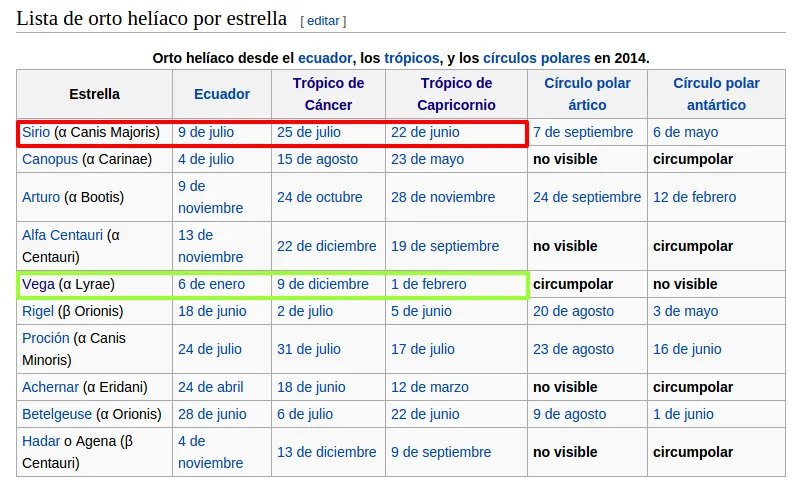
However, there is another possibility: according to Wikipedia, the heliacal rising of Sirius, currently, from the Tropic of Cancer (low latitude of the northern hemisphere), would be on July 25.
The opposite, then, could occur by considering a star whose "heliacal rising" would be with a six-month difference, for example, Vega, in Lyra. In which case, we could propose a new concept: the lirícula.
The lirícula or anti-canícula, however, might not be the exact opposite.
THE TIME OF THE LUKEWARM
If we consider that the canícula and its apparent opposite (lirícula or anti-canícula) have something in common, then, the opposite would be something else. Summer and winter imply extreme temperatures. The opposite would be times of average temperatures. What could we call such periods?
If summer and winter are associated with the solstices (June and December), the average temperatures are related to spring and autumn, that is, the equinoxes (March and September).
We could look for stars whose heliacal rising coincides with those two months, in which case we would have two new concepts, or we could look for a concept for both, since they are not so different from each other, unlike summer and winter.
It occurs to me to propose the concept of "ceticula". Ceti, genitive of Cetus, the whale or sea monster, which is one of the constellations that forms a region of "water" in the sky, along with Aquarius and Pisces.
Whales, although mammals, share a behavior with birds: migration. They migrate in winter to warm waters.
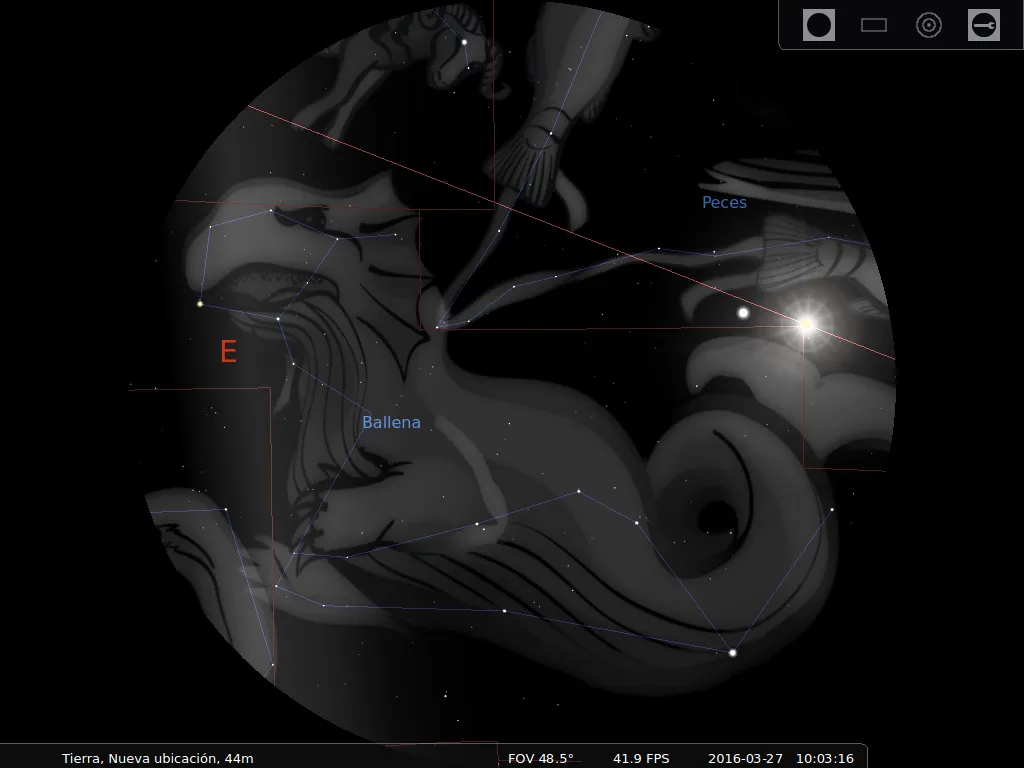
Furthermore, Cetus could well be considered a "special" constellation for crossing the ecliptic a little bit and therefore being a zodiacal constellation, in March, when the Sun "passes through" it (as seen in the simulated image above).
Carl Sagan liked whales. Perhaps someone will think of narrating his life as "The Man Who Loved Whales". From there to putting the image of a cetacean on the national currency bills, there is a long way [6]. History is made by people and societies. We should not confuse the song of the whales with that of the sirens who, according to mythology, mesmerized sailors.
The periods of mildness would not exist if it weren't for the periods of maximum temperatures and vice versa. One forges its opposite. But let's not be mistaken: even in nature, the periods of "equilibrium" are somewhat deceptive and fleeting. The El Niño phenomenon, climate changes (natural and anthropogenic) blur the seasons.
IS IT NECESSARY TO CREATE NEW WORDS?
I don't know. Is the word "running" necessary? Words and things only have value insofar as they are used and are used only if they have some utility. How much utility has the word "canicula" had until now, even though it appears in the DRAE?
Perhaps it hasn't had widespread use because it was unknown or because when we did know it, we gave it a single hemispheric meaning. Expanding its meaning to others might allow us to add use to an already created word, and if that were the case, then the creation of new concepts would have its logic.
Not every word has an antonym. But some seem to require it: reciprocal antonyms where the existence of one requires the opposite: summer-winter, day-night. In that sense, a necessary reciprocity for "canicula" seems to exist.
Thinking about these "astronomical words" is also thinking about reality in a broader extent.
Sources and related links
- [1] Canícula in "El cielo las estrellas", Guillermo Abramson's blog
http://www.guillermoabramson.blogspot.com.ar/2010/08/canicula.html - [2] The canícula and the star Sirius
http://www.estrellasyborrascas.com/cieloytierra.php?ID=13 - La canícula
Apolonio Juárez Núñez - Laboratorio de Ciencias Aplicadas, UAP
http://www.cienciasaplicadas.buap.mx/Divulgacion/ArticulosDivulgacion/Tierra/lacanicula.htm - [3] Heliacal rising on Wikipedia
https://es.wikipedia.org/wiki/Orto_hel%C3%ADaco - [4] Applet from the University of Nebraska-Lincoln page
http://astro.unl.edu/classaction/animations/ancientastro/heliacalrisingsim.html
[5] Padura, Leonardo; El hombre que amaba a los perros, 11th Argentine reprint in Maxi collection June 2015; Tusquets; page 681.
[6] Clarín: Controversy because on the new $200 bill they put the whale upside down http://www.clarin.com/sociedad/Polemica-billete-pusieron-ballena-reves_0_1507049506.html
Canícula in the DRAE http://dle.rae.es/?id=78yFVD7
About the images
Screenshots from Stellarium http://www.stellarium.org/es/
Screenshot of Wikipedia entry same as in [3].