In the following analysis, I propose that a myth can never be true. About urban myths like "Planet X" or "energy cleansings" as booby traps.
There are several types of truth. One type of truth is metaphorical, used in art and also in myths. An example is the allegory of the cave. We use that story to account for, to explain, roughly, the educational process. Film theorists also use it, since a movie theater can be compared to a cave where images that are not real are projected.
But it is certainly false that there exists a group of men in a dark, underground cavern, with a fire between the upper entrance and them, and because of which, tied to the walls, its inhabitants only see the projected shadows of the real people who pass, outside, in front of the entrance.
And it doesn't matter if that is false because its goal is allegorical, educational, pedagogical. In any case, it does matter that we know how to differentiate discursive genres. If we didn't, we would believe that Superman and Batman and Spider-Man exist, the nuclear man, the bionic woman, "bad vibes", vampires, zombies, fairies, goblins, elves, angels, demons, the abominable snowman, Planet X, and a long etcetera.
There is a big difference between those who postulate "Planet X" and those who postulated "Planet 9". Beyond the differences of who those people are, what they studied or what status (titles) they have, the important thing is the arguments.
Those who propose the existence of Planet X are sure, as a revealed truth, that it exists and that NASA and other organizations know it and hide it. Their arguments, however, to support their claims are unsustainable.
On the other hand, when scientists postulate that a Planet 9 would exist, first of all they pose in their postulation the doubt, in potential: it is a possibility, to be verified.
URBAN MYTHS
There are those who maintain that there are true myths and others who maintain that every myth is false. Let's look at two examples:
In the same edition of the newspaper Página/12 from October 20, 2015, these two news items appeared:
Myths and truths about livestock activity [1] and Against the falsehood of certain myths [2].
In the first case, "myths" is contrasted with "truths", so we could say that in that usage, the concept of myth would be related to the non-true. The "non-true" could be a lie, fraud, or simple mistake.
In the second case, on the other hand, the title takes a stance against the falsehood of "certain" myths, and therefore not all, from which it is inferred that for the writer (or his interviewee) some myths would indeed be true.
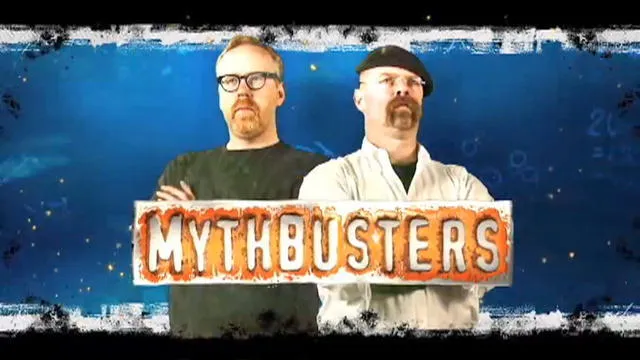
Another example of "true myths" could be found in the television series MythBusters broadcast on Discovery Channel. On the website (on the channel's website) there is a section called Myth Results divided in turn into "categories". I take as an example the subpage Myth Results: Survival. There we will see a list of myths, many of them "defeated" (the term in English is Busted), but some "confirmed", as seen in this screenshot.
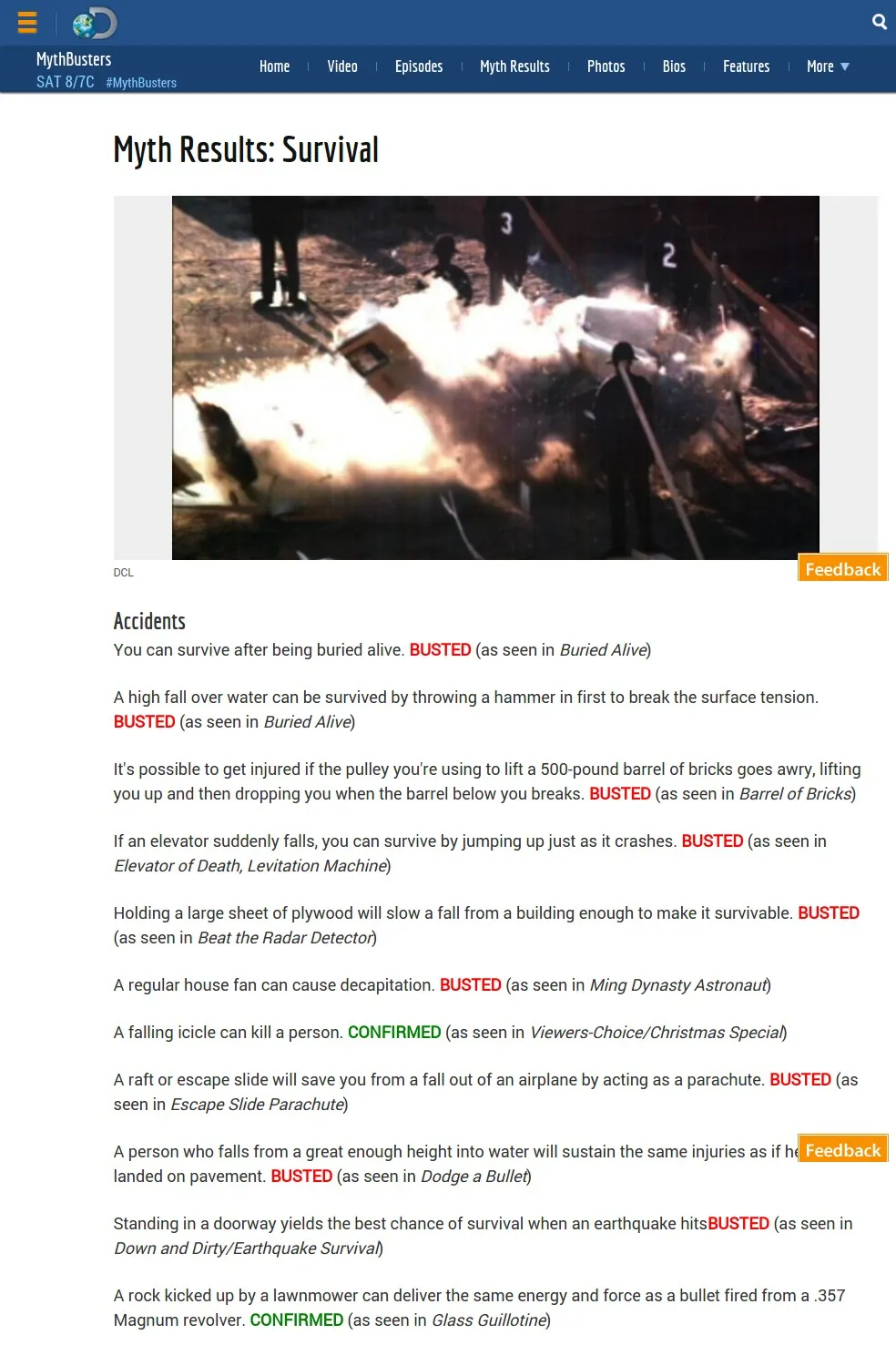
So, is it possible for a myth to be true? If we let ourselves be guided by some of the cited discourses, it seems so. If, on the other hand, we take other discourses as valid, no.
One way to overcome this dichotomy is to define these myths, I mean urban myths, particularly.
MYTHS AS (HYPO)THESES
What I propose is to think of myths as hypotheses, assumptions to be verified, with the difference that instead of being presented in that way, they are presented as a conclusion, a thesis.
For example, I could wonder (a hypothesis is an educated guess, a question to be answered) if people who have an even number of freckles are successful. Although it sounds somewhat far-fetched (we will find that scientists investigate even stranger things), let's suppose we gave validity to the hypothesis.
But if it is a hypothesis, it is a question to be answered, not an answer. Between the hypothesis and the conclusion (finished answer, but not definitive, not absolute, otherwise it wouldn't be science), investigation must mediate. One does not reach a conclusion because "it seems to me", but through a series of arguments based on observations and experiments.
Planet X does not arise in that way. It could be posed as a scientific hypothesis, in which case, one would then have to seek the means to prove or discard it through observations and experiments. If a set of computer simulations showed that it is theoretically possible, it is not enough, one would have to go out and look for such a planet. That is EXACTLY what happens with Planet 9. It is a possibility, based on calculations and simulations, that must be verified. Until that happens, it will be a theoretical construct, not an established truth.
Urban myths ARE unanswered questions, hypotheses that could make sense in the scientific framework, but that ARE PRESENTED as conclusions, without any investigation having mediated. We could also think, in some cases, that certain myths are actually poorly formed theses (for example illogical or unprovable), that is, hypotheses based on invalid arguments.
But because they SEEM "logical", plausible in some sense, we believe them, which constitutes myths as booby traps that we repeat as if we knew something "for real" after having read it on a forum or webpage or heard it on the radio and it seems "believable" to us.
What "MythBusters" do is NOT show that a myth is true or false: they turn myths into hypotheses (they ask themselves with the goal of verifying) and therefore when they confirm or discard, they do so on hypotheses, not on myths. Myths are believed or not believed.
For the newspaper Clarín, one must "believe or bust" as indicated by Santiago Fioriti when reporting that the nation's president had three "energy cleansings" done to his office [3].
It is postulated that negative (or positive) energies exist and it is affirmed without any investigation mediating. THAT is a myth, not a scientific thesis or hypothesis.
Fioriti is right. Since one cannot believe, then, one must bust.
Sources and related links
- [1] Myths and truths about livestock activity, by Sebastián Premici, 10-20-2015.
http://www.pagina12.com.ar/diario/economia/2-284224-2015-10-20.html - [2] Against the falsehood of certain myths, by Cristian Vitale, 10-20-2015.
http://www.pagina12.com.ar/diario/suplementos/espectaculos/17-36987-2015-10-20.html
[3] Macri renovated his office and had three “energy cleansings” done, by Santiago Fioriti, 01-28-2016.
http://www.clarin.com/politica/macri-rosada-climatizacion_energetica_0_1512448742.html
About the images
Screenshot and initial image from Discovery.com