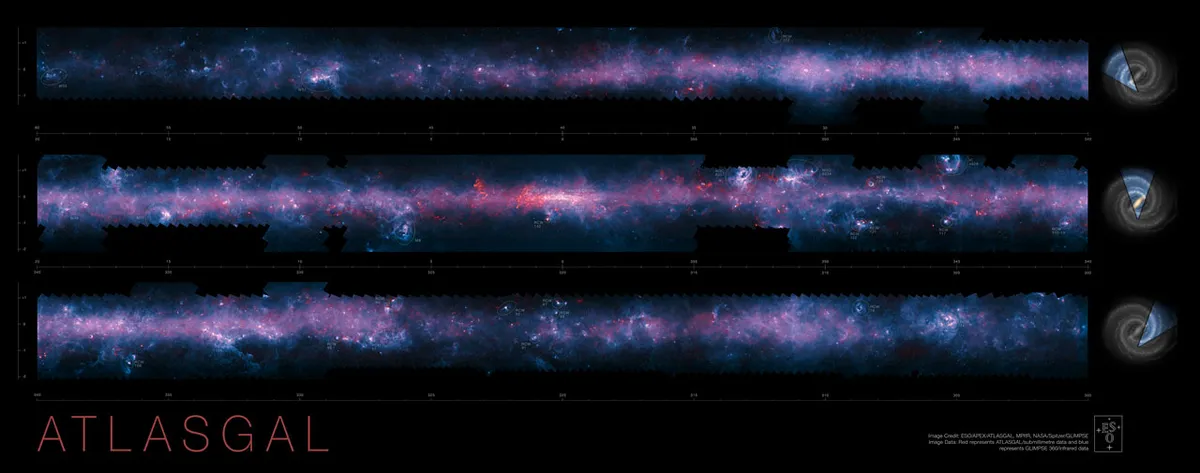
A spectacular new image of the Milky Way has been released to commemorate the completion of the ATLASGAL survey (APEX Telescope Large Area Survey of the Galaxy).
For the first time, the APEX telescope, installed in Chile, has mapped the entire area of the galactic plane visible from the southern hemisphere at submillimeter wavelengths (between infrared light and radio waves) in more detail than recent surveys conducted from space. The pioneering 12-meter APEX telescope allows astronomers to study the cold universe: gas, dust and other celestial objects that are only a few tens of degrees above absolute zero.
The APEX telescope (Atacama Pathfinder Experiment) is located 5,100 meters above sea level on the Chajnantor plateau in the Atacama region (Chile). The ATLASGAL survey took advantage of the telescope's unique characteristics to obtain a detailed view of the distribution of dense, cold gas along the plane of the Milky Way. The new image includes most of the star-forming regions of the southern Milky Way. The map was constructed from individual APEX observations of radiation with a wavelength of 870 μm (0.87 mm). The northern part of the Milky Way had already been mapped by the James Clerk Maxwell Telescope and other telescopes, but the southern sky is particularly important because it includes the galactic center and because it is accessible for carrying out more detailed follow-up observations with ALMA.
The new ATLASGAL maps cover an area of sky 140 degrees long and 3 degrees wide, more than four times larger than the first version of ATLASGAL [1]. The first data release covered an area of approximately 95 square degrees, a very long and narrow strip along the galactic plane two degrees wide and over 40 degrees long. The current final maps cover 420 square degrees, more than four times larger.
The new maps are also of higher quality, as some areas were re-observed to obtain more uniform data quality over the total study area.
The ATLASGAL survey is the most successful individual large program of APEX, with nearly 70 associated scientific papers already published, and its legacy will be greatly expanded with all the reduced data products now available to the entire astronomical community.
At the heart of APEX are its sensitive instruments. One of them, LABOCA (LArge Bolometer CAmera) was used for the ATLASGAL survey. LABOCA measures incoming radiation by recording the small temperature increases it causes in its detectors, and can capture emissions from the dark, cold dust bands that obscure starlight.
The new version of ATLASGAL complements observations from ESA's Planck satellite. The combination of Planck and APEX data allowed astronomers to detect emissions spread over a larger area of the sky and, from there, estimate the fraction of dense gas within the galaxy. ATLASGAL data were also used to create a complete census of cold, massive clouds in which new generations of stars are forming. Planck data cover the entire sky, but with low spatial resolution. ATLASGAL covers only the galactic plane, but with high angular resolution. The combination of both provides an excellent spatial dynamic range.
"ATLASGAL allows us to obtain revealing information about where the next generation of clusters and massive stars is forming. By combining these observations with those from Planck, we can now find a connection with the large-scale structures of giant molecular clouds", comments Timea Csengeri, from the Max Planck Institute for Radio Astronomy (MPIfR) in Bonn (Germany), who led the work of combining APEX and Planck data.
The APEX telescope recently celebrated ten years of successful research into the cold universe. It plays an important role, not only as a pioneering experiment, but also as a complementary facility to ALMA, the Atacama Large Millimeter/submillimeter Array, which is also located on the Chajnantor plateau. APEX is based on a prototype antenna built for the ALMA project, and has located many objects that ALMA can study in great detail.
Leonardo Testi (ESO), a member of the ATLASGAL team and European Project Scientist for the ALMA project, concludes: "Thanks to ATLASGAL we have a new and transformative way of seeing the dense interstellar medium of our own galaxy, the Milky Way. The new version of the complete survey opens the possibility of exploiting this wonderful dataset to make new discoveries. Many teams of scientists are already using the ATLASGAL data to plan their follow-up observations with ALMA in detail".
Additional information
ATLASGAL is a collaboration between the Max Planck Institute for Radio Astronomy (MPIfR), the Max Planck Institute for Astronomy (MPIA), ESO, and the University of Chile.
APEX is a collaboration between the Max Planck Institute for Radio Astronomy (MPIfR), the Onsala Space Observatory (OSO) and ESO. APEX operations at Chajnantor are managed by ESO.
Sources and related links
- ATLASGAL survey of the Milky Way completed
https://www.eso.org/public/spain/news/eso1606/ - [1] ESO: first version of ATLASGAL
https://www.eso.org/public/spain/news/eso0924/
About the images
Initial image: This image of the Milky Way has been released to commemorate the completion of the ATLASGAL survey, a large-area survey of the galaxy by the APEX telescope.
APEX data, at a wavelength of 0.87 millimeters, appear in red, and the blue background image was captured at shorter infrared wavelengths by NASA's Spitzer Space Telescope as part of the GLIMPSE survey. The extended, fainter reddish structures come from complementary observations made by ESA's Planck satellite.
The names of many of the most prominent objects have been annotated and the parts of the galaxy shown in the three sections are indicated on the right.
Credit: ESO/APEX/ATLASGAL consortium/NASA/GLIMPSE consortium/ESA/Planck
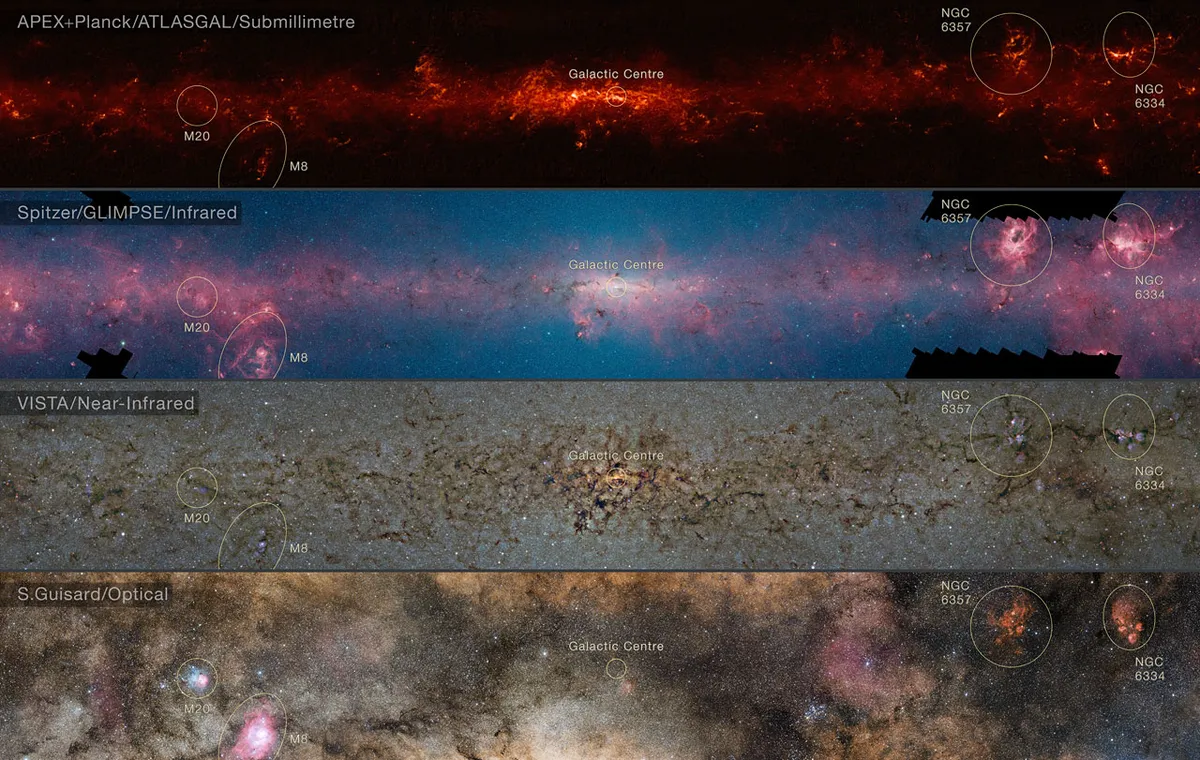
Image 2: This comparison shows the central regions of the Milky Way observed at different wavelengths.
The upper panel shows compact sources of submillimeter radiation captured by APEX as part of the ATLASGAL survey, combined with complementary data obtained by ESA's Planck satellite, in order to capture more extensive phenomena.
The second panel shows the same region viewed at shorter, infrared wavelengths, captured by NASA's Spitzer Space Telescope.
The third panel shows the same areas of the sky, again, at even shorter wavelengths, in the near-infrared, seen by ESO's VISTA Infrared Survey Telescope, installed at the Paranal Observatory (Chile). The regions that appear as dark dust curls are seen as bright in the images captured by ATLASGAL.
Finally, the last image shows the most well-known image, in the visible light range, in which most of the more distant structures are hidden from view.
The meaning of the colors varies from image to image and cannot be compared directly.
Credit: ESO/ATLASGAL consortium/NASA/GLIMPSE consortium/VVV Survey/ESA/Planck/D. Minniti/S. Guisard
Acknowledgement: Ignacio Toledo, Martin Kornmesser