What does a professional astronomer think of astrology?
What follows is a translation of an article published in an astronomical outreach magazine of the IAU (the International Astronomical Union) called CAP Journal. The article was published in issue 5, January 2009, signed by Daniel Kunth.
The note was, at the same time, a translation into English done by journalist Emma-Kate Symons and edited by Brooke Sing (editor of CAP Journal).
Daniel Kunth is an astrophysicist specialized in extragalactic astronomy. He devotes time to outreach by giving talks and writing articles, in particular about the relationship between astronomy and astrology.
The following article is part of a personal initiative ContraLaAstrología, with the goal of presenting more solid arguments against that pseudoscience than those usually presented to the general public. In that context, I considered it appropriate not only to make my personal point of view clear, as an astronomy enthusiast, but also the view of a professional astronomer.
Summary
As science communicators in astronomy we often find a strong public interest in astrology: how the stars and planets would directly affect our individual lives. Currently astrology is in contradiction with the scientific nature of astronomy, but it was not always so. Here is presented a historical background of astrology to have a better understanding of where it comes from and why it has such an enduring place in all forms of global communication.
Astrology adapted to changes in society throughout history and, as a result, continues to benefit from a positive public image. The social and commercial success of astrology, largely driven by the media, is surprising given the dominance of science in our society. Its foundational basis exploits the widespread belief in the existence of pervasive connections between the macrocosm (the Universe as a whole) and our microcosm (human society and social relations).
Astrologers attempt to decipher the hidden meaning behind planetary movements and their positions which they consider correspond to human personality traits or predict major or minor life events. The lexical ambiguity with which these predictions are made, however, produces results that cannot be proven or refuted.
Without an objective method by which a predicted result can be tested, astrology cannot be considered a science. Astrological analyses, which in some cases are sophisticated, do not use any traditional methodology in the sciences. Astrology escapes the need to confront hypotheses with evidence, the opposite of a rigorous scientific approach.
Astronomers oppose not only the astrological assertion that the positions of objects in the cosmos can directly impact people's destiny, but also the astrological ignorance of physical reality, the richness and variety of stars and planets.
Furthermore, no serious statistical study has been able to establish the reliability of astrological predictions. In modern times, most of its adherents opt for psychological interpretations of astrology in which the stars set the keys to our destiny, personality and predilections from the very moment of birth. The foundation of belief in astrology is based on a deterministic approach and constitutes a psychological alienation that can easily be exploited by those interested in making a profit.
Throughout our civilization, astrology has had casual and fervent believers in almost every social class or culture. From ancient times to the present, human beings have been challenged to predict and prepare for life events of rejoicing and catastrophe. Faced with disorder on Earth, astrology proposes that an ordered and readable structure exists in the firmament that is intricately involved with human life. However, this belief does not constitute a cosmic science because neither the tools of astrologers nor their subjective analyses allow deducing facts or proving a theory. Is astrology then a social science? That is, a mode of knowledge in competition with scientific cosmology?
Some astrologers, dissatisfied with being relegated to the margins of official sciences, demand academic recognition that would allow the public to fund astrological research and reinforce the scientific and academic sense of astrology and its followers. The use of computers, statistics and highly precise ephemerides suggests an increasingly scientific practice. However, a large majority of scientists completely reject the scientific relevance of astrology and remain critical of the new superficial uses of technology.
Astrologers have been at the center of an explosion in traditional and electronic press that has bombarded readers with an intense (and lucrative) commercialization of astrology. Astrology in print media is especially common, from dailies to weeklies, many newspapers offer an astrology column. Some people read their horoscope as if it were fiction; others trust its predictions and advice that would help them manage their personal or professional life or perhaps know when and where to plan vacations. If so much money is devoted to astrology perhaps it is because it fills an essential need that neither science nor psychology, even religion, takes into consideration.
Symbolism in astrology
One of the great persuasive forces in astrology lies in its symbolic perception of the world. This symbolism comes, to a greater or lesser extent, from observations made since antiquity in relation to the brightness or color of astronomical bodies, the apparent capricious movements of the planets, as well as the proximity to the Sun or the Moon. These symbols do not have a universal value: each culture elaborates its own.
Most people know their zodiac sign: being a Cancer means that at the moment of birth, the Sun (when projected in the sky) was in the position corresponding to the sign of Cancer. In order to focus on the individual or help account for the evident differences between those with the same sign, it is nuanced with other personalized elements, such as the ascendant that appears in the East at the precise moment of birth or the position of the major planets in the natal chart.
Astrologers are equally interested in planetary transits when planets pass certain significant points in the natal chart. They consider them to be triggers of events or decisions (marriages, divorces, births...) already predicted in the chart at the moment of birth. Transits occupy a key position in astrology because it is considered possible to predict the main transitions of a life through calculations. Horoscopes usually make use of this technique to determine the angles of a planet relative to a sign in a chart. For example, a person born under the sign of Virgo could have the planet Mars in a close location in the chart to their sign; the astrological characterization of Mars as the planet of war could be interpreted as an indication of conflict.
A brief return to the past
Historically, astrology and astronomy were not considered entirely separate fields; much of an astrologer's time was spent working with star maps or taking meticulous measurements. Observations repeated thousands of times allowed the prediction of certain celestial events and, as a result, terrestrial events (Egyptian calendars were inextricably linked to the life of the Nile). From the correlation between celestial and terrestrial events, a control of the latter over the former was imagined. The planets or "wandering stars" were perceived as a code of communication from the deities; thus, the observation of small planetary movements was a way to interpret the desire of the Gods. The Greeks and later the Romans were convinced of the divine nature of this type of astrology, also known as Chaldean, derived from its Sumerian origins. In ancient Greece, the regularity and usually predictable nature of celestial events gave birth to a mathematical mysticism, a singular marriage between mathematics and divination from which emerged the Western astrology that endures to this day.
Modern astrology has broken with the concept of the gods, but retained the belief that a universal will can be perceived through a careful assessment of planetary movements. With the evolution of scientific knowledge and tools, the gap widened between the premises of astrology and those of the sciences.
Historically, astronomers renounced unproven principles about the influence and connection between planetary configurations and terrestrial events. This was the origin of disagreements and finally a rupture between astrology and astronomy. Astronomy attempts to explain the cosmos: scientists are objective observers. The astronomer builds or rejects a theory based on available evidence, while the work of an astrologer is guided by a doctrine of predetermination.
During this transition, astrologers were confronted with shocks they had not foreseen: the Earth was no longer the center of the system, the separation between the sublunar and supralunar worlds was no longer justified, and distances exploded. According to the philosopher Alexandre Koyré, our human world, once at the center of everything, was transformed into a small player in an infinite Universe.
Astrology face to face with science
Now we have a cosmos to investigate, studied by two very different schools of analysis. Many astrologers describe themselves as scientists and insist on the existence of genuine celestial influences on individuals. They hope to demonstrate their authenticity by using statistical studies that are often poorly conceived and poorly executed (Franknoi, 1989).
By borrowing calculation methods (astrologers' ephemerides are scientific tables graciously made available to the public by astronomers), this type of astrology regains a kind of scientific legitimacy that plays a role in its durability. The confusion of genres and the public's questions are transmitted through debates in the media where astronomers and astrologers confront each other. The most critical arguments of astronomers about astrology focus on the disregard for the physical reality of the universe and its richness. What is the point of invoking the sky and its planets if they are not taken into account for themselves, that is, if the sky has no object?
In essence, the symbolic language of astrology has some limits that keep it at a distance from the realities of the physical world. Taking the example of the planet Mars: for the astrologer, the red color evokes blood fluid, therefore war and thus death; for the scientist, the red color can have multiple causal reasons, which can only be determined by experiments. The first space missions to Mars attested to the presence of iron on the surface of that planet; the red color is partially due to the oxidation of iron. Oxidation, however, requires the presence of oxygen, most notably in the form of water. Water is considered synonymous with life on Earth, so the question arose about the existence of life on Mars. Did life exist in the past? Such a hypothesis would be explored in future missions to the red planet. The Mars-red-war-blood and death, the symbolic chain that functions as an analogy has given way to Mars-red-iron-water and life, which comes from strict links with causality.
Mars, a simple mass of red stone covered with iron oxide, continues to be assigned the virtues of the god of war. We see how a relevant observation - that of color - can provoke a simple and elementary symbolic interpretation.
However, once the nature of the planet is known and the causal relationships are revealed, the associative game can persist after losing all real significance, which never ceases to amaze.
It is certainly unnecessary to understand the nature of a phenomenon to establish its existence, but the first question, beyond all controversy, is to know whether astrological influence follows from the facts.
Unfortunately, astrologers do not bother to submit their hypotheses to a definitive test of refutation. The exception is the test conducted by Carlson and published in Nature in 1985 that tested the precepts and foundations of astrology. The result was that all astrological principles put to the test were discredited.
Astrological predictions of catastrophic events rarely specify the size of the disasters, location, and precise date of occurrence, which is why they cannot be contradicted or refuted. Even at the beginning of each year we see in the media a wave of predictions that are rarely verified, a fact that the public does not seem eager to take into account. A renowned astrologer once predicted a great catastrophe because the solar eclipse of August 1999 coincided with the flyby of the Cassini spacecraft. A petition was immediately sent to NASA to change the mission date!
Despite the abundance of evidence that astrology is essentially a non-science, the academic platform of astrology offers a certain psychological depth. Predictions can be so ambivalent that there is an almost unlimited number of interpretations on each subject. Scientists consider such profusion as redundant, manifested by the number of possibilities exceeding the number of uncertainties. Astrological language, with numerous possible meanings, allows those who use it a great margin of appreciation.
Science is at the same time knowledge, method, and proof. It attempts to transcend cultures and national affiliations and evolves without demanding a psychological belief as a prerequisite for exploring the nature of the world. On the other hand, the term astrology merits the plural form, as diverse as its schools. Different and numerous disciplines of astrology usually contradict or ignore each other without consensus or even without the need for consensus.
Public attitude
26% of people surveyed in France stated that they "believed in the predictions of astrologers"; among them, one third takes horoscopes into account in their lives.
41% of people surveyed stated that they believed in the explanation of personality traits of astrological signs.
About 13% consulted an astrologer.
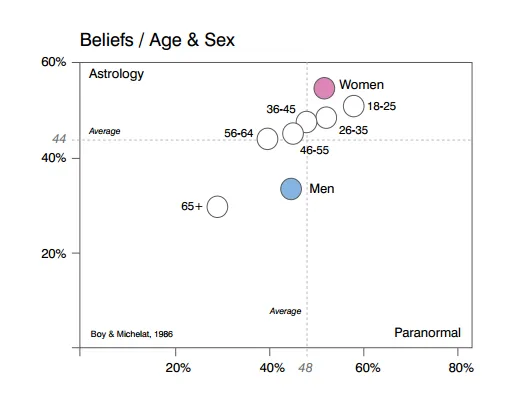
On the abscissa axis (horizontal axis, x) belief in the paranormal is indicated and on the ordinate axis (vertical, y) belief in astrology. The average is indicated in both cases: 48% believe in the paranormal and 44% in astrology. These beliefs seem to decrease with the age of the respondents and would be higher in women than in men.
The public's enthusiasm for astrology moves more and more toward the psychological goal of releasing the potentialities of individuals. During a session, an astrologer works in the field of affections, not rationality. The client finds himself in the expectant position of the believer, a mechanism by which he hears what he wants to hear and discounts or ignores what does not agree with his expectations.
Astrology remains at its core as the art of predicting the future, a future written according to the tendencies acquired at birth by the influence of the stars. However, this deprivation of free will engenders alienation and a strong risk of psychological manipulation (it is not uncommon to find people who consult their astrologer before making decisions). The deterministic nature of astrology leads to the irreducible paradox in which astrologers work as if they were psychologists. The free will invoked by psychological astrologers is confronted by the determinism of astrology. How can this personal autonomy be reconciled with the winds of fate or the bad luck that Jupiter or Saturn provoke when passing through the birth sign? The client expects the answer to be revealed to him. Astrological analysis, in the vast majority of cases, is performed for profit interest, which is why astrologers formulate very broad assertions, the opposite of the generally prudent interpretations offered by psychotherapists.
The influence of an astrologer is not found only in the private sphere. It has penetrated the field of politics and civil society. Certain businesses use astrology as a recruitment channel. Astrology is sometimes considered more suitable for evaluating the potential of candidates than their Curriculum Vitae and motivation! A financial astrology, based on the apparent movement of Uranus, has been a fad even on Wall Street and astrology has been used in the calculation of insurance premiums for companies! In fact, for almost every human activity or phenomenon in which there is great uncertainty, we will find astrologers eager to impart a sense of cosmic order and to be paid to assure us peace of mind.
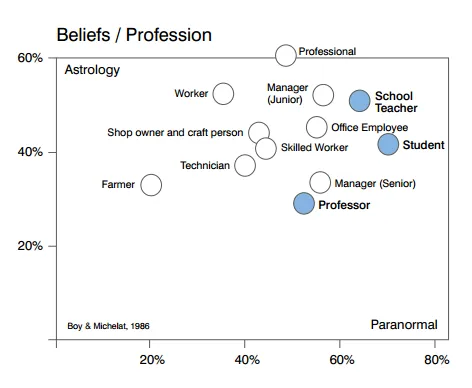
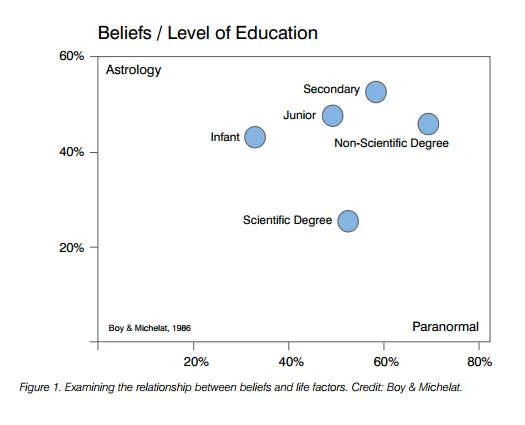
Belief in astrology is not only the privilege of those who have access through instruction, but it develops in a sort of intermediate state (Boy & Michelat, 1986). Statistically, belief in astrology increases with a declared interest in sciences, with a peak among the middle class that possesses an intermediate degree of education and then decreases among graduates (notably among scientists) (see figures 1-3). Sociologist Theodor Adorno (1994) pointed out that belief in astrology is characterized by a state of being that he called semi-erudition. The semi-erudite borrows some pseudoscientific shortcuts to find answers to questions about his future as a result of an unsuccessful conversion to the system of scientific thought.
The nature of astrology
Astrology is not monolithic, but finds an anchor in the common current of thought related to tradition. It weaves social connections and allows a group to identify with a cultural community.
We can characterize two classes of astrologers. Those who call themselves scientific astrologers work under the premise that they live in a world of physical causal influence between people and the cosmos. Such astrology uses a kind of scientific analysis path that molds concepts brought from other scientific fields to fit the astrological model. More traditional astrologers consider the sky as a symbolic template and use mythical narratives at will to expand their interpretations instead of exposing a physical cause-effect methodology. Astrology can be perceived as a language that presents the world using specific vocabulary and grammatical technique. The scientific refutations presented by astronomers only fleetingly embarrass those astrologers for whom the object of astrology is not the study of the cosmos, but of man, at the same time object and subject.
Fundamentally, the differences are obvious. The scientific astrologer makes an art of mathematics. The metaphysical astrologer attaches no importance to scientific astrology. There is a third class of astrologer in the middle, probably the majority, for whom the practice is based on a penetrating intuition of psychology and deductions. It is believed that the cosmos influences individuals at the moment of birth and that the person's future is encoded in that specific and unique formation. For that community, the astrologer is simply the interpreter who analyzes the characteristics of the natal chart. That astrological discourse is very malleable, which explains its ability to adapt to the cultural norms of modern and post-modern society. This is due to the rich and symbolic language of astrology: a natal chart can be interpreted in so many ways as to make an impartial and unequivocal analysis impossible. Astrology seduces timelessly, not because it carries the scientific weight of proven or probable hypotheses, but because it imposes an apparent order on the unknown future. The unbridled commercial exploitation of those who seek answers by those who adopt the manipulation of a complex language and the social need for stability can only be condemned.
Some astrologers may have skills in making omens and auguries about our perception of reality, but the premises and methods of astrology differ fundamentally from those of science, even the social sciences, and possess no scientific validation.
References
• Adorno T. W. 1994, The Stars Down to Earth and Other Essays on the Irrational in Culture, (London: Routledge)
• Caudron D. et al. 1996, The Mars Effect, (London: Prometheus Books)
• Boy D. & Michelat G. 1986, Croyances aux parasciences: dimensions sociales et culturelles, Revue Française de Sociologie, 43-1, 35-45
• Carlson, S. 1985, A double blind test of astrology, Nature, 318, 419-425
• Fraknoi, A. 1989, Your astrology defense kit, Sky & Telescope, 146-150
• Kunth D. & Zarka P. 2005, Astrologie, Que Sais-je no 2481, (Paris: Eds. Presses Universitaire de France)
• Peretti-Watel P. 2002, Sous les étoiles, rien de nouveau?, Revue Française de Sociologie 43-1, 3-3
Sources and related links
CAP Journal 5: Astrology and Astronomy: From Conjunction to Opposition (Daniel Kunth)
http://www.capjournal.org/issues/05/index.php
About the images
The three figures correspond to Boy & Michelat, 1986.
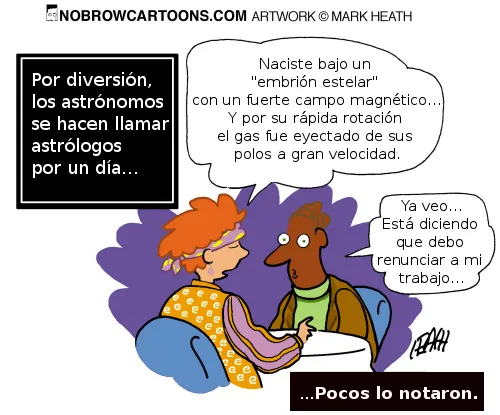
Cartoon by Nobrow Cartoons, Mark Heath https://nobrowcartoons.wordpress.com/2013/06/13/how-to-distinguish-between-astronomers-and-astrologers/